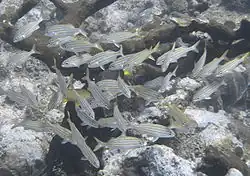
Haemulon chrysargyreum
Taxonavigation
| Taxonavigation: Lutjaniformes |
|---|
|
Superregnum: Eukaryota |
Familia: Haemulidae
Genus: Haemulon
Species: Haemulon chrysargyreum
Name
Haemulon chrysargyreum (Günther, 1859)
References
[1] Anderson, W.; Claro, R.; Cowan, J.; et al. (2017) [errata version of 2015 assessment]. "Haemulon chrysargyreum". IUCN Red List of Threatened Species. 2015: e.T194417A115335430. doi:10.2305/IUCN.UK.2015-4.RLTS.T194417A2333728.en. Retrieved 30 March 2021.
[2] Froese, Rainer; Pauly, Daniel (eds.). "Haemulon chrysargyreum". FishBase. December 2019 version.
[3] Robins, C.R. & G.C. Ray (1986). A field guide to Atlantic coast fishes of North America. Houghton Mifflin Company, Boston, U.S.A. p. 354.
[4] Courtenay, W.R. & H.F. Sahlman (1978). "Pomadasyidae". In W. Fischer (ed.). FAO species identification sheets for fishery purposes. Western Central Atlantic (Fishing Area 31), Volume 4. FAO, Rome.
[5] "Species: Brachygenys chrysargyreum, Smallmouth grunt". Shorefishes of the Greater Caribbean online information. Smithsonian Tropical Research Institute. Retrieved 30 March 2021.
[6] Cervigón, F. (1993). Los peces marinos de Venezuela. Volume 2 (in Spanish). Fundación Científica Los Roques, Caracas,Venezuela. p. 497.
[7] Eschmeyer, William N.; Fricke, Ron & van der Laan, Richard (eds.). "Species in the genus Haemulon". Catalog of Fishes. California Academy of Sciences. Retrieved 30 March 2021.
[8] Christopher Scharpf; Kenneth J. Lazara, eds. (5 January 2021). "Order LUTJANIFORMES: Families HAEMULIDAE and LUTJANIDAE". The ETYFish Project Fish Name Etymology Database. Christopher Scharpf and Kenneth J. Lazara. Archived from the original on 12 April 2021. Retrieved 30 March 2021.
[9] Eschmeyer, William N.; Fricke, Ron & van der Laan, Richard (eds.). "Species in the genus Brachygenys". Catalog of Fishes. California Academy of Sciences. Retrieved 30 March 2021.
[10] Tavera, J.J.P; A.A., Balart; E.F.; et al. (2012). "Molecular phylogeny of grunts (Teleostei, Haemulidae), with an emphasis on the ecology, evolution, and speciation history of New World species". BMC Evolutionary Biology. 12 (57): 57. Bibcode:2012BMCEE..12...57T. doi:10.1186/1471-2148-12-57. PMC 3472276. PMID 22537107.
[11] Paolo Parenti (2019). "An annotated checklist of the fishes of the family Haemulidae (Teleostei: Perciformes)". Iranian Journal of Ichthyology. 6 (3): 150–196.
[12] Lindeman, K.C. (2002). "Haemulidae". In Kent E. Carpenter (ed.). The living marine resources of the Western Central Atlantic. Vol. 3: Bony fishes part 2 (Opistognathidae to Molidae) (PDF). FAO Species Identification Guides for Fisheries Purposes. American Society of Ichthyologists and Herpetologists Special Publication No. 5. FAO of the U.N., Rome. pp. 1522–1550.
[13] "Haemulon chrysargyreum". Saltcorner!. Bob Goemans. 2012. Retrieved 30 March 2021.
Vernacular names
- English: Smallmouth Grunt