A photon is emitted from a source and reflected off an object (or objects) until it hits the human eye. The color of the object we see depends on the photon wavelength. If photon travels with constant speed how does the human eye know how far the object from which the photon was reflected?
Asked
Active
Viewed 2,748 times
2


-
3Why do you think the human eye "knows" that? – ACuriousMind Sep 30 '14 at 19:31
-
Who says it does? – Kyle Kanos Sep 30 '14 at 19:31
-
1It doesn't. That's why we need two eyes for binocular vision. – CuriousOne Sep 30 '14 at 19:32
-
I agree with CuriousOne. If you're interested, there's more about this at http://en.wikipedia.org/wiki/Binocular_vision. Good luck! – CoilKid Sep 30 '14 at 19:40
2 Answers
5
To have depth perception two eyes are needed. Our two eyes are some distance apart which causes the photons from an object to arrive at slightly different angles. The brain then reconstructs the depth field from these differences.
Similarly, we can figure out how far nearby stars are by using images made by a telescope at two different times of the year, since when the earth is (for example) at two opposite positions of its orbit around the sun, it acts like two "eyes" that are a large distance apart.

Jasper
- 1,508
-
-
1You cannot see depth with one eye , except for the "simulated" depth that your brain tries to invent based on shadows, color, sharpness and previous experience. – Jasper Sep 30 '14 at 21:33
-
The brain can combine multiple cues to determine distance - also the focus distance, whether other objects are overlapping, size, or for large distances, the haziness. So you can tell distance with a single eye under the right circumstances. – Demis Oct 04 '17 at 07:53
-
2
Binocular vision has already been discussed, but it left out an important aspect.
A single eye is sensitive to distance. The shape of the lens changes to focus on near/far objects.
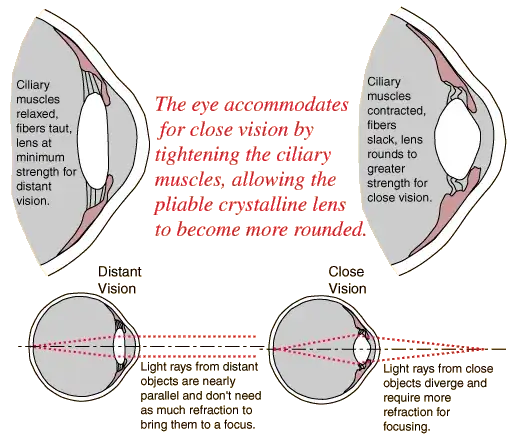
The reason this is needed is that our pupil has finite size and cannot be modeled as a pinhole. The same physics is going on here as in a lens of a camera focusing on an object. The rays coming from objects will be focused at different points depending on their distance to the eye; only those objects whose rays are focused on the retina are in focus.
So, in principle, one could use the shape of the lens to determine distance to an object.

BMS
- 11,493
-
Thx for answer. What I have problem to understand is when I close 1 eye (so without binocular vision) I can pretty well tell that for example "that car is somewhat 50m away" or "that building is like 300m away" but how do I know if object is bigger and more far away or just smaller and closer. – mhgnhg Sep 30 '14 at 22:33
-
1@mhgnhg, you already have some idea how big a car or a building is, so your brain just estimates the distance based on how big it looks compared to how big it guesses it really is (and other clues available in what you see). – The Photon Sep 30 '14 at 22:41
-
Google "Forced Perspective" or look at http://www.hongkiat.com/blog/force-perspective-photos/ – DJohnM Sep 30 '14 at 22:47
-
@ThePhoton Yes but even when you see new object you haven't seen before you can pretty well tell it (I know there are pictures where you cannot tell difference that's why I said pretty well) - if I would make from clay object you haven't seen before and throw it into air you could tell in approximation how far it is from you – mhgnhg Sep 30 '14 at 22:57
-
@mhgnhg: I think a few trivial optical illusions would cure you from imagining that you can tell depth with one eye. The example of a falling object doesn't count because your brain knows, again, how to estimate the height based on the time it takes for something to fall. – CuriousOne Sep 30 '14 at 23:26
-
@CuriousOne How does it know "the time it takes for something to fall" before it starts falling - if i throw object upward how does it know if it is small object with low velocity(close object) or big object with high velocity(far object) – mhgnhg Sep 30 '14 at 23:47
-
:-) Because everything you throw is in free fall (minus air resistance) from the moment you let go of it, even it if travels upwards. – CuriousOne Sep 30 '14 at 23:49
-
@CuriousOne It doesn't give the brain info if it is "small object with low velocity(close object) or big object with high velocity(far object)" – mhgnhg Sep 30 '14 at 23:55
-
A small object close to the ground will fall in a short amount of time, a large object far away will take much longer to fall from a larger height. Do the math. :-) – CuriousOne Oct 01 '14 at 00:00
-
@CuriousOne When object is going upward you don't know if it is small object close to you that will fall in a short amount of time or large object far away that will take much longer to fall. Because you don't know if it is big or small object you can't tell their velocities or accelerations. – mhgnhg Oct 01 '14 at 00:16
-
Free fall is free fall. The trajectory is symmetric. Do the math... or watch an educational video on the internet. :-) – CuriousOne Oct 01 '14 at 00:19
-
@CuriousOne It seems you doesn't get what I am saying. This discussion is pointless, especially with childish responses like "Do the math" or " or watch an educational video on the internet. :-)" - no offense – mhgnhg Oct 01 '14 at 00:37
-
I am sorry that you don't have the patience to listen to good advice. Have a nice one! :-) – CuriousOne Oct 01 '14 at 00:38
-
@mhgnhg Your brain is actually really smart. A lot of things that get attributed to sight are actually part of its processing. The brain will integrate thousands of small details to provide you depth information. In technological environments, it's known as "sensor fusion." As a result, you can make good guesses about depth in a remarkable number of cases. However, there are cases that fail. For example, there is "looming," which is when you move towards your prey in a way that keeps your relative angle constant. This is sufficiently confusing enough that it is used by... – Cort Ammon Aug 25 '15 at 05:04
-
... real life predators in the natural world. By keeping your angle constant as the prey moves, they lose one of the major details which is fused into a final "depth." As a result, they can't get a good enough depth track until the predator is on them. – Cort Ammon Aug 25 '15 at 05:05