43

What are the advantages and disadvantages of using auto ISO on a DSLR?

Using manual ISO obviously gives you more control, but auto ISO may mean that you get "the shot" under quickly changing conditions (such as street photography, varying quickly between direct sunlight, shade, indoor lighting.

Is auto ISO a convenient feature or a bad habit?

mattdm
  • 143,140
  • 52
  • 417
  • 741
SoftMemes
  • 1,715
  • 3
  • 18
  • 26

7 Answers7

48

Hardware ISO control exists to amplify the signal before readout to maximise the signal to noise ratio. Without read noise you wouldn't need ISO if you had a high precision ADC as you could simply shoot everything at the native sensitivity, and if the image was too dark just apply digital gain (multiply the pixel values).

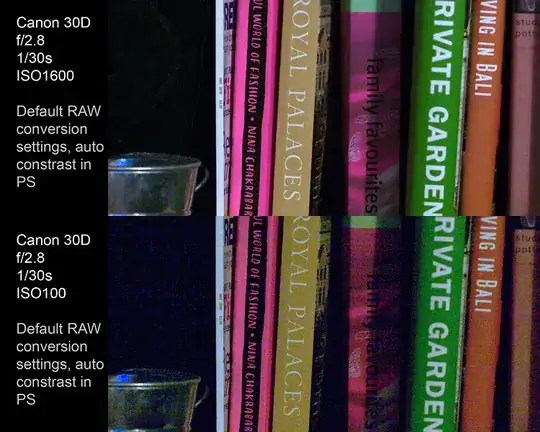
It's easy to demonstrate this effect. The following two images had the same shutter speed and aperture. The top one was shot at the metered ISO 1600, the bottom one was shot at ISO 100, which resulted in underexposure which was fixed in photoshop:

The ISO 100 image is noisier, on account of read noise being amplified when the exposure is fixed. The ISO 1600 is amplified before readout so read noise is much lower.

As such ISO is not a creative control (like shutter speed and aperture) it is a practicality, required by the need to overcome noise. Contrary to popular opinion using a lower ISO wont give you less noise. Unless you also decrease shutter speed or open the aperture, both of which can result in a different looking image.

I don't consider it "lazy" to use auto-ISO, as the camera is not altering the creative controls, it's just trying to minimise read noise for you.

With auto-ISO in manual the pros and cons are pretty clear:

+ You can adapt to changeable lighting whilst sticking to your preferred aperture and shutter speed

- You're still at the mercy of the camera's light meter, you can get overexposure if the meter gets confused (which wouldn't happen if you fix the ISO to a low value).

- Some cameras don't offer exposure compensation with auto-ISO meaning if the metering is consistently off due to scene content you might not be using the optimal noise reducing ISO.

Using auto ISO in either program, shutter priority or aperture priority is slightly different as there are two or three values for the camera to choose, and the ISO value is no longer simply dependent on the light reading.

+ You'll be able to use preferable shutter speeds aperture more of the time than if ISO sensitivity was fixed.

- You're at the mercy of the auto-ISO algorithm, you're still letting the camera make creative decisions.

Michael C
  • 175,039
  • 10
  • 209
  • 561
Matt Grum
  • 118,892
  • 5
  • 274
  • 436
  • Can you please elaborate on the point of lower ISO not giving less noise? Are you saying that taking a picture at ISO 100 and one at ISO 200 (with the same shutter speed and aperture), then raising the brightness of the first one stop in post would give two equally noisy pictures? – SoftMemes Mar 24 '12 at 13:18
  • 5
    @Freed If your low ISO shot is underexposed which you have to fix digitally then you wont get equal noise, you will actually get more noise. So the only way to get lower noise by lowering ISO is if you also get more light down the lens. Once you've maximised the amount of incoming light, then you want to use the highest ISO possible (without overexposing) to minimise noise. As counter intuitive as it sounds, it's easy to demonstrate - I've updating my answer with a visual example. – Matt Grum Mar 24 '12 at 13:29
  • 2
    I've never thought about it that way, the fact that increasing ISO can lead to a less noisy final picture, but it does make sense now, thank you! – SoftMemes Mar 24 '12 at 13:33
  • 1
    Is that always the case, or is there a level where pushing the ISO will generate proportionally more noise than boosting the exposure numerically in post would..? – SoftMemes Mar 24 '12 at 13:37
  • 2
    I understand your argument BUT if I was taking those photos I'd have judged that the ISO 100 picture was underexposed. The f2.8 affects the image so I'd leave that alone if possible. If ISO 1600 was necessary at f2.8 and I cared about noise then I'd try very hard to use both lower shutter speed and ISO. If no tripod or bracing point (doorway, pile of books, two elbows on the table and brace camera back against my head, ....) was available THEN I'd use ISO 1600. The 30D photo is OK enough for many purposes, but usefully less noise would be possible if you can tolerate the lower shutter speed. – Russell McMahon Mar 24 '12 at 13:46
  • 10
    I love this point that matt makes often, he's trying demonstrate just ISO so youu can't also change shutter speed. He's showing that the "correct" ISO is better than an artificially low one. – rfusca Mar 24 '12 at 14:59
  • @rfusca - He's showing that the "correct" ISO is better than under exposure in some cases. How much better depends on the degree of under exposure. The 100 ISO shot is bad, but the 1600 ISO shot is not marvellous noisewise. 400 ISO at about 1/8 second looks about right. Deep breath, elbows out, brace ... . Shutter speed is a definite available parameter in the example given - books breathe really slow. If it had been people it would be different. Then there is the possibility of extra lighting & ... . – Russell McMahon Mar 24 '12 at 15:26
  • 2
    @russell - you can't judge iso if you change shutter speed - shutter speed is more of a creative decision. – rfusca Mar 24 '12 at 18:23
  • 2
    @mattgrum - maybe these should be repeated with a moving subject where the need to isolate one variable is more obvious. – rfusca Mar 24 '12 at 18:25
  • 1
    The problem is that @MattGrum's example of ISO preference is only correct under certain circumstances. An example that negates this POV/use case: if I'm using a high enough shutter speed to freeze something (say, 1/1000), and switching to a lower ISO still freezes the subject (say, 1/500), then switching to the lower ISO is likely of benefit for less noise and increased DR. – Dan Wolfgang Mar 24 '12 at 21:50
  • 4
    @Dan I'm not saying use the highest ISO possible in all circumstances, I'm saying to minimise noise get as much light into the camera as possible then use the highest ISO you can without overexposing. Your example doesn't negate this at all. – Matt Grum Mar 24 '12 at 22:33
  • 1
    And my point is that when adjusting the shutter speed won't change your intent, using the lowest ISO you can provides the benefit of lower noise and greater DR. If you're not using shutter speed as a creative control, you can interchange shutter speed and ISO to get the exposure correct, and favoring a lower ISO is advantageous. – Dan Wolfgang Mar 24 '12 at 22:47
  • 6
    @Dan If changing shutter speed won't change your intent, using a lower ISO wont give any benefit. Using a lower ISO and decreasing the shutter speed will. It's the shutter speed that is having the biggest influence on noise, not the ISO setting. You're not favouring a lower ISO, you're favouring letting more light into the camera to reduce photon noise. Lowering the ISO is simply necessary to prevent overexposure. – Matt Grum Mar 24 '12 at 23:22
  • 1
    It's the shutter speed that is having the biggest influence on noise, not the ISO setting. No, that's wrong. Changing the gain applied to the sensor output is what affects noise. Higher gain (ISO) results in a lower signal-to-noise ratio, which means more noise. Shutter speed doesn't even enter into it. – Dan Wolfgang Mar 24 '12 at 23:31
  • 4
    @Dan actually no, applying gain increases noise and signal, leaving signal to noise ratio largely unchanged (a tiny bit of noise is introduced by the circuitry), reducing the amount of light does reduce signal to noise ratio as you get a lot more photon noise. Try it, take two shots with different ISO settings and two shots with different shutter speeds and measure the SNR. – Matt Grum Mar 24 '12 at 23:39
  • Assume that a shutter assembly is accurate and that the ISO measurements are accurate for a given camera. At f2.8 I get a proper exposure with ISO 200 and 1/125 sec. I can also get the same exposure at f2.8 with ISO 6400 and 1/4000 sec. You're saying you'd prefer the latter? – Dan Wolfgang Mar 25 '12 at 00:13
  • 4
    No I'm saying noise is most strongly influenced by amount of incoming light - therefore the 1/125 is preferable as there is more light, hence less noise. This isn't the correct medium for discussion, so for now I'll just say I will do the experiment when I get a chance. – Matt Grum Mar 25 '12 at 00:18
  • @rfusca - EVERYTHING is a creative decision :-). For correct exposure EV = ISO / (100 x Shutter_Speed x Aperture^2). This is a formal definition. ISO maps to noise in a non linear manner which varies camera to camera but generally higher ISO = more noise. If you deviate from the above formula you over or under expose. – Russell McMahon Mar 25 '12 at 01:43
  • 2
    The statement Without read noise you wouldn't need ISO as you could simply shoot everything at the native sensitivity is incorrect. Even with no read noise, you would still get quantization effects, due to the fact that the process of reading the sensor involves discrete quantization. Even with no noise, you would still see a posterization effect as the range of luminance in the exposure becomes smaller as a function of the ADC range. Basically, to not have to adjust the ISO and have similar performance at all light levels would require no read noise, and a ADC with infinite number of bits. – Fake Name Mar 25 '12 at 08:34
  • 1
    @Fake Name, that's a good point, I was ignoring quantization noise. You'd only need one extra bit per stop you wanted to recover, the highest hardware amplified ISO these days is probably 25600 (the two highest settings are usually done in software). So to match current performance and do away with hardware ISO you'd only need a 22 bit ADC, a little short of infinity ;) – Matt Grum Mar 25 '12 at 13:26
  • @Matt Grum - But having more ADC bits would also improve the quality of shots with proper lighting, so performance would still degrade as the light decreased. Anyways, I was speaking to a hypothetical situation, not a specific ISO range. – Fake Name Mar 26 '12 at 04:06
  • +1 for the answer. This site needs for example/demonstration photos. -1(sanity) after reading that discussion, I don't know how you're able to view photography is such an extreme technical view yet still come at it creatively. – Vian Esterhuizen Mar 27 '12 at 06:44
  • This is the best answer I have seen on this site, ever. – Michael Nielsen Oct 01 '12 at 09:51
  • this is misleading because you're working with [at least] 6 variables here: light + (aperture&shutter speed) + iso + post-processing = final exposure + noise. and what you've shown is that holding light, a/s, and the final exposure constant, decreasing ISO, and increasing post-processing results in greater noise. in order to get a real meaningful understanding of what one factor does to another you can't have so many things changing at the same time – DHall Oct 31 '12 at 01:54
  • Great answer! I was part of the people misbelieving that High ISO = Noise. This explanation of ISO on DSLR should be in every beginner 101 photography course. – liquidity Oct 31 '12 at 03:16
  • @DHall I'm often accused of changing too many variables with this experiment, but the truth is that one variable changes (ISO) and the output is normalised, which is perfectly valid science and is an approach used all the time. If instead of presenting the results visually I calculated the SNR (signal to noise ratio) normalisation (indeed any post processing) would be unnecessary and you'd have exactly one variable changing. – Matt Grum Apr 10 '13 at 16:37
  • Did you apply the auto-correction to the RAW file before or after the conversion to 24/32-bit RGB? Because I ran the same experiment, and (correctly applying before any other RAW conversion) I found the exact opposite result, though the difference between ISO 3200 and ISO 100 was not nearly as drastic for me. If you did apply it to the RAW, do you have any idea what could be causing my results to be different? – BlueRaja - Danny Pflughoeft Apr 11 '13 at 01:32
  • @BlueRaja-DannyPflughoeft The result is the same regardless of whether you do the correction during or after RAW conversion. No way is more "correct". As I explained in my answer to your question, the reason you're getting different results is that your Sony camera reduces read noise very well on chip, meaning it doesn't get baked into the RAW file when you underexpose like it does with the 30D. With no read noise, there's little reason to raise ISO, except to reduce quantization noise. – Matt Grum Apr 11 '13 at 08:59
  • @MattGrum: Er, no that's not correct. If you do it after the RAW-to-32-bit-RGB conversion, you get quantization noise (due to doing the amplification digitally - I believe you even mentioned that in one of your answers here). And if you do it once it's been saved as a JPEG, you get additional compression noise. So you're saying you didn't apply the correction to the RAW file? – BlueRaja - Danny Pflughoeft Apr 11 '13 at 09:09
  • @BlueRaja-DannyPflughoeft raising the exposure after RAW-to-16-bit-per-channel-RGB conversion as I did will introduce a very very tiny amount of quantization noise, but given the lower order bits are noise anyway, and the fact that the result had to be saved an 8bit JPEG for the web this is totally inconsequential. Yes I am saying I didn't apply the correction to the RAW file, I also saying it would make no visible difference if I had. It's a complete red herring, your results are different due to the Sony sensor. – Matt Grum Apr 11 '13 at 09:29
13

I found a very definite advantage of auto-ISO in a situation I was in last week. I was on a mountain in Wales doing some low-fly shooting which is where pilots train in low-level flying by navigating the mountains, and scream down the valleys.

Initially I was using Tv mode with 1/1000th and ISO 400, and letting the camera choose the aperture. But I found in actuality, that if I put the camera in M mode, fixed 1/1000th, or 1/1250th, and fixed f/8, and auto-ISO, then I was getting a good fast shutter speed, good depth of field at f/8, and the camera was auto-choosing the ISO and selecting anywhere between ISO 320 and ISO 1600 depending on cloud cover, background, etc, for exposure settings.

It may not have been the 'correct' way to do it, but I found it an interesting technique anyway..

Obviously, for somewhat 'quieter' situations, where you are in control of your subjects, and can take your time, then auto-ISO is probably not best suited to that task! :)

Mike
  • 7,754
  • 1
  • 25
  • 36
8

When I'm in a setting where I have controlled lights, camera on a tripod and the subject posed, I shoot with complete manual control because I'm not rushed, everything is planned.

When I'm in the wilderness, be it urban/city or true nature, then I often use the TAv mode on my camera which, for those not familiar with Pentax, is effectively manual mode with auto ISO. Based on my anticipated subjects, I'll set the shutter speed and aperture (tweeking as things change) and just let the camera pick the ISO. I don't want to be fumbling for the right settings as a scene unfolds!

The difference I described, however, is the basis of where some will define "bad habit" and others will not. Studio photographers, measuring everything, may see anything but manual to be lazy and giving up control. Street photographers, or photojournalists, don't have the luxury, they're given mere moments in time to capture the shot and will see features like auto ISO has helping to make that happen. Google the term "f/8 and be there" to see the history of that idea.

Either way, the ISO isn't about controlling motion or depth of field, the artistic elements of the shot. So, really, who cares? Worry about your composition, your subject, and don't sweat the technical details.

Joanne C
  • 33,138
  • 4
  • 72
  • 132
  • ISO itself isn't about controlling those things, agreed, and if you do shoot in manual mode with auto ISO (which I never really had considered) you're in full control, but auto ISO in any of the other modes will mean that the shutter speed or aperture also vary unpredictably... – SoftMemes Mar 24 '12 at 13:26
  • @Freed - Not so, auto ISO in other modes does not mean unpredictable. The camera should allow you specify the creative parameter to favour adjustment. For example, in aperture priority, you can favour the shutter speed so ISO will rise before that or you can favour ISO and shutter speed will decrease. These aren't random at all. – Joanne C Mar 24 '12 at 13:32
  • My D7000 lets me set the highest ISO and slowest shutter speed to use in auto ISO mode, I'm not quite sure how it balances shutter speed and ISO in aperture priority mode within those parameters however. – SoftMemes Mar 24 '12 at 13:40
  • @Freed they explain it in the manual, but the control of this does depend on the camera. For Pentax, it's call "Program Line" and is coupled with other settings to determine the behaviour. You can always try some sequences out with your camera to get a feel for the behaviour. – Joanne C Mar 24 '12 at 14:13
  • @Freed - it simply goes for higher ISO when it hits the minimum shutter speed you chose, in order to keep above that limit. If it reaches the highest ISO you set and still it thinks it's underexposing, it starts lowering the shutter speed. Different cameras may have different behaviours: Nikons do it that way, AFAIK. – MattiaG Mar 24 '12 at 14:20
6

I used to be afraid of high ISOs but it is of course a cause-effect mindtrick: we are used to seeing noisy high ISO images from reviews and flashless lowlight scenes. But we forget that there's differnt types of noise in the process and not all of them gets amplified in the analogue gain (controlled by the ISO setting) - however, it all will get mulitplied in the contrast manipulation in postprocessing.

I was inspired by Matt Grum's point that increasing light through the lens and adding light to the scene changes (improves) signal to noise ratio, not the ISO to make a test. I let the raw converter find the best black point and white point individually for each image, which results in an equal resulting exposure.

No Flash, F/4.5, ISO 200,400,800,1600

Large image no flash

This is without flash, F/4.5, Shutter 1/15, ISO 200,400,800,1600 (left to right). Indeed, we see more noise in the ISO 200 especially.

Then I added light with a flash on manual setting 1/16 but I had to adjust the exposure not to blind the camera (F/8, 1/50sec, ISO 200,400,800,1600):

Flash low setting

Large image low flash

Here we see Less noise than above overall because the photon density improved, even through the same amount of light gets integrated on the sensor (since I changed the shutter time and aperture to compensate), and there is still more noise in the low ISO settings.

Now I can add even more light with flash setting 1/4 while keeping the camera settings equal (1/50 sec F/8):

High flash ISO 200,400,800

Large image High flash

Now the noise is gone from all the ISOs. I couldn't go to ISO1600 here because it would oversaturate the whites. It confirms that ISO doesn't increase noise, but it can even decrease it, because you make the fixed readout noise less significant.

So you should only worry about the aperture and shutter time and let the camera set the ISO (or do it yourself) accordingly to ensure you always make use of the full digital dynamic range, and don't worry about the number it turns out to be. If you have optimized the amount of light on the scene, through the lens and integration time as much as you can, you are good to go.

Michael Nielsen
  • 10,644
  • 35
  • 48
2

Auto ISO is a convenient feature AND a bad habit :-).
From the following ramble:

  • If you have a superb high ISO performing cameras (D700 up) auto ISO may be marvellous

  • For studio and fixed use or when you have time to think it is of very little value.

  • For walk around situations with mere mortal cameras, upper ISO setting is liable to be noise constrained in a given setting and lower ISO setting is liable to be blur or subject motion constrained. Chances are that setting a wide ISO range will hurt you more than help.

  • So, as long as your camera allows rapid ISO changing and as long as doing it is etched into your brain so it can be done without thought, auto-ISO does not really offer you a vast amount and can reduce rather than improve your end results.


I have a Sony A77 with max and min of the range settable on Auto ISO.
For gneral purpose use I use Aperture priority mode, but may use anything else that suits if required.
If I use auto-ISo at all I usually set it over a rather tight range - say 400-800, MAYBE 400-1600.

The most major problem is probably that the camera does not know what your intentions are, and ISO setting can affect not only noise levels but also eg motion performance. I recently took a photo from a moving car with the camera set to auto ISO 400-1600. It was a spur of the moment shoot-it-or-lose it occasion with no time to alter settings. The camera decided it was a nice bright day so 400 ISO would be just fine. I lost 2 stops of shutter speed on a shot where blur rather than noise was important and the result suffered. If I had been on foot outside then it would have been a fine choice. But by the same token, if 400 ISO was OK for wandering around I may have used it and if a dark doorway or similar demanded it I could have made the choice between extra care and bracing or ISO changing.

A question set worth asking is, under what conditions would a really wide range of ISO settings be acceptable?, and if they would not be, what advantage do I gain from a say 1 or 2 stop range?

If you are using a flash, or taking a group or semi formal photo (wedding, 21st, family group photo) then you would usually have a reasonable exact idea of what you want to achieve. Not only ISO but aperture, white balance setting , any dynamic contrast adjustment options and effects or filters or, ... . With perhaps shutter speed being the free variable which allows the others to be preset. If you do all that and then shutter speed is too low you go back and change something. Auto ISO is unlikely to help in such a case. ie if 50 ISO is preferred then you are unlikely to be happy with 100. If 800 is acceptable would 200 cause unexpected problems with subject motion or camera shake or ... .

I do a fair amount of what loosely fits into the "street photography" category - mainly for fun but with some paid jobs (also for fun of course :-) ). . Party, sports casual, children at play, street scenes, walking through a fair or festival, literally people in the street (Ladies Market in Mongkok, HK is hard to beat for variety and interest, but it may also be my local mall ), ... . With the A77, up to 1600 ISO gives an acceptably good result for me in most such situations for spontaneous spur of the moment shots. I almost invariably use aperture priority. A child running needs larger aperture to boost shutter speed, plus good care in focusing accordingly. People walking or stationary allow f8+ in most cases. If a group of people pose or take time to let me interact I'll usually drop ISO to 400 or so allowing smaller aperture, and deeper depth of focus. A dark alley way may tempt me to ISO 3200 - but I'm more likely to try bracing against a doorway and Ninja breathing.
THE POINT of all the preceding, is that in few of those case would auto ISO be my friend. The running child does not want the camera to choose 400 ISO. The group shot may as well have the acceptable 400 ISO quality or lower. If i decide to use flash I may drop to ISO 200 or 100 deep-ending. If I drop off the 18-250mm walkabout lens that I usually fit and fit the 50mm f1.8 or 500 mm f8 mirror that I carry almost everywhere then I also have a very very good idea of the ISO that will match the reason that made me change lenses.

SO for me auto-ISO is of some use, but when I am "out and about" it is liable to get in the way of what I want to do, because what I want to do is very variable. If you have a camera with superb low ISO performance (say approaching D700 capability on up) then you may be able to afford a wide ISO range, But with more mortal cameras you tend to be hemmed in at one end by noise and at the other end by potential blue. Auto-ISO is still useful, but I can easily live without it.

One last factor is ease of ISO change with the camera being used.
With the A77 the ISO button is just rear of the shutter button - slide index finger back and press. Then either roll the front adjuster which is under your right middle finger or (milliseconds slower but what I actually do) flip index finger onto front adjuster and jump ISO up in multiples of 2, then finger back again to shutter OR roll rear control which is under your left thumb to step ISO in EV/3 or EV/2 steps. Very fast. If your camera takes many seconds to set the ISO setting the options may change.

Russell McMahon
  • 19,630
  • 1
  • 44
  • 79
  • I agree. I haven't found any advantage in the camera deciding the ISO for me. Most of the time I leave ISO set to 1600, which is the highest setting for my camera where there is basically no penalty in noise. Like you, I then set the mode to aperture priority. Each shot I can then make a quick tradeoff between shutter speed and depth of field by changing only one parameter, the aperture. For high speed action or a long hand-held lens I might use ISO 3200 or 6400 be default, but that is unusual. – Olin Lathrop Mar 24 '12 at 21:28
  • @Olin, you walk around with your camera set to 1600 by default!? What beast of a camera do you use? – SoftMemes Mar 24 '12 at 23:53
  • @Freed - I'll answer for Olin. His camera is the very best there is for walk around high ISO noise quality. Better than a D4 or D800 or 5D MKIII or ... . He has a D3s :-) ! – Russell McMahon Mar 25 '12 at 01:35
  • @Russel, that would explain it. I got a D7000 and was quite impressed by its noise performance (compared to my previous camera), but you definitely don't go around shooting at 1600 with it unless you're forced to. – SoftMemes Mar 25 '12 at 01:47
  • @Freed: Yes, Russell is right about the D3S. I have done ISO versus noise tests and put the result at http://www.embedinc.com/d3s. You can judge for yourself, but ISO 1600 yields quite decent quality in my opinion. Having the extra shutter speed or depth of field at your fingertips is more useful than I imagined before having experienced it. I've gotten away with hand holding 300 mm shots I wouldn't even have attempted before, and indoors mostly "just works". I haven't used a flash yet. – Olin Lathrop Mar 25 '12 at 12:49
1

I'm on a D7000 and I tend to shoot in aperture mode with auto-ISO on. My reasons are that I shoot unplanned wildlife (no control of subject) and I do so with a 500 mm tele zoom that does not let in a lot of light. So, in A mode, shooting by hand, the only way I can get a guaranteed minimal shutter speed of say 1/500s is to raise the ISO and I let the camera decide how high.

I do consider it a bad habit because at times I get images that are sharp yet too noisy. I'm now bettering myself by slowly decreasing the maximum ISO one can set in the auto ISO settings. Capping it to a maximum makes it painfully visible where you have serious lighting problems, because it will result in longer shutter times. Sometimes I simply have to conclude that the shot is not possible given the scene and my equipment.

Fer
  • 756
  • 1
  • 8
  • 16
-1

If you know how to quickly meter and light an unfolding scene, then you can shoot using a set, low iso, just like in the good old days of film, which were about 16 years ago. If you came of age with digital and auto settings, then you will probably always rely on automatic tricks like constantly changing auto iso. I like more control than that in all situations, because I am still a smarter shooter than my D750. Even at a major event, I'm the guy with a monopod or tripod shooting slow shutters and popping rear curtain flash for proper ghosting. Or I'm leaning on something.

I recently edited about 1,000 corporate-event images from a newbie with an 810 using auto iso. Some were as high as 6000+, but most were in the 640 to 3200 range. The higher iso images were poorly lighted, and flat as a result (don't get me started about his compositions; even using the auto settings he couldn't get the unfolding action framed!). I would never shoot higher than 800 for professional work, even on my 750, and even then only indoors in darkness or at night. I actually go the other way, and try to shoot 400-100 or even "Lo" for landscapes or instances where I want a slower shutter speed for motion blur. But I learned on Velvia 50 and Kodachrome 64 where there's no room for error. (But if you work at a newspaper or strictly online, where low-quality shots can be easily hidden by low-quality publishing, then go for it; just hope you don't get recognized later and asked to print an exhibit from those RAW images.)

  • 2
    I can't see how this answers the question. This is about the advantages and disadvantages of using auto ISO. – Hugo Jul 11 '15 at 18:08