34

I always hear this term, e.g.,

  • I had to go down one stop
  • Increasing X by Y raises Z by one stop
  • I turned down the flash/the light two stops
  • This lens/sensor/strobe/Photoshop tweak raises X by around one stop

That one too!: "Around one stop"... Is there a 0.85 or a 1.13 of a stop, to be exact?

Is this (always) the same thing as an f-stop? I am so confused!

William C
  • 1,524
  • 2
  • 13
  • 19

6 Answers6

26

A stop will halve or double the amount of light, depending on the direction and that could mean the amount of light reaching the sensor or how sensitive the sensor is made to the light that is reaching it.

So, for example, to reduce something a stop, I could go from ISO 800 to ISO 400, or I could go from a 1/500 to 1/1000 shutter speed, or I could change the aperture from f/2.8 to f/4. Going opposite direction on any of these would increase the light by a stop.

An f-stop is the term used to describe the aperture positions on a lens. It's the basis for the more general term of a "stop" when describing the amount of light for the exposure.

Joanne C
  • 33,138
  • 4
  • 72
  • 132
  • A small doubt here. Given other parameters are unchanged, varying the ISO doesn't change the amount of light entering. It's just an amplification of the available light. Am I right here? – surajck Jul 05 '19 at 11:20
  • 1
    @surajck Yes, you are right. Varying ISO doesn't change the amount of light entering. But it does change the eventual brightness values, and influences the appearance of the photo like changing shutter speed or aperture does. In casual conversation the difference is sometimes glossed over, but it's good to remember what actually happens. Good catch. – Roel Schroeven Jul 17 '19 at 23:00
  • @surajck I disagree. The relationship includes the ISO in exactly the same way. Doubling or halving the ISO changes the exposure/amount of light/relationship by one "stop." One "stop" is a statement about relative amount – Stan Jul 18 '19 at 03:19
  • @RoelSchroeven I believe your comment is confusing. It seems to contradict itself. – Stan Jul 18 '19 at 03:25
  • @Stan How does doubling or halving the ISO change the amount of light? – Roel Schroeven Jul 18 '19 at 07:22
  • 1
    @RoelSchroeven It changes the exposure by (wait for it) one stop. : ^ ) – Stan Jul 18 '19 at 12:31
  • 1
    @Stan The exposure, yes, but you also said changing the ISO changes the amount of light. How? How does changing the ISO change the amount of light that reaches the sensor or film? Because that's what surajck's question is about. He thinks ISO does not affect the amount of light on the sensor, but instead changes exposure through amplification. And he's right. (Except it's not the light that's amplified, it's the electronic signal). Or in the case of film, film of different ISO has different sensitivity to light. – Roel Schroeven Jul 18 '19 at 14:20
  • @RoelSchroeven changing the ISO changes the way the camera meters for the F-stop and shutter speed, so it does change the exposure but not directly. – Mark Ransom Jul 18 '19 at 18:26
  • 1
    @MarkRansom Let's not make things even more confusing; let's keep aperture and shutter speed equal and only vary the ISO. The question is what happens then. There is no doubt that that affects the exposure, but what Stan claims is that it does that via affecting the amount of light captured and that is just not true. – Roel Schroeven Jul 18 '19 at 22:24
  • @RoelSchroeven in any discussion of exposure the topic of ISO is bound to come up. It's important to know what it affects and what it does not. It does affect the exposure, but not in the way people might naturally expect as you point out. – Mark Ransom Jul 18 '19 at 22:55
  • My question was about what happens if all the other parameters of the camera are held constant, and two shots are taken at ISO 100 and ISO 200. In both these scenarios, the 'amount of light' hitting the sensor is the same. Thanks @RoelSchroeven for clearing that up. – surajck Jul 21 '19 at 18:22
  • @Stan changing the exposure by one stop, yes that could be the words you guys use on the field. But it is not done by letting more light in in my specific case. It just gives the same result as changing the exposure by one stop. – surajck Jul 21 '19 at 18:23
  • @surajck Okay, I think I understand your line of questioning. When you change ISO/ASA setting, the sensitivity to E by the sensor is altered (increased or decreased) not the stimulus affecting the sensor per se. Does this make sense to you? The same E will affect a more sensitive sensor more than it does a less sensitive sensor. – Stan Jul 21 '19 at 19:26
24

An alteration of 1 stop either halves or doubles the exposure of a photograph. And you're right, it's exactly the same thing as an f-stop.

Imagine you've pointed your camera at a scene and it's recommending the following settings:

  1. A shutter speed of 1/100s
  2. An aperture of f/5.6
  3. A sensitivity setting of ISO 400

We could make the photo appear twice as bright by doing any of the following:

  1. Doubling the shutter speed to 1/50s
  2. Doubling the area of the aperture by increasing it one full f-stop, to f/4
  3. Doubling the sensitivity setting to ISO 800

Any of these could be described as increasing the exposure by 1 stop.

Likewise, to make the scene appear half as bright, we can reduce the exposure by 1 stop by taking one of the opposite steps

  1. Halving the shutter speed to 1/200s
  2. Halving the aperture area by reducing it one full f-stop, to f/8
  3. Halving the sensitivity to ISO 200.

Note that we use the word "stop" even when we're not adjusting the f-stop (aperture) setting. It's just become a general term to mean a factor of 2.

Mark Whitaker
  • 8,900
  • 3
  • 42
  • 78
8

It looks like you already have quite good answers, except for the possibility of fractional stops. The answer to this last point is yes, fractional stops do make sense: 0.85 stops varies the exposure by a factor 1.8, and 1.13 stops is a factor 2.2. More generally, if you vary the exposure by a factor k, then the number of stops is log(k)/log(2). In other words, k=2^(number_of_stops).

As an example, below is a table to convert an exposure variation (given as a factor, e.g. “× 2.5” means 2.5 times more exposure) to a number of stops. It goes from -2 to +2 by third-stops.

exposure    stops
-----------------
× 4         +2
× 3.2       +1⅔
× 2.5       +1⅓
× 2         +1
× 1.6       +2/3
× 1.25      +1/3
× 1         0
× 0.8       -1/3
× 0.64      -2/3
× 0.5       -1
× 0.4       -1⅓
× 0.32      -1⅔
× 0.25      -2
Edgar Bonet
  • 3,435
  • 20
  • 17
5

In our jargon, a stop is a ratio of 2 between two amounts of light. AFAIK its origin is the mechanical "stopping" of the lens aperture, where each "stop" used to close the aperture's diameter in a sqrt(2) factor and thus the aperture area was reduced in a half.

The term is now used in broader context then apertures, but all are equivalent in effect - one half or twice the exposure. Also, a half or twice the amount of light fired by a flash or similar light.

If your image is slightly overexposed, you may need to reduce the exposure in about a stop (usually, cameras will let you control the amount in granularity of a third or a half) to recover the highlights. Similarly, if it is too dark, you should add a stop to recover the shadows.

If you shoot a portrait using a flash, you may need to decrease the flash output by a stop to reduce the flash exposure by half, and so not "burn" your subject's face.

ysap
  • 11,208
  • 3
  • 37
  • 56
4

Wikipedia has good description about it. It is also called F-Stop. This pic is from Wiki.
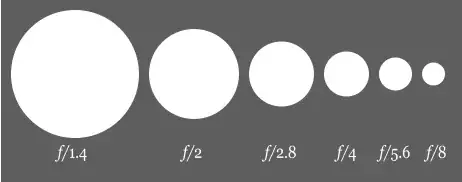
enter image description here

F-Stop = Focal Length / Diameter of the hole through which light comes (Aperture). In other words

F-stop = F/A

As the above answer explains well,

1 stop = double the light
2 stop = 2*2 = 4 Times the light
3 stop = 2*2*2 = 8 times the light

So to change from ISO200->ISO400 is one stop. ISO200-ISO800 is two stops and so forth.

Another way of showing stops is by means of focal length, as show in the pic

one stop = f/5.6
two stop = f/4
three stop = f/2.8

Why is the denominator not the whole number? This is because it is the ration of area. And the ratios of areas must be whole number. Don't go by the number underneath the f. This is just a number that divides the area exactly by two.

Another thing that is hidden in all this calculation is the the aperture (through which light enter the camera). This is variable and can be increased, decreased. The greater the aperture of the lens, the greater is the price. And that is because that lens is capable of feeding more light to the camera at any one instant.

For simplicity consider a 35mm lens (35mm is the focal length). If we know its f-number, we an find the max aperture size. Lets say it has f-number = 1.8. Lets calculate Aperture.

F-stop = F/A 
=> A = F/F-stop
=> Aperture = 35mm/1.8 = 19.4mm (This is the maximum aperture this lens can have which is obviously very large).

Now consider a different lens 35mm/f 16. Lets fine it aperture size

A = 35mm/16 = 2.1mm. You can see that this will allow far more light than the first lens we consider.

Now consider another lens 85mm/f 1.8, lets find its aperture size

A = 85mm/1.8 = 47.2mm (Maximum Aperture).

You can see that this lens has huge aperture and you can see that why it is so expensive. So aperture seems to be the hidden factor.


Addition:Where do those numbers come from?

Lenses are marked with a series of f-stops, each one lets in half as much light as the previous one. The light-gathering ability of a lens is determined by its area, and f-stops are determined by diameter. Area is related to diameter squared. The progression of f-stops, 1 - 1.4 - 2 - 2.8 - 4 - 5.6 - 8 - 11 - 16 - 22 - 32, are powers of the square root of 2. source

TheTechGuy
  • 1,561
  • 5
  • 21
  • 29
  • 1
    The actual, physical lens aperture in millimeters is seldom specified because it is quite uninformative on its own. What is of interest is the f-number - focal length divided by max aperture size. not the aperture size per se. For photographic purposes it is interesting to know whether the 85mm lens is f/1.2 or f/1.8, not whether its physical aperture is 71mm or 47mm. An 85 f/1.8 (47mm aperture) will give you exactly the same exposure as a 35mm f/1.8 (19.5mm aperture) or a 200mm f/1.8 (111mm aperture). "The lens has 20mm max aperture" tells me nothing, "the lens is f/1.4" tells me lots. – Staale S Sep 15 '11 at 21:34
  • 1
    This isn't a bad answer at all, but the question on f-stop linked to in @William C's question covers what an f-stop is pretty well; the question is basically is it a synonym or is there more to it? – mattdm Sep 15 '11 at 21:34
2

The aperture term "F-stop" is why we call a stop a stop. But the exposure effect of fiddling with shutter speed or ISO is the same as the exposure effect of fiddling with the aperture (f-stop), so the term "stop" has grown as a useful shorthand to cover all three. It means, basically, doubling or halving the exposure, whether this is done by adjusting any one or more of the three things: aperture, shutter speed, or ISO. Or by some other means. Or it can describe the light - "a cloud covered the sun so the light fell by a stop", ie. the available light suddenly dropped by fifty percent.

"I lowered the exposure two stops" means that you went from ISO 400 to 100, or from 1/100 sec to 1/400 sec, or from f/4 to f/8, or to ISO 200 and 1/200 sec still at f/4, or put a two-stop neutral density filter on the lens (another variable! And a two-stop filter is called an ND4, not ND2, just to keep us on our toes), or some other permutation thereof, without actually going into the gory details of precisely which factors you adjusted.

By extension, it is also used for describing the power of a flash - "turning the flash down one stop" simply means halving its output. The effect on exposure is the same as stopping the lens down from f/5.6 to f/8.

Staale S
  • 7,514
  • 24
  • 32