I know that arbitrary graphs can be embedded trivially in $\mathbb{R^3}$ and that planar graphs can be drawn on a plane using Schnyder's grid embedding algorithm after triangulation. And then there is also the $(i, i^2, i^3)$ moment curve approach..
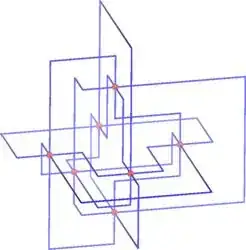
What I am looking for is a non-crossing embedding of arbitrary graphs in multiple coplanar two-dimensional layers within $\mathbb{R^3}$ (a stack of $\mathbb{R^2}$ planes, $\mathbb{R^2} \times \mathbb{Z}$, discretized $\mathbb{R^3}$, 3D grid) just like the moment curve. But to make things more interesting I'd like the resulting embedding to look nice, i.e. minimizing the number of layers needed for an embedding and/or minimizing edge length. (Probably I want an embedding in $\mathbb{Z}^3$ or an minimum node distance constraint $|v_i - v_j| \ge 1$ for this to make sense)
I am new to this, so pointers to literature or more appropriate search keywords are highly welcome too. Perhaps this is a special/relaxed case of realization where distances between neighbors should be $1$, or maybe it is something along the lines of chip layout optimization. Does it make a difference if the graph is sparse? Is there a theory about embedding planar graphs in $\mathbb{R}^3$ to get shorter edge length?