1

Prove $$\left(\sum\limits_{i=1}^{n}x_i\right)^2\ge\sum\limits_{i=1}^{n}x_i^2,$$

for $x_i\ge0,\,\forall\,i\in\{1, \cdots, n\}.$

I tried by recurrence.

  • For $n=1$, It is true.
  • Suppose it is true for $n$, Prove for $n+1$:
    • $$\left(\sum\limits_{i=1}^{n+1}x_i\right)^2=\left(\sum\limits_{i=1}^{n}x_i+x_{n+1}\right)^2=\left(\sum\limits_{i=1}^{n}x_i\right)^2+2x_{n+1}\left(\sum\limits_{i=1}^{n}x_i\right)+x_{n+1}^2\ge\sum\limits_{i=1}^{n}x_i^2+2x_{n+1}\left(\sum\limits_{i=1}^{n}x_i\right)+x_{n+1}^2\ge\sum\limits_{i=1}^{n}x_i^2+x_{n+1}^2=\sum\limits_{i=1}^{n+1}x_i^2,$$

This is correct (Probably).

Is there any other method?

Jika
  • 2,970

3 Answers3

5

Prove inductively that

$$\left(\sum_{i=1}^nx_i\right)^2=\sum_{i=1}^nx_i^2+2\sum_{1\le i<j\le n}x_ix_j$$

and from here your inequality follows at once.

DonAntonio
  • 211,718
  • 17
  • 136
  • 287
5

Both expressions are homogeneous of degree $2$. The inequality is clearly true (and an equality) for $\sum x_i = 0$, so we can ignore that case. By homogeneity, we can then assume $\sum x_i = 1$. But that means $x_i \leqslant 1$ for all $i$, and hence $x_i^2 \leqslant x_i$, whence

$$\sum_{i=1}^n x_i^2 \leqslant \sum_{i=1}^n x_i = 1 = \left(\sum_{i=1}^n x_i\right)^2.$$

Daniel Fischer
  • 206,697
5

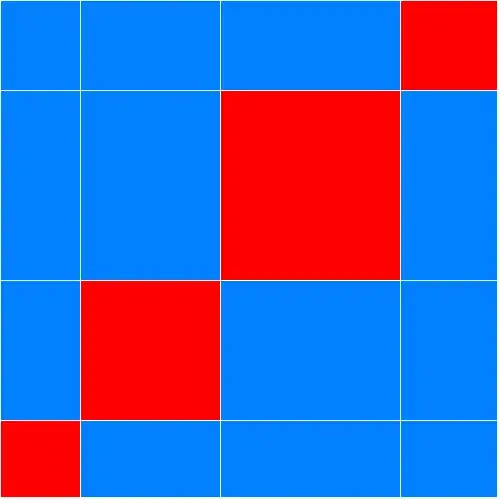
$\qquad\qquad$

$$x_1\qquad\qquad\qquad\qquad x_2\qquad\qquad\qquad\qquad x_3\qquad\qquad\qquad\qquad x_4$$

Imagine a square whose side S is the sum of n segments $x_k$ . Then its area A is $S^2=\bigg(\displaystyle\sum_{k=1}^nx_k\bigg)^2$. But the sum of the smaller squares along the diagonal is $\displaystyle\sum_{k=1}^nx_k^2$, which is obviously smaller than A, of which it is but a part. I offer this geometric approach as an intuitive supplement to the algebraic proofs given by the other commenters. I hope it will prove a helpful addition to the thread.

Lucian
  • 48,334
  • 2
  • 83
  • 154