27

This had never even crossed my mind as an issue before, but someone brought it up in a comment on another TTR-related question, and having checked the USA rulebook I'm no longer 100% sure:

When calculating who gets the "Longest Route" bonus card, do you go by number of train cars in the route, or number of links/cities in the route?

I suspect the official answer will be well-known to anyone who plays a lot of Ticket To Ride online, but for those of us who don't... what's the correct interpretation?

goldPseudo
  • 6,682
  • 2
  • 28
  • 51
thesunneversets
  • 40,947
  • 9
  • 135
  • 208

1 Answers1

29

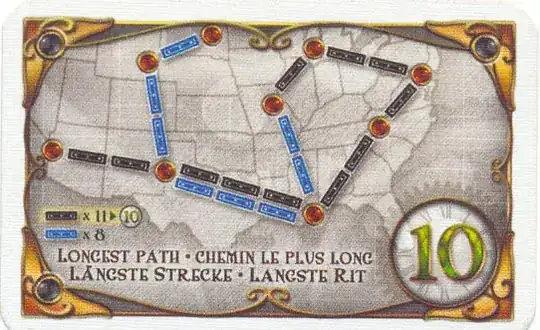
The owner of the longest continuous number of train cars is the one who gets the Longest Path card. (It works just like Longest Road in Settlers of Catan.)

Here is an image provided by Matthew Frederick from his original edition of the game:

Longest Path card showing that it's calculated based on the number of train cars - black route consists of 11 cars, while blue route consists of 8, so black has the longest path

He also notes that the online versions provided by Days of Wonder work this way as well.

V2Blast
  • 111
  • 6
Pat Ludwig
  • 29,963
  • 6
  • 114
  • 155
  • 1
    That's what I always assumed, I'd hate to have been playing the game wrong for all these years! The other way would create an interesting tension with the natural impulse to build longer routes (because they're worth more points in and off themselves) though. – thesunneversets Jan 11 '11 at 18:14
  • @thesun, I think that's the point! :-) – Kristo Jan 12 '11 at 20:55
  • 1
    It's definitely, absolutely, positively the number of train cars. The Longest Path card itself -- at least in the original edition that I own -- shows an example, noting that Black has 11 and Blue has 8, with the picture showing 11 and 8 train cars. It's also how the Days Of Wonder owned-and-operated online version works. – Matthew Frederick Jan 13 '11 at 01:34
  • Pat, I'm not sure on the best course of action (1 - edit your answer, or 2 - make my own answer). Those of us who know the rule can interpret/apply your first sentence (and @Matthew 's comment about 11 cars vs 8 cars) correctly, but "longest continuous number of train cars" is very imprecise. Without citing a bunch of wolfram math definitions, maybe we could say "The owner of the longest simple (non-self-intersecting) route, as measured by number of trains,..." or something like that? It is certainly possible for an 11 car (non simple) route to be "shorter" than an 8 car route. – The Chaz 2.0 Mar 08 '12 at 14:28
  • 1
    @TheChaz - it may be worth another question to more strictly define this. My interpretation would be that you could form a loop (and thus intersect), but the termination of the loop would be the endpoint of the whole chain. – Pat Ludwig Mar 08 '12 at 15:02
  • I'd better (re)consult the rules before going further :) – The Chaz 2.0 Mar 08 '12 at 15:31
  • 2
    @TheChaz The path can indeed self-intersect; you simply cannot use any train car twice. Loops are fine, and the route need not terminate at the end of such a loop as long as, again, you do not count any train car twice. No interpretation is required as long as you follow that rule. FWIW this is both how the rule was explained to me by the game's designer, Alan Moon, and how it's scored in the official computerized versions, both on the publisher's website and on the iPad and iPhone apps. – Matthew Frederick Mar 08 '12 at 21:25
  • @Matthew: That is helpful and definitive. I guess most times that I've played (live or on iOS), it hasn't come up since the winner of Longest Route usually has... well... one really long route! – The Chaz 2.0 Mar 08 '12 at 21:28
  • 3
    @TheChaz For those of a more Wikipedian mindset who'd like a third-party reference, here's one of the publishers, Eric Hautemont, answering the question on BoardGameGeek: http://www.boardgamegeek.com/thread/19560/longest-path-questionj – Matthew Frederick Mar 08 '12 at 21:54
  • I see now that you all are right. However, the rules as worded are clearly wrong! It should say "longest continuous path of trains" rather than "longest continuous path of routes" because a "route" is quite clearly defined as the connection between two cities, not each single train. –  Jan 03 '13 at 04:48
  • Is the route between Pittsburgh and Toronto the same length as the route between Pittsburgh and St. Louis? I mean that rhetorically but seriously. – mattdm Jan 03 '13 at 12:22