3

I have a $300 MTB used for commuting. It has been three years now, and the rain and snow have said their word. Two weeks ago I disassembled the fork and spent a good one hour with the sandpaper, removing rust. Still some was left. It has been two rainshowers from then. Yesterday I had another look and ... it is not promising.

I have move aggressive means of removing material (so that there will remain no rust) - a grinding wheel. However, I am afraid to use it, as I guess it will be weakening the tubes too much. I do not seek top performance - it is a no-steal bike (for example the handlebar is visibly bent).

Below are the two pictures. Should I clean the rust? How? How reliable is the fork currently? How long does it have left?

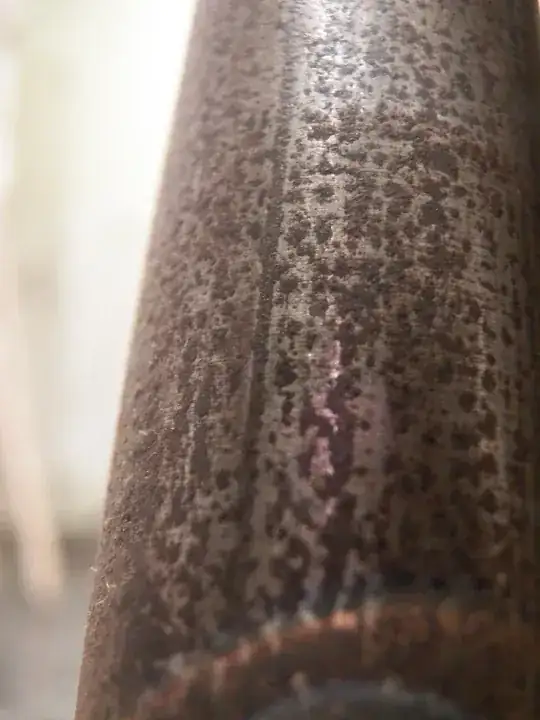
enter image description here enter image description here

Vorac
  • 13,698
  • 19
  • 82
  • 153
  • 2
    I'm more worried about the bent handlebars. A stuck suspension fork will only become a rigid fork while a fatigued handlebar can fail unexpectedly (as aluminum has a tendency to do.) They're a replaceable part that could cause a nasty accident. – WTHarper Jan 20 '13 at 01:22
  • So long as that's not a sliding surface it's not what I'd consider "serious". Removing the rust will remove any protective plating and make matters worse. – Daniel R Hicks Dec 07 '13 at 13:34

4 Answers4

8

This is obviously (from the images) a suspension fork, and a very low-end one. Suspension forks are heavier than their rigid counterparts, but the trade-off is that they absorb shocks. These rust spots MUST MEAN the fork has long ago COMPLETELY LOST its ability to work properly as a suspension. As a result, you are carrying useless extra-weight, are not getting a suspension effect, are risking some worse failure along the way, and are risking some crash/injury.

The surface presenting the rust is the surface where sliding occurs (the "telescopes"). This surface must be perfectly smooth and shiny, and the rust shown necessarily means it is not, and never will be, as new again. Grinding will remove dust, but will not make the surface smooth nor prevent more rust to build-up afterwards.

My suggestion: sell the fork for metal recycling, and buy either a new suspension fork, or a rigid fork.

Hope this helps.

heltonbiker
  • 18,957
  • 8
  • 55
  • 88
  • 1
    The fork tended to work worse the last year, but after I disassembled it and oiled it with teflon oil, it is working very very perfectly! My worry is exactly that it will fail when I least expect it. – Vorac Sep 26 '12 at 13:34
  • 1
    That it goes up and down does not mean it serves any purpose besides going up and down. Below-low-end suspension (I mean rust, common, even low end forks don't rust) only eats up energy that you otherwise could have put into forward motion, destroys your back and look cool. I'd go for a rigid fork, too. – Baarn Sep 26 '12 at 13:49
  • 1
  • The fork probably won't break, but most probably will have some play and be uncomfortable. 2) TEFLON OIL is absolutely not intended for use inside a suspension. Silicon-based grease (or, considering the low-endness, ANY grease) is best, just in case you prefer to keep this fork.
  • – heltonbiker Sep 26 '12 at 14:48
  • 1
    The surface does not have to be perfectly shiny if it is a non-hydraulic, spring-loaded fork. The shine is esthetic only. If you push down on it and it returns, it's working. In any case, it is possible to make the surface completely shiny! Just sand it with finer and finer papers and then give it a polish with a polishing compound. But, I would not waste my time, though. – Kaz Sep 27 '12 at 21:36
  • @Kaz I partially agree. Shiny and smooth are two different things and you can get one without the other. By "shiny" I mean a surface that most likely will work fine against bushings, providing low friction, sealing of lubrication / against water and preservation of the bushings themselves. By smooth I mean cylindrical, not dented, bent, grooved or otherwise irregular. In any case, the OP suspension is wasted by both criteria. – heltonbiker Sep 27 '12 at 21:47
  • @Kaz, if you post this as an answer, I will accept it. Ant the a discussion could form under it as to how adequate it is. Also note that the rust is only at the lower end - when the fork is assembled, no rust is visible. – Vorac Sep 29 '12 at 07:03