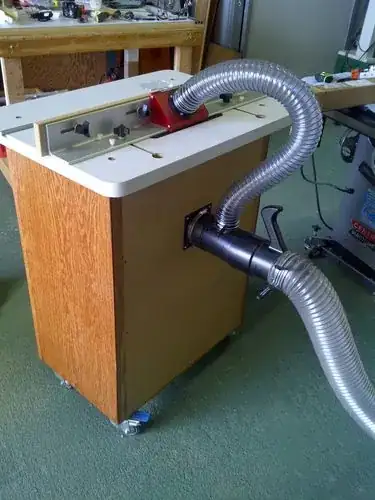
bowlturner already mentioned that reducing from 4" to 2.5" does not work very well with a dust collector and suggested some possible reasons why a 2.5" fence hookup is so common for router table dust collection.
I'll try to specifically answer your question about two 4" ports:
I'm wondering if there's anything wrong with using two 4" ports
instead of a 2.5/4.
The typical rule of thumb suggests that you want to maintain about 4000 FPM air velocity through your dust collection system. If you drop too far below the recommended air velocity, dust can pile up in the lines.
If you split a 4" hose into two 4" hoses, you've effectively cut the air velocity in half for each branch. (In this particular example, the 90 degree tee and the question mark-shaped flex hose will add some extra resistance. The air will follow the path of least resistance, so the straight branch into the cabinet will still pull more air than the branch that goes to the fence--but for the sake of simplicity, we'll ignore that for now.)
In order to maintain 4000 FPM after splitting into two 4" hoses, you either want to start out with the dust collector pulling the air twice as fast through a single line of the same diameter, or you want to start out with the dust collector pulling air at the same velocity through a line whose cross-sectional area is twice as large before splitting into the two 4" lines.
Now let's plug your specific dust collector into the equation. WOOD Magazine tested the Central Machinery 2hp dust collector from Harbor Freight and found that it only pulls 536 CFM @ 4.25" WC static pressure (a far cry from its advertised 1550 CFM). Coincidentally, 536 CFM is almost exactly the amount of airflow you need in order to draw the air through a 5" line at 4000 FPM. But if you're just using 4" hose all the way, 536 CFM equates to 6142 FPM through a 4" hose according to Bill Pentz's static pressure spreadsheet. So at first glance, it appears this dust collector falls short by quite a bit. But that's not the whole story.
The good news is that 4000 FPM is only necessary to lift dust vertically. If we're talking horizontal and downhill runs, 3000 FPM is adequate. So if you can smooth out the bends in the line (specifically, replace the tee with a wye and straighten out the question mark-shaped loop), you should have no trouble pulling air through each branch at about 3000 FPM. Mathematically speaking, your dust collector should be able to handle a slightly improved configuration just fine, and realistically speaking, the pictured configuration is suboptimal but possibly "good enough."