9

I have heard that the old-school way of creating a flat surface is to use a hand plane, and that if you use the right tools, you may not even have to sand because the surface is so smooth. Can I use a flat hand plane to smooth an flatten a curved surface? Is there a tool specifically for it?

The surface in mind is a U shaped stool top, so there is only a single curve, though I have to handle both the inside and the outside.

I know I can just sand it, and that's what I plan to do if I don't have an alternative. Is this the easiest/classical way of handling such a surface?

Matt
  • 20,188
  • 41
  • 99
  • 202

6 Answers6

8

This is a tangential point to your main question but has a bearing on my suggested solution:

I have heard that the old-school way of creating a flat surface is to use a hand plane, and that if you use the right tools, you may not even have to sand because the surface is so smooth.

While that can be true it does tend to get overstated by some planing enthusiasts. It was actually quite common in the past for even the surface left by a "smoother", or smoothing plane, to be further refined. Be it by scraping and/or with some abrasives (even before the advent of sandpaper).

Can I use a flat hand plane to smooth an flatten a curved surface?
The surface in mind is a U shaped stool top, so there is only a single curve

So I'm presuming this is dished, i.e. has a concave surface. Generally speaking a regular flat-soled plane can only be used on convex surfaces, not on concavities because the flat bottom will 'bridge' from toe to heel and prevent the cutting edge from contacting the wood.

There are a number of other edged tools that can be use for concave surfaces. In terms of smoothing the surface specifically (rather than creating it in the first place) the main one is the compass plane.

The all-metal version had a flexible steel sole whose curvature could be adjusted to match the surface you were working on:

Record compass plane

Wooden versions are also an option and these can have soles that curve in one or both directions, the latter allowing work on compound curves (a surface dished both front-to-back as well as side-to-side).

Compass planes are specialised pieces of kit and can be quite expensive, but are of course purpose-made for the job and do it well and efficiently.

There is a simpler option, one much better suited if only a small amount of smoothing is needed and that is the curved card scraper. Card scrapers are widely sold in sets of three shapes, and this may be the ideal way to buy them as all three shapes will prove useful. For use on a hollow seat the best choice is the one that looks a little like a stylised comma:

Card scrapers

All card scrapers can be used in either a pulling or pushing motion depending on user preference and the demands of the shape being worked.

After scraping you may end up with a surface you deem finish-ready, but this isn't always possible (due to vagaries in the wood as well as how sharp the scraper is) so don't feel any embarrassment if you need to do final smoothing using sandpaper.

Graphus
  • 65,691
  • 3
  • 50
  • 139
  • You've provided some nice solutions. It seems like you're using "convexities" in a couple places where you mean to use "concavities." Also I haven't used a compass plane, but based on a FWW article it seems you can use it to produce both convex and concave surfaces. – rob Jun 15 '15 at 20:00
  • @rob, "t seems like you're using "convexities" in a couple places where you mean to use "concavities." Oops yes! Fixing that now. – Graphus Jun 16 '15 at 08:57
  • Let's say for thoroughness sake that I have done the very rough work, but have to remove some tearout/nicks, and refine the curve further before I start smoothing it. In such a scenario, might this be a bit much for the hand scraper? If I'm not too keen on buying a specialized tool (depends on how often I see the job require it), does a spokeshave seem like an option you'd use? Basically I'm trying to get the answers to bind together, or pick between the answers right now :) – Merlyn Morgan-Graham Jun 27 '15 at 19:30
  • 1
    @MerlynMorgan-Graham, "remove some tearout ... might this be a bit much for the hand scraper?" nope, removing tearout is one of the things that scrapers excel at. "does a spokeshave seem like an option you'd use?" I'm a little biased as IMO spokeshaves are an amazing and under-used tool these days. They're not ideal as a standalone tool for doing major hollowing, but for occasional use & for gentler curves they are a very viable option. If you need to do major hollowing a suitable angle-grinder bit or a scorp would be the ways to go, depending on whether you're a powertool or handtool guy. – Graphus Jun 28 '15 at 08:40
  • @Graphus: Thanks much! This is very helpful. I got some scrapers earlier today and need to learn how to properly sharpen them so they don't just make dust, and how to not totally destroy my hands with them ;) Youtube is helping me for the first one. Cheers! – Merlyn Morgan-Graham Jun 28 '15 at 09:20
  • 1
    @MerlynMorgan-Graham, re. sharpening scrapers, obviously you'll have seen guides showing the classic preparation method: filling, stoning, then using a burnisher of some kind to first draw and then turn the burr. This is a very good way to prep a scraper, but, it's not the only way. You'll notice when you first file the edge of a scraper that there's a burr created, that burr can be used for scraping. It's not as refined as you'd get the trad way, but particularly if you intend to sand afterwards anyway it can be more than good enough. Plus of course it saves having to buy a $$ burnisher :-) – Graphus Jun 28 '15 at 13:06
  • @MerlynMorgan-Graham, re. destroying your hands, for rectangular card scrapers my tip would be not to prep all sides! Some people do all four sides but I just do the two long sides. For the curved or "gooseneck" scraper because you might want a burr on the entire outside edge it can be worth wearing work gloves to protect your hands. – Graphus Jun 28 '15 at 13:09
  • Thanks for the tips :) I think I derped, and I think the off-the-shelf card may have a machining/stamping burr to begin with that I didn't take care of. I'll find out soon. As for gloves, I want to avoid them so my hands adapt to reasonable use, but I agree and will heed the suggestion w/ the "french curve"/"gooseneck" scrapers. I don't think it's reasonable to use those barehanded. – Merlyn Morgan-Graham Jul 01 '15 at 00:45
6

There is a compass plane, a plane with bent or bendable sole.
Unfortunately I couldn't find an image with a proper license (sic) The radius on a compass plane is probably too big for a stool.

There is also the spokeshave with much shorter sole.
It can be concave or flat or convex.

Spokeshave

A third solution is to mount the stool top on something that lets it rotate and then plane with an ordinary plane lain at side.

The fine touch you can do with a card scraper.

Card scraper for convex and concave surfaces

LosManos
  • 1,000
  • 2
  • 6
  • 14
5

Was also going to suggest mini block planes as well for the outside of you "U". Their size lends to detail and you can easily shape the blades to be soothing blades which prevent the edges from digging in (More used for flat surfaces but if you already own these tools it could work.)

While looking at pictures I also found references to shaping planes which can be used on both the inside and outside of your "U". In the following picture the tools are upside down so you can see the cutting side/face.

Shaping Planes

Image from Leevalley Tools

Side note

The other answers do a good job of mentioning tools for working curved surfaces. I would like to make a small addition since you were talking about old-school methods.

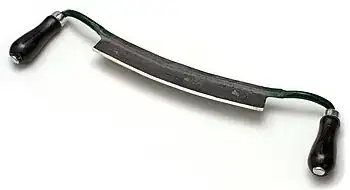
I realize that you are looking to refine in this particular case but uf your stock is large and you want to remove larger portions quickly then you could use a draw knife ( also known as a pull knife ) before you get to the smoothing tools.

Pull Knife

Image source: Wikipedia

Matt
  • 20,188
  • 41
  • 99
  • 202
  • I'm not sure the draw knife is applicable since the question is specifically about refining a curved surface, not roughing it out. – rob Jun 15 '15 at 14:28
  • @rob I suppose you're right. I will reverse the content of the answer and mention the flat knife in passing. I made some minor changes – Matt Jun 15 '15 at 14:29
  • The draw knife mention is still useful to me, so thanks for that! I'm mostly interested in hand-tool options because I'll be moving to a small apartment in the city soon where I won't really be able to do power tools, and in general it just seems like a fun idea :) – Merlyn Morgan-Graham Jun 27 '15 at 19:23
5

The tool for this is called a scorp. There are small ones for carving out wooden spoons, and large ones for chair seats. They are like a drawknife, but curved.

Here's an example:

enter image description here

That said, unless you are making a lot of these, and willing to invest a fair amount of effort, it might not be worth it to buy a scorp. A curved hand scraper (just a 3 x 8 or so sheet of steel with a curved, honed edge) will get the job done.

Doresoom
  • 4,358
  • 4
  • 31
  • 55
3

Generally speaking you would use a spokeshave which is like a plane with no sole.

You can then refine that edge with a card scraper to make it smooth.

2

I highly recommend a Stanley 113 - compass plane. The base of the plane is adjustable allowing for you to plane different angles. Remember if you are doing something like a rocker you can use a jack plane on the convexed portion and the compass plane on the concaved.

MatthewR
  • 499
  • 3
  • 8