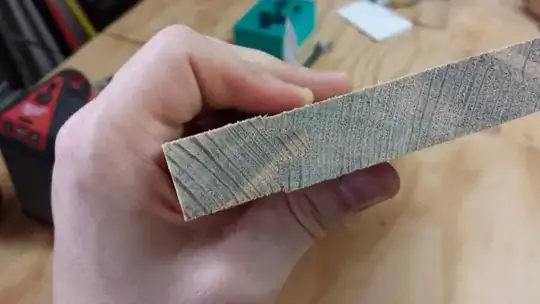
Although you're using a tongue and groove set, the process would be very similar with other bits. However, the reference surfaces might differ.
Depending on which bits you're using, you should have at least 2 routers, one set up to cut the groove and another one (or two) set up to cut the tongue. For the examples below, I'll assume you only have 1 router.
Keep in mind that anytime you're trying to make mating parts, you should avoid measuring on each separate part. You can measure on the first part, but after that you should ideally use some type of gauge to transfer the measurement directly from one part to the other. In many cases, the first part itself is the gauge.
Method 1: no special tools required
- For simplicity of explanation, let's cut the tongue first.
- Install the groove cutter bit and line the tongue board up alongside the router bit. Don't plug in the router yet (you did unplug it to change the router bit, right?)
- Adjust the height of the tongue cutter until it is perfectly lined up with the tongue. With the router unplugged, use your finger to tell when the groove bit's cutter is perfectly lined up with the tongue. Whether it's true or not, the common wisdom in the woodworking field is that the human finger has a resolution of about 1/1000". Alternatively, you can lay a small flat scrap across the top of the tongue and micro-adjust the router bit until it just kisses the scrap (in that case, a backlight will help you see when the gap is closed).
- Cut the groove on the second workpiece.
Method 2: caliper

(Source)
For the purposes of this example, I'll assume you have a caliper, but you can apply the same gauging concept to other measurement devices.
- For simplicity of explanation, cut the tongue first.
- Lay a shim (e.g., a flat, rigid metal ruler) alongside the tongue piece so the tongue overhangs the shim.
- Using the depth gauge of your caliper, measure the distance from the the top of the tongue to the shim. Lock the reading into your caliper using the lock screw. This measurement is the distance from the top of the tongue to the baseplate of your router, minus the thickness of the shim.
- Install the groove cutter bit and line the groove board up roughly alongside the router bit, then raise the bit upward slightly (assuming your router has the bit facing upward at this point).
- Register the depth gauge end of your caliper along the groove bit's cutter.
- Using the router's micro-adjustment knob, adjust the bit downward (again, assuming the bit is facing upward) until the caliper's depth gauge bottoms out on the shim (which is now lying across the hole in your router table or baseplate).
- Cut the tongue on the second workpiece.
Method 3: caliper
For the purposes of this example, I'll assume you have a caliper. Note that this example is slightly convoluted in an effort to demonstrate how to take a reading using one part of a caliper, then transfer it using a different part.
- For simplicity of explanation, let's cut the groove first.
- Using the lower jaws of the caliper, take the outside measurement of the thickness of the lip that was touching the router base (or router table), and lock this measurement into your caliper with the lock screw.
- Install the tongue cutter bit.
- Transfer your previous measurement directly when setting up to cut the tongue. Use the depth rod to gauge the height of the tongue cutter, while adjusting the height using your router's coarse and fine adjustment knobs.
- Cut the tongue.