32

Whenever I shop at airports abroad, I always get asked to choose between the currency options while paying via my credit card.

One is the local currency and another one is the currency of the country where the card is issued in[India(INR) in my case].

Why are there two options? And what are the benefits of choosing one over the other?

Dawny33
  • 834
  • 1
  • 9
  • 22
  • 4
    In addition to both of the answers, see the following BBC article for supporting evidence on card payers being ripped off if they choose the non-local currency - http://www.bbc.com/news/business-40702496 –  Jul 26 '17 at 05:13
  • 4
    This has nothing to do with airports. – gerrit Jul 26 '17 at 10:06
  • 3
    Cross-site duplicate: https://money.stackexchange.com/q/10837/9083 – gerrit Jul 26 '17 at 10:07
  • Get a card like Revolut and your worries would be gone. – JonathanReez Jul 26 '17 at 10:42
  • 1
    @JonathanReez Interesting, but Wikipedia tells me it's only free up to to 200 Euros/GBP per month. That's some very low-budget travel. – gerrit Jul 26 '17 at 13:15
  • 1
    @gerrit it's free up to 200GBP/month withdrawals. Card transactions are unlimited. – JonathanReez Jul 26 '17 at 15:42
  • @gerrit Which, funnily enough, links back to this SE. – reirab Jul 26 '17 at 21:31
  • 8
    Not a serious answer, but let me say it: whenever people have to choose between two options that they don't really understand, most will choose the first one, just because... It's the first one. Interface designers know this, and they will make sure that it corresponds to the best choice for them - which happens to be the worst one for you. So, rule of thumb: if you are in doubt, go for the second one. Overly cynical? Maybe... – Fabio says Reinstate Monica Jul 27 '17 at 01:25
  • 3
    @FabioTurati The exception is wine lists, where people always choose the second wine on the list (because they don't want to appear cheap). Restaurants know this, so they always put the greatest mark up on the second wine. So, if you're going for a cheap bottle of wine, you should always choose the first one - at least until this information becomes more widely disseminated! – Strawberry Jul 27 '17 at 12:40
  • @gerrit There are quite a few UK cards that offer 0% spread on FX. The Lloyds Avios card also offers Avios on top, and at a better rate than my Amex Plat. (But this card is no good for cash withdrawals, just purchases.) – Calchas Jul 27 '17 at 14:56
  • Some of my personal examples of DCC offers, compared to using local currency - https://blog.docbert.org/dynamic-currency-conversion/ – Doc Jul 30 '17 at 05:54

5 Answers5

38

If you select the local currency, it will be converted to your card's currency according to the terms of your cardholder agreement (e.g. in the US and Canada it's often Visa/Mastercard's current rate + 2.5%, or possibly less for some fancy cards with annual fees). Some cards may add a per-transaction fixed fee on top of that.

If you select your card's currency, conversion will be done by the merchant bank of the vendor where you're using the card. The advantage is that you see right away how much you're paying in your card's currency - there are no surprises on the bill later on. The disadvantage is that the rate is, as far as I know, usually worse that your own bank's rate (especially if you have a really good credit card).

When making a big purchase, it's worth comparing the rates. For small purchases, find out before your trip whether your card charges any foreign currency per-transaction fixed fees and what the rate markup is (e.g. 2.5%). If there is no fixed fee and the percentage is not too bad, just charge in foreign currency all the time.

Eugene O
  • 9,124
  • 3
  • 42
  • 58
  • 3
    For small purchases and fixed fees cash payment would be the cheapest option. – gerrit Jul 26 '17 at 10:11
  • 8
    @gerrit That depends how much the foreign cash cost you. Sometimes the fees for cash can be MUCH higher than the fees for credit cards. – Spehro Pefhany Jul 26 '17 at 14:34
  • 1
    Your answer seems to be the most correct one, as you point out both sides. But it fails to highlight what most - if not all - who have fallen victim to this will know: It is a scheme to generate revenue by ripping of gullible users! The card issuing bank has a reputation and a contract to lose, if they screw their customers over. The provider of the terminal not so much. So, who is more likely to cheat? :) – I'm with Monica Jul 26 '17 at 15:06
  • 5
    It's not only "fancy cards with annual fees" that charge lower rates (though it's mostly that); some no-fee cards, e.g. from Capital One and Discover (though Discover is not very accepted abroad) also have no foreign transaction fee. – Danica Jul 26 '17 at 16:51
  • 4
    It is not always true that you know the final price if you choose the card's native currency ("no surprises"). Your card may have a fee for all transactions involving a foreign bank, even if denominated in the card's native currency. So you could en up paying an unfavorable DCC exchange rate, plus a fee from your card issuer. – Kevin Cathcart Jul 26 '17 at 19:18
  • Dougal speaks the truth. I presently have 8 cards, 4 of which have no annual fees. Only one of my cards has any foreign transaction fees at all. – reirab Jul 26 '17 at 21:50
  • @KevinCathcart is correct, and this important: if you have a bad card (and many USA cards are), they will still impose a cross-border fee even if the transaction is denominated in dollars. Moreover, the dollar conversion rate offered at the point of sale is always terrible. I have never seen a situation where you should pay with a card in dollars instead of local currency. – Andrew Lazarus Jul 27 '17 at 17:53
25

The service you are referring to is called "dynamic currency conversion" and is sold as an extra convenience in locales with a heavy tourist presence, not just in airports. Many people are tempted to opt for their home currency because they assume that it will relieve them of inter-bank fees and disadvantageous exchange rates.

Starting with your second question...

And what are the benefits of choosing one over the other?

The benefit of paying in local currency is obvious: i.e., you know what the transaction involves. Generally it is picked up by the card issuer and passed through with predictable rates and fees that are governed by the regulator in your home country. So while the end-user faces uncertainty in knowing the precise exchange rate that will appear on their bill, they have the certainty of knowing that it will be set within a regulatory framework and hence 'near the market'.

When you opt to pay in your own currency abroad the exchange rate is established right then by whichever bank is servicing the retailer, and you have no control over it. This can lead to an uncomfortable difference in what you have actually paid.

The regulators in Europe require those offering 'dynamic currency conversion' to exhibit the exchange rate prior to the customer's approving the purchase.

Dynamic currency conversion is legal in the UK and across Europe, as long as traders display not just the price but also the exchange rate being used before the payment is made.

Source: Tourists warned over exchange rate costs (BBC, 24 July 2017)

BUT, they do not regulate how the exchange rate is presented to the customer, and therein lies a problem. What may be presented is the inverse rate of the bank's counterparty's bid and this is a rate applicable to the currency wholesale markets and not available to an ordinary mortal. So in order to evaluate it, the customer has to take the inverse of the rate and then compare it to the relative savings they could achieve by using an ATM. People are not generally willing to go through that kind of hassle.

Your other question...

Why are there two options?

Merchants love it because they receive a commission from the DCC provider.

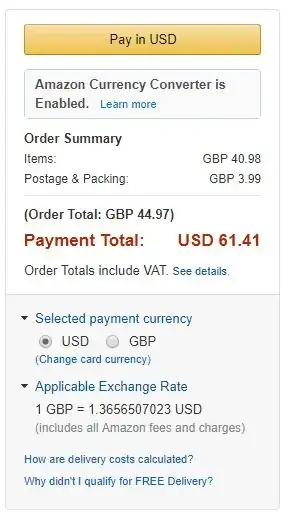
Merchants that operate a global presence, like Costco for example, will avoid offering the service because it interferes with their internal hedging strategies. Amazon, on the other hand, will offer DCC to customers whose credit cards are denominated in multiple currencies; my observation is that Amazon likes to display a bid-side retail rate derived from yesterday's rate (fair enough for most purposes).
enter image description here

This shows a live screen grab from Amazon's DCC. The exchange rate works out to 500 pips over the prior day's mid-market rate. You can't purchase in this quantity (it's too low) from a retail bank for a rate that attractive, so in this case DCC makes sense. Caveat emptor and your mileage may vary.


Extended discussion on the advantages and disadvantages in the DCC Wiki Article.

Gayot Fow
  • 85,024
  • 26
  • 229
  • 405
  • w.r.t your last para: Strangely, unlike BA, Brittany Ferries offers GBP & EUR on board (as well as for ticket sales) and earlier this month it was advantageous to pay them in GBP. Their costs are likely to be weighted towards EUR (HQ, suppliers). Presumably it can be taken into account in a hedging strategy, maybe even used in one. – Chris H - UK Jul 26 '17 at 07:59
  • I think you have things backwards: It's when paying in your own currency that you “know” what the transaction involves and that's what banks are preying on. Sure, you have no way to judge how good the exchange rate is and you will be overcharged but the number you see is a number you recognise and that's also the number that will be charged to your bank account. – Relaxed Jul 26 '17 at 09:53
  • 1
    By contrast, when paying in a local currency, you don't actually know what you will be charged in your home currency (the only one relevant to almost everybody as that's the one you can most easily relate to, the one you are using to judge prices usually and the one in which you are paid). You could look up the card issuer's fees and conditions and you will almost always get a better deal that way but the number you see on the screen is more difficult to interpret. The number that will appear on your bank account statement is not transparent and feels “unknown”. – Relaxed Jul 26 '17 at 09:54
  • 1
    @Relaxed: The answer is right. When you choose to pay in home currency, you know the final bill, but you don't know how that number was obtained. When you choose to pay in local currency, you don't know the final amount, but you know it is being calculated by your financial network. – Ben Voigt Jul 26 '17 at 16:43
  • @BenVoigt That's exactly what I am saying and the opposite of what the answer implies, so which is it? Also, realistically, most people haven't looked up the fees beforehand, which is precisely why it feels like an unknown quantity. Even if it's possible to look them up (although finding the exact exchange rate isn't necessarily trivial) and generally a better deal. – Relaxed Jul 26 '17 at 18:31
  • 1
    @Relaxed: You're focused on knowing the number at the time of transaction, while Gayot focused on knowing who controls the number. You're misinterpreting the answer based on your own opinion of which is more important. – Ben Voigt Jul 26 '17 at 20:21
  • @BenVoigt I am indeed focusing on knowing the number at the time of the transaction, I was very explicit about that and I explained why. That's precisely why I think the answer gets things backwards by focusing on something else. How is that a misinterpretation? – Relaxed Jul 26 '17 at 22:34
  • And I am certainly not suggesting that knowing the number ought to be important or is important to me. I never use DCC. What I am saying is that people are tempted to do it because it gives them a feeling of certainty. By contrast, the main benefit of being charged in the local currency is that it is actually cheaper. The answer gets both of these points exactly backwards. – Relaxed Jul 26 '17 at 22:43
  • If you are talking about ticket sales, BA is very happy to do the currency conversion for you by telephone or in person. They will use the IATA Consolidated Exchange Rates, which is essentially the average of yesterday's buy price for the currency pair in question. It is usually very close to the spot rate. It's necessary for all (network) airlines and TAs to agree on exchange rates to ensure that if a ticket is reissued/exchanged/refunded in a different sales office, the correct money can be moved around. – Calchas Jul 27 '17 at 15:01
  • Merchants are not exposed to any fluctuation risk as they will always receive the amount as billed by them in the local currency. They do however get a kickback from the DCC provider. – lxgr Jul 27 '17 at 15:51
  • @lxgr astute comment! Well received too, can you read it now? – Gayot Fow Jul 27 '17 at 16:28
  • "so in this case DCC makes sense". What? Hell no it doesn't! Based on oanda.com, this rate is over 4 worse than the spot rate on the day of your post. If you have a credit card that gives spot rate or similar (and there are many that do now days) then this would leave you far, far worse off than paying in local currency. – Doc Jul 30 '17 at 05:52
  • What does Amazon have to do with this? -1 – Burhan Khalid Jul 30 '17 at 06:51
  • @Doc go back to oanda.com and try to get that rate for a quantity of GBP 44.97! (in the money transfer tab) And in this case anyway, USD is local currency for that card because it's denominated in USD. – Gayot Fow Jul 30 '17 at 06:55
  • @BurhanKhalid it's an online screen accessible to lots of people that shows an implementation of DCC and thus removes it from the abstract, but your down vote is fine anyway. – Gayot Fow Jul 30 '17 at 07:05
  • I mean, the OP is asking for using credit cards at airports (presumably not accessing Amazon from a laptop at an airport) - adding Amazon to the mix just confuses matters IMO. – Burhan Khalid Jul 30 '17 at 07:06
  • @BurhanKhalid so noted. I'll think it over for a bit and see if it continues to make sense or not. – Gayot Fow Jul 30 '17 at 07:17
12

It is always most beneficial to use the local amount and not the converted-on-spot amount.


I get asked this a lot as I work in electronic banking.

There are a few things that determine how you are charged:

  1. The currency your card is issued in.
  2. The local currency of the merchant's acquiring bank.
  3. The schema (VISA, MasterCard) currency being used for interchange.
  4. The interchange fees.
  5. The foreign transaction fees.
  6. The currency of the account your card is linked with (if it is not a credit card).

The bottom line is that all reconciliation between banks and the card networks (called schemes) happens in major trading currencies; usually it is the USD, but sometimes in Euros. There is an interbank rate which is updated twice in a business day.

So all transactions have to be charged and billed in this major currency. Lets say, its the USD.

So if your card is issued in INR, and its a credit card and you choose the local currency at the point-of-sale device then:

  1. The local currency amount is converted to USD at the rate of the merchant's bank's agreement with the schema (card network). Usually, it is a markup over the midmarket or bloomberg rate.

  2. This amount is charged to your card.

  3. Your bank then takes this amount in USD and converts it back to INR at some other rate.

  4. The bank then adds the transaction and network fees.

  5. This total amount is then charged against your account or card balance.

If your card is issued in INR, and you chose INR at the point-of-sale:

  1. You are getting the INR equivalent of the amount in local currency, converted to USD (at the merchant's bank rate), then converted to INR again (at the merchant's bank rate). Again, this rate is a midmarket rate.

  2. This INR amount is then converted to USD at the network (schema) rate and charged to your card.

  3. The normal steps from above are followed.

If your card is issued in a major currency, like the USD - then you are spared a few rates.

Burhan Khalid
  • 39,678
  • 4
  • 82
  • 157
  • 1
    This is a great answer. I would recommend you move the punchline (the highlighted text that summarises the post) to the top. I never knew what to choose when faced with this option and recently my bank (UBS) announced a 1.75% fee on using cards abroad, if you used one of those methods. Unfortunately, I couldn't remember which! Since I have a trip coming up, I re-checked the T&Cs and indeed, it is the converted transaction that they charge for. So it is best to pay in local currency and let your bank do their thing on the FOREX. You'll still get screwed, but less so... – Oscar Bravo Jul 26 '17 at 10:13
  • 1
    The second scenario is not accurate in Europe. Several times a merchant selected USD without asking me. Each time, not only was the rate unfavorable, the receipt explicitly added a "commission." Walmart pulls the same stunt in Mexico. – WGroleau Jul 26 '17 at 12:42
  • 1
    If it was always beneficial then surely the choice simply wouldn't exist! – Strawberry Jul 27 '17 at 12:35
  • 1
    There are always things that exist that aren't beneficial for you. You just have to know and make smart choices. – Burhan Khalid Jul 27 '17 at 13:14
  • @Strawberry Why not? No one ever went broke underestimating the stupidity of the American public. (Inaccurate but true paraphrase of H.L. Mencken.) – Andrew Lazarus Jul 27 '17 at 17:56
  • Did you actually read the OP's questions? – Gayot Fow Jul 30 '17 at 06:59
4

Some banks want an extra fee if you pay in a foreign currency, and the exchange rate can be worse than the official one.
So, paying in your currency is cheaper.

On the other side, the shop or ATM may charge you, too if you pay in your currency.

For example, getting money from a Swiss ATM in SFR is free of charge with my credit card, but definitely not with my debit card. Charging the card in EUR on the same ATM would be free for both cards, while the ATM itself would take a fee for this. That fee is cheaper than the fee for by debit card, but using the credit card is for free.

sweber
  • 1,380
  • 10
  • 14
  • 2
    Focusing on fees or some transaction being “free” is somewhat misguided, the exchange rate spread is a big factor, with or without fixed fee. All players get their cut, question is how much? – Relaxed Jul 26 '17 at 10:01
  • 1
    With my UK debit card, the foreign transaction fee is £1.25. I thought that was a ripoff, but I used my UK credit card for a foreign transaction once, and the fee was £8.50 :S – gerrit Jul 26 '17 at 10:10
  • @gerrit They are both rip offs. Get better cards for your travels! – Calchas Jul 27 '17 at 15:08
  • @Calchas I tend to use my Dutch debit card, which charges €0.15 or so for a transaction, and some modest % on the rate. – gerrit Jul 27 '17 at 15:16
3

Usually (depending on your card) your bank offers a better exchange rate than the merchant, so choosing the merchant's currency is cheaper than choosing your card's currency.

Problems with refunds

However, one thing to consider is what happens if the product you bought is broken or the merchant fails to deliver the product. You could object against your credit card statement, but the easier and faster way is to talk directly to the merchant. Now the merchant will usually refund the amount of money he received in his currency, and the credit card company will convert it back to your currency. This means that the merchant will not refund the fee you paid to your bank when you bought the product AND the bank will charge an additional fee for the money transferred back from the merchant to your credit card (because the bank converts it from the merchant's currency to your currency)

TheEspinosa
  • 326
  • 1
  • 6
  • I confess I am surprised by this. I'd have thought that if the merchant reverses the transaction, the exact same amount will be paid back? – Calchas Jul 27 '17 at 14:57
  • The one time I got my money back (for a flight that was cancelled) I did get everything back, to the last cent. – Willeke Jul 27 '17 at 15:26
  • It might depend on the merchant. I had a flight cancelled and the airline just put the amount they received back to my card, so I payed the credit card's fee twice. @Calchas I might have been unlucky with the airline and maybe more reputable airlines know how to properly reverse a transaction. – TheEspinosa Jul 31 '17 at 07:52
  • @TheEspinosa It may be worth putting in a short complaint to your credit card provider. – Calchas Jul 31 '17 at 08:34
  • @Calchas: I tried to get the money (the fee) back, but gave up after fighting with an incompetent intern at my bank. – TheEspinosa Jul 31 '17 at 08:36