33

I am looking at flights from Boston to Paris and I see that there are two non-stop flights with different travel duration:

enter image description here

For this itinerary, Air France takes 6h40 while Delta takes 7h04.

Why don't they have the same travel duration? Is it typically due to the type of airplane, the route, or something else?


Another example (2h10 difference):

enter image description here

Franck Dernoncourt
  • 57,214
  • 30
  • 185
  • 366
  • 2
    Incidentally, Air France has two flights between BOS and CDG, with different planned duration (6:40 and 6:45). – Relaxed Sep 09 '14 at 01:52
  • 1
    Out of curiosity: I know this view but can't seem to remember the name of the website; where does your screenshot come from? – Relaxed Sep 09 '14 at 02:10
  • 2
    @Relaxed https://www.hipmunk.com ! – Franck Dernoncourt Sep 09 '14 at 02:20
  • This is not really an answer, but I'd ask the airline. I usually fly KLM and they answer all types of questions within the hour in their Facebook page. I guess AirFrance has the same kind of support as they're partner airlines. – Sandra Sep 09 '14 at 10:05
  • 2
    It's not 100% clear from this screenshot, but it looks those are two flights the same day with very close (or identical) departure times. Having made this trip a few times, which were always co-operated AF/Delta, I very strongly suspect it is in fact the same flight, operated by one of the two partner airlines. Which would make the difference in travel time even more surprising. – Marc van Leeuwen Sep 09 '14 at 11:54
  • 1
    @MarcvanLeeuwen as far as I can see from the screenshot, the difference is 2 hours (Delta 7 p.m./AF 9 p.m.), so it will be a different airplane. – Alexander Sep 09 '14 at 13:24
  • @Alexander: OK, so I misread the chart. Apparently the dimensions and placement of the coloured rectangle with the airline name corresponds to the departure/arrival times. – Marc van Leeuwen Sep 09 '14 at 13:28
  • 1
    Perhaps this isn't enough for an answer, but I've had experience with certain budget airlines who add an extra hour or so to the flight time (which is spent waiting for boarding to open) so they can claim in advertising that their flights arrive on time with 9X% frequency. – apsillers Sep 09 '14 at 18:26
  • @MarcvanLeeuwen There are three flights a day from Boston to Charles-de-Gaulle, one of them operated by Delta but available as a code share from Air France and the other two operated by Air France. Those are really two distinct flights. – Relaxed Sep 10 '14 at 04:00

6 Answers6

39

Assuming they are not code sharing the identical flight :-).
While I have flown frequently in recent years, the following are "common sense" conjectures, not information based on knowledge of the deep inner workings of the system - as will be obvious when you read them.

  • Delta may be more honest or realistic than Air France.
    Pilots quite frequently announce "we are eg 15 minutes earlier / later than expected due to ...". Usually head or tail winds. The mean or the median or the 3rd quartile or ... trip times may all be valid figures to use.

  • The two airlines may use a different terminal at one or both ends with different taxi and processing times.

  • An airline may choose to fly a less aggressive more fuel efficient flight profile.

  • As boarding time is affected by actual departure time the airline MAY choose to alter projected departure times to manage passenger expectations.

  • I had meant to add (honest :-) ), but forgot, and it was pointed out by others subsequently - aircraft capabilities may differ. Apparently, fastest by a nose, you'll get is ~+ 0.86 mach in a 747-400. That's probably air speed so ground speed will vary with altitude and wind speed. There are various cost/speed tradeoffs and some aircraft will reward their operators more with lower speeds. See list of claimed cruising speeds as a fraction of mach 1 at end of this post.

  • They may have different security arrangements. For example, on some flights that I have taken, at some airports QANTAS have their own portable XRay machine and re XRay passengers luggage at the gate. You'd not expect this to affect shown transit time but it could depending how they determine these figures.


Optimum cruising speeds:

These speeds are user supplied from a discussion here. This provides a short but useful comment on variation of mach 1 with altitude.

Boeing 747-400 0.86
Boeing 787 0.85
Boeing 777 0.84
Boeing 767 0.80
Boeing 757 0.80
Boeing 737 -800 0.78
Boeing 737 - 300/400/500 0.74

Airbus 380 0.85
Airbus 340 -300/600 0.82
Airbus 330 0.82
Airbus 320 0.78
Airbus 310 0.78

McDonnell MD-11 0.85

Russell McMahon
  • 10,197
  • 34
  • 49
  • 1
    Though about the first one too but glancing at the 10 days or so available for free on flightaware.com, AF321 and AF333 seem genuinely shorter than DL243. (Not completely sure about that but I think this is time actually spent in the air, so it would also rule out the second, fourth and fifth hypotheses). – Relaxed Sep 09 '14 at 02:08
  • 11
    Forgot something rather obvious in your list - different aircraft have different cruising speeds. 25 minutes difference on a 7-hour flight is only 40km/h different in cruise speed. – Paul Sep 09 '14 at 03:04
  • And an airplane just can't always land as soon as they arrive near the airport - Sometimes they have to circle around for a while (flew in to Zurich a couple of times and descent almost always took a different amount of time). – Louis Huppenbauer Sep 09 '14 at 07:51
  • 1
    @LouisHuppenbauer But that wouldn't account for a different scheduled duration when flying to the same airport, except, perhaps, if Air France can count on being given some priority over other airlines at CDG?! – Relaxed Sep 09 '14 at 08:49
  • I assume it may be due to gate location. Since CDG is the main hub of Air France, they likely have the "best" gates, which don't require a lot of taxxing. Or perhaps they have their own terminal, which means they don't have to cue up in the more crowded runways (speculation). – Nix Sep 09 '14 at 09:04
  • 1
    EDIT: Delta also considers CDG a hub, although with much fewer routes than Air France. They land at the same terminal. Delta considers BOS their hub also, and depart from a different gate than Air France. Thus, gate location is likely not the answer in this example. – Nix Sep 09 '14 at 09:14
  • They may take different routes and/or use different cruising altitudes as well (else we'd hear about collisions daily!), which can affect travel time. – Flimzy Sep 09 '14 at 15:00
  • 1
    +1 There is nothing wrong with improving your answer based on discussion or other answers! That's exactly what comments are for. – Relaxed Sep 10 '14 at 11:39
  • I'd also note that many airlines are "cushioning" their flight duration to leave room for delays, and each airline will have its own practice on that. – ISAE Aug 02 '19 at 15:55
19

The differing durations are a result of the aircraft that are used to fly the route by the two airlines. Delta uses a Boeing 757 aircraft while the Air Frances uses the slightly faster Boeing 747 and Boeing 777 aircraft on this route.

rubai
  • 191
  • 2
  • Though about this one too but Wikipedia quotes almost the same speed for the 757 and the 747, while the 777 seems actually slower. – Relaxed Sep 09 '14 at 06:30
  • 1
    B747 has four engines whereas B757 has only two. This might impact constraints on actual routes. – mouviciel Sep 09 '14 at 07:26
  • @mouviciel But one of the short flights uses a 777 and it's only 5 min longer than the 747 one. Many things might add constraints but until now, I only see speculation but no solid explanation… – Relaxed Sep 09 '14 at 08:46
  • 2
    @gougoul mentioned this in their answer, but just to expand - the number of engines would only come into effect for ETOPS Extended Range Twin Operations (how far away can the plane fly from land if it has two engines) - and in that respect, the 757 has a 120 minutes ETOPS rating. For the 747 this doesn't apply (for obvious reasons). – Burhan Khalid Sep 09 '14 at 08:56
  • IIRC, the 777 has an ETOPS rating of something like 330 minutes. In other words, it's certified to fly anywhere in the world except about half of Antarctica. – reirab Sep 09 '14 at 19:45
  • 1
    @Relaxed What speed numbers are you looking at? I see cruising speeds on Wikipedia of Mach 0.84 for the 777 and 0.84-0.85 for the 747 (Air France) vs. Mach 0.80 for the 757 (Delta). It's not a huge difference (5%), but over ~3000 miles / 6 hours it adds up and corresponds well to the ~5% difference in flight duration. – nobody Sep 09 '14 at 19:53
  • @AndrewMedico That might be the explanation then, I must have looked at the top speeds or something. – Relaxed Sep 10 '14 at 03:59
7

Depending on plane ETOPS, route can be different, even if the planes have the same engine number. 777 has quite a big ETOPS...

edit: To add some explanation. ETOPS (Extended range Twin Operations) is a rule which allows 2 engine planes to fly over oceans. Depending on how strongly the manufacturers promise that their engines are reliable the plane may be certified to fly routes where they are upto 120, 180, 330 minutes from the nearest airport.

A flight from the USA to Europe wouldn't normally be very much longer even for 120min ETOPS.

Vince
  • 21,005
  • 10
  • 89
  • 146
gougoul
  • 79
  • 1
  • Yeah, but this doesn't apply to the 747 :) – Burhan Khalid Sep 09 '14 at 08:57
  • @BurhanKhalid Which does support gougoul's point, namely that Air France's 747s and 777s could fly more directly than Delta's 757s (although I am not too sure it matters in this case, 120 minutes seems enough in the North Atlantic). – Relaxed Sep 09 '14 at 09:50
  • 1
    It would help if you elaborated. Not everyone knows what ETOPS is, or why it would make a difference. You're the expert, impart some knowledge! :D – Mark Mayo Sep 09 '14 at 11:59
  • 1
    Every child knows that ETOPS is the abbreviation for artificial numbEr TO increase Plane Sales! – Alexander Sep 09 '14 at 13:42
  • @Relaxed Actually, from a quick search on gcmap, it looks like 120 minute ETOPS would require at least a slight diversion from the most direct route from BOS to CDG. It's not much, though. – reirab Sep 09 '14 at 19:38
  • @reirab though most aircrafts go a bit further to the north since it saves some fuel. So there's no worry about that little triangle for the BOS-CDG route. – yo' Sep 10 '14 at 15:25
  • @tohecz That would depend on current weather conditions. In particular, it would depend on the current location of the jet stream. If not for weather factors, the arc mapped on the link above would use the least fuel (because it's the shortest route.) Having said that, as reflected in my more recent answer, the 757-200 is actually 180 minute ETOPS certified, so it's allowed to go pretty much wherever it wants in the North Atlantic. – reirab Sep 10 '14 at 15:31
  • LOL - I don't think I had heard the "Engines Turn Or Passengers Swim" explanation for ETOPS before. - Having said that, as I pointed out in my answer, this answer isn't actually the reason because the 757 has 180 minute ETOPS certification, which allows it to go anywhere in the North Atlantic without route modification. – reirab Sep 12 '14 at 14:38
6

While this is just as much of an educated guess as all of the other answers, I would suspect that part of it is probably due to congestion at one or both terminals at the scheduled times of day. You can see this effect even on domestic flights. Even for the same cities on the same airline with the exact same model of aircraft, it's not unusual for scheduled durations even on domestic routes to vary by 5-15 minutes depending on time of day, especially at major hubs (which both Boston and CDG are.)

I do suspect that aircraft type also has something to do with it in this particular case, though. As other answers have mentioned, the 757 cruises a bit slower than the 777 or 747 (at 35,000 ft: Mach 0.80 for 757 vs. Mach 0.84 for 777 or 747-400.)

Edit: My answer originally stated that the 757 was limited to 120 minute ETOPS (e.g. that it was required to stay within 120 minutes of a potential diversionary field.) However, according to Boeing, 757-200s (both RR and P&W engine configurations) were upgraded to 180 Minute ETOPS certification. I have updated the map below from gcmap to show areas where the 757 is allowed to fly under 180-minute ETOPS, which includes the entire North Atlantic. As such, the 757-200 is not limited on where it can fly between BOS and CDG by ETOPS regulations, so ETOPS shouldn't be a factor in why the Delta flight takes longer.
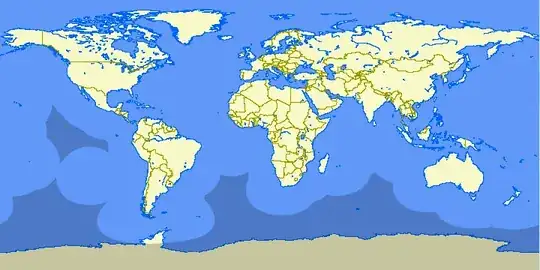

757 180 Minute ETOPS map

reirab
  • 13,358
  • 2
  • 54
  • 92
5

Different airlines will estimate different times based on their own data. As such, it is reasonable to expect a few minutes variation from one airline to the next.

Large variations between flights at significantly different times of the day can also occur (even for the same airline). This is often due to the congestion of planes at peak times of day. I recall an article (that I can't find at the moment) that noted one airline had more than an hour of extra time for a particular route that arrived at a very busy airport. The same route earlier in the day didn't need the extra buffer.

For the example you illustrated, the flights nearly overlap. However, the Delta flight leaves at 7:00 (a peak traffic time). It could easily be that the Delta flight is anticipating sitting in "heavy traffic" waiting to take off. Since departure times are based on the time leaving the gate and entering the queue to take off, this causes a longer flight.

Likewise, 7:00 AM might be a higher traffic time than 8:00 AM for the arrival airport.

Andrew Ferrier
  • 12,368
  • 10
  • 61
  • 98
Elros
  • 231
  • 1
  • 6
  • It's really not that unusual for a flight at a busy airport to have at least close to an hour buffer built in. On Delta's flights between Nashville and Atlanta, for instance, it's not uncommon for them to have 1:10 - 1:20 scheduled when the flight itself takes only 35 minutes. Most of that is just anticipating taxi time and waiting for a departure runway in Atlanta or, when going the other direction, taxi time and waiting to park at the gate in Atlanta. – reirab Sep 12 '14 at 14:32
2

I have observed within Europe, that some airlines tend to overestimate the duration that their flights take, for flights of 2:30 duration of around 10-12 minutes. This way, even if there's unexpected delay, the plane will still arrive on time.

A pilot once told me that this has behavioral reasons. People don't mind being a bit late, but being a bit later than expected, that's the worst!

Whether Delta does that, and to what extend they do this with long-distance flights, I am unaware of.

FooBar
  • 481
  • 1
  • 4
  • 13