20

The US passport includes a field called "Nationality". If you search for a sample image online, it reads "UNITED STATES OF AMERICA" (example). Could it ever be anything else? On a side note, if it's always the same, why is it mentioned? I would appreciate any sources. Thank you.

Edit: Thank you everybody. My main question is, can Nationality on a US passport state anything other than "UNITED STATES OF AMERICA" (the "why" around putting nationality there is a tangent). The suggested answer does not address it.

Alex
  • 309
  • 2
  • 5
  • 1
    Yeah, this is just one of those weird things about passports. When they started putting this item in the data page, it was preprinted along with the form labels rather than by the printer that added the individualized data. I don't know when that changed. – phoog Feb 21 '23 at 20:24
  • 6
    Does this answer your question? What is the difference between "Country of Issue" and "Country of Citizenship" of a passport? The question is at least very closely related and one of the answers claim that some citizens of American Samoa can get passport issued by the USA without being US citizens. – Tor-Einar Jarnbjo Feb 21 '23 at 20:31
  • 5
    @Tor-EinarJarnbjo Apparently people who are "non-citizen nationals" of the US due to their connection with American Samoa get a passport with a note inside it, not a change on the bio page. – mlc Feb 22 '23 at 04:03
  • 2
    @Tor-EinarJarnbjo A non-citizen US national is very close to a US citizen. The biggest difference is they cannot vote for president, which they can't anyway if they are a resident of a territory (they vote for territorial governor instead). They have the right to live and work in a state, and if they do, after 3 months they can convert to full citizenship. It only applies to American Samoa because nationals of other inhabited territories (PR, CNMI, Guam, USVI) were auto converted to citizenship at some point. – user71659 Feb 22 '23 at 18:41
  • @phoog - that's wrong. In many countries (notably the UK) there are different "types" of nationalities. Hence the field. – Fattie Feb 23 '23 at 18:22
  • @Fattie What other countries do that? – Azor Ahai -him- Feb 24 '23 at 03:35
  • Disappointed that none of the existing answers address some edge cases. (1) Foreign nationals serving in U.S. armed forces. (2) Citizens of the Compact of Free Association before their countries issued their own passports. (3) Citizens of COFA residing in the U.S. (I don't have answers, just possibilities.) – DrSheldon Feb 25 '23 at 06:38

5 Answers5

36

Passports all have that field. It enables officers to flip to the picture page and get every piece of information they want in a consistent format. (Plus the various machines that scan passports at checkin and the thing they slide your passport through that reads the characters at the bottom of the page.) All the Canadian passports say CANADIAN in them (plus CANADIENNE). (To see an example, expand the Canadian Passport section of this government page about ID.) If it wasn't there, because it's obviously whoever issued the passport, then the officer would have to look elsewhere (eg the front cover) to see who issued the passport, and machine-scanning would be harder too.

Bottom line: while it's the same for all US passports, it's not the same for all passports the people who look at passports see every day.

Kate Gregory
  • 80,213
  • 14
  • 232
  • 333
  • 1
    Thank you. The Canadian passport also includes the "Issuing Country" ("CAN") as well as the "Issuing Authority" (city, which may be outside of Canada). On a US passport, those are "Code" ("USA") and "Authority". Those two fields determine who issued the passport. So, what would the role of Nationality be then, as it appears redundant? – Alex Feb 21 '23 at 19:30
  • 4
    My Issuing Authority says "Whitby". Do you think the immigration officer in Fiji or Singapore knows that is a city in Canada, especially since there's a Whitby in the UK? – Kate Gregory Feb 21 '23 at 19:32
  • 7
    @Alex: A passport is not the only kind of travel document. For example, a Refugee Travel Document could be issued by a country, but the holder would not have the nationality of that country. – Greg Hewgill Feb 21 '23 at 19:32
  • @KateGregory I thought "CAN" code denotes the passport/citizenship as Canadian. – Alex Feb 21 '23 at 19:35
  • 18
    @Alex: There are also special cases of nationality, such as British Overseas National who would hold a passport issued by the UK but not be British citizens. – Greg Hewgill Feb 21 '23 at 19:35
  • While CAN means it was issued by Canada, it is a code that has to be looked up. So having it clearly spelled out in a consistent location for all passports (and perhaps other documents too that I haven't seen) has value. It only feels redundant to you if you consider subsets like "US passports" or "Canadian passports" – Kate Gregory Feb 21 '23 at 19:38
  • @GregHewgill not all information in the visual inspection zone is in the machine readable zone. Nationality certainly is, however. – phoog Feb 21 '23 at 20:27
  • Your passport also has a digital copy of your passport picture stored in its chip. This can be picked up by RFID scanners. Specialized licensed software can even read it using your phone... facial recognition systems use this picture to score your actual face, and to link alternate travel documents together. – Nelson Feb 22 '23 at 06:34
35

On a side note, if it's always the same, why is it mentioned?

Some countries have different classes of citizenship, largely due to their colonial history. For example, a British citizen would hold a British passport (code GBR) with nationality as "BRITISH CITIZEN".

A citizen of Bermuda, for example, would hold a British Passport, that has the same cover with the words "Government of Bermuda" on the front. Inside, it would have code GBR but nationality as "BRITISH OVERSEAS TERRITORIES".

As a British Overseas Territories citizen, they would be entitled British consular assistance, but would not have permission to reside or work in the UK. That person would also hold Bermudan residency status, to enable them to live and work in Bermuda. If they wanted to move to the British Virgin Islands, they would have to acquire BVI status.

There are other situations like British National (Overseas) status, for those who wanted to retain British status after the handover of Hong Kong to China in 1997. The BN(O) passport has the same cover as the British passport, but again, the "BRITISH NATIONAL (OVERSEAS)" nationality indicates limited rights to reside in the UK.

user71659
  • 3,101
  • 1
  • 16
  • 23
  • 1
    Great points. This Reddit post has examples of British passports with different nationalities. Apparently, an alternate spelling is "BRITISH NATIONAL (OVERSEAS)". There is also "BRITISH SUBJECT". – Alex Feb 22 '23 at 09:32
  • The US also has different classes of nationality. All US citizens are also US nationals, but there are some US nationals who are not US citizens. Those are people born in Commonwealth of the Northern Mariana Islands, Swains Island, and American Samoa . I believe, Filipinos also had this status until the Philippines became independent. – Kevin Keane Feb 25 '23 at 02:19
  • @KevinKeane Yes, but the rights of non-citizen US nationals are close enough to citizens that the US doesn't distinguish them on the biographic page: they have a notation on a back page instead. Unlike the UK, these people can all reside and work in the US. Most CNMI non-citizen nationals were automatically upgraded to citizenship in 1986, unless they specifically opted out, as were Guam and Puerto Rico, and US Virgin Islands non-citizen nationals at points in the past. – user71659 Feb 25 '23 at 07:27
  • @user71659 I disagree. Of course, "close enough" is a matter of opinion. The ACLU considers it a major, and discriminatory, difference. One big difference is that US non-citizen nationals can't vote even if they live in the 50 states and aren't considered citizens from birth (although there is a court case that could change that). Guam, PR, VI, and also Hawaii are a different situation because Congress explicitly, and voluntarily, granted them citizenship. And the Philippines are the opposite example, US nationality was effectively taken away. The PP annotation was only done to save money. – Kevin Keane Mar 16 '23 at 06:45
21

My main question is, can Nationality on a US passport state anything other than "UNITED STATES OF AMERICA"

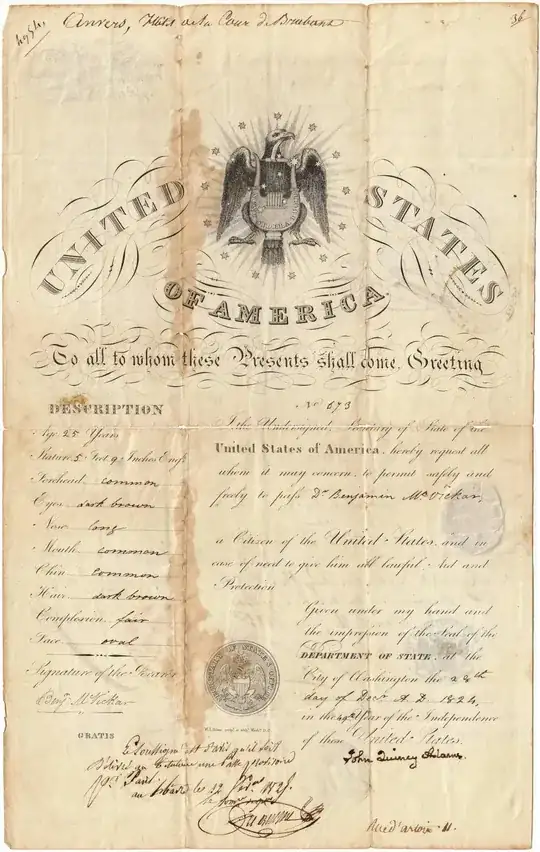
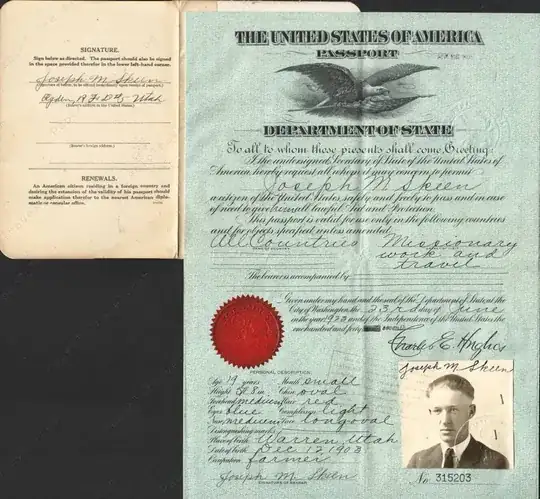
No, since even before the 1856 enacted passport statute, passports issued by the Secretary of State for travel outside the United States, generaly contained the text that the person is a "Citizen of the United States".

The United States Passport: Past, Present, Future - United States. Passport Office (1976) - Google Books

  • PDF page 50:

In 1856 Congress enacted what remains today as the basic passport statute.

This law provided that the Secretary of State be authorized to grant and issue passports, and cause them to be granted and verified in foreign countries by diplomatic and consular officers of the United States under such rules as the President might prescibe. No one else was to issue passports, and they must be issued to none but citizens of the United States.

The Act of 1856 also made it a penal offense for a consular officer to issue a passport to anyone who was not a U.S. citizen.

1824 1923

On a side note, if it's always the same, why is it mentioned?
I would appreciate any sources.

This is due to the norm set out in the 1920 League of Nations Passport Conference ¹, where it contains the wording:

in the event of a passport being issued by a Government to persons other than its nationals.

Until 1914 passports could be issued to non-nationals and sometimes done for residents.

During the 1920's, this praxis was replaced with the general rule that passports should only be issued to nationals (introduction of the 'foreigners passport' in 1922).

Some countries still have different grades of citizenship.

A UK passport can contain British citizen or subject, with the holder being treated differently based on that entry.

¹ the present day ICAO recommendations are based on these norms developed during the 1920's

Mark Johnson
  • 27,184
  • 3
  • 47
  • 109
  • 1
    While this doesn't change the ultimate answer, I would note that, while there were not non-citizen nationals of the U.S. in 1856, there have been for the last several decades at least. 8 USC 1408 defines classes of persons who are nationals of the United States, but not citizens. Nationals of the United States can have U.S. passports, even though they are not citizens. It's still correct that there are no U.S. passports with a nationality other than United States, though. – reirab Feb 24 '23 at 22:38
  • 1
    Non-citizen nationals of the U.S. are mostly people who live in "outlying possessions" of the United States, which include American Samoa and Swains Island. If I remember correctly, one or more of Micronesia, Palau, and the Marshall Islands also used to be outlying possessions of the U.S., but all 3 are now independent countries in compacts of free association with the U.S. – reirab Feb 24 '23 at 22:42
9

There are travel documents resembling passports for people who do not have a nationality, or are "stateless".

An example from Germany can be found here.

The document format and page layout resemble a passport. The cover page contains the logo "BUNDESREPUBLIK DEUTSCHLAND" with the Eagle icon. This could potentially be taken for a passport, so that an explicit nationality field (which in this case reads "STAATENLOS GEMÄSS KONVENTION 1954") is helpful to avoid erroneous readings, as Kate mentioned.

  • Furthermore germany also issues travel documents to foreigners if there's some reason to do so (I know someone that is a foreign citizen that lives in germany and has changed their gender marker in Germany, and they were issued a reiseausweis für ausländer), containing their nationality in the nationality field: https://de.wikipedia.org/wiki/Reiseausweis_f%C3%BCr_Ausl%C3%A4nder – ave Feb 22 '23 at 12:36
  • 3
    Similarly the US issues offers "re-entry permits" for permanent residents which can serve as a travel document. – Peter Green Feb 22 '23 at 15:43
  • 1
    Another example (in English): https://en.wikipedia.org/wiki/Refugee_travel_document#/media/File:Australian_Titres_de_Voyage_Bio-data_Page.jpg – littleadv Feb 24 '23 at 06:09
  • It won't let me edit the typo because it's only one character – perhaps you can do it yourself: It's "GEMÄSS" with an 'E'. – joriki Feb 24 '23 at 07:14
  • 1
    @joriki Thanks, corrected. I don't quite understand the "no short edits" rule. I mean, I understand the rule, but not its reason ;-). – Peter - Reinstate Monica Feb 24 '23 at 07:54
  • @littleadv Interesting! All documents in the gallery at the bottom of this Wikipedia page have two diagonal stripes in the top left corner, distinguishing it clearly from a passport. That page actually refers to similar, but distinct documents for refugees (who are not necessarily stateless) according to a 1951 convention. – Peter - Reinstate Monica Feb 24 '23 at 08:06
  • @Peter-ReinstateMonica notice the document type at the first position of the MRZ: it's "P". – littleadv Feb 24 '23 at 08:09
  • @littleadv And in the German stateless document it is "PT". That's interesting because in the machine readable passport format specification, the first field is the document type. "Capital letter P to designate an MRP. One additional capital letter may be used, in the character position after the letter P and at the discretion of the issuing State or organization, to designate other types of passports such as MRP issued to diplomatic staff [...], or a passport issued for a special purpose." – Peter - Reinstate Monica Feb 24 '23 at 08:26
-1

No, the nationality field on a United States passport can only be "UNITED STATES OF AMERICA." This is because a passport is an official document issued by a country to its citizens, and it is used to verify their identity and citizenship when traveling internationally.

The purpose of the nationality field on a passport is to indicate the issuing country of the passport. In the case of a United States passport, the nationality field indicates that the passport is issued by the United States government to a citizen of the United States.

Sources:

U.S. Department of State, "What is a Passport?" https://travel.state.gov/content/travel/en/passports/what-is-a-passport.html U.S. Department of State, "U.S. Passport Card FAQs" https://travel.state.gov/content/travel/en/passports/how-apply/cards.html#1 I hope this helps answer your question!

  • 3
    Both of your links recieve a 404 - Page Not Found error. – Mark Johnson Feb 24 '23 at 04:09
  • 4
    Also, the first part of statement two is false, as user71659 outlines above. – MadHatter Feb 24 '23 at 06:59
  • As noted elsewhere, there are non-citizen US nationals who will also be issued US passports. These passports have the same nationality field, because Department of State decided that printing separate passports for such a small number of people would be too expensive. They do carry an endorsement that the bearer is a US national but not a US citizen. – Kevin Keane Feb 25 '23 at 02:31