0

I wish to exchange 300,000 Lao Kip to Thai Baht.

How to calculate this?

For example according to Google the exchange rate is 0.0020

300,000 * 0.0020 == 600

Also according to Google 300,000 Laotian Kip equals 586.01 Thai Baht, not 600.

So, how to calculate?

Toto
  • 13
  • 2
  • 1
    I think the .0020 number might be just rounded up from .00195 – hojusaram Jan 23 '23 at 05:53
  • Keep in mind that the ACTUAL rate that you will see will depend A LOT on the exact way the exchange is done. A bank or money exchanger will often give you rate that's much worse than the official rate and add fees and charges on top of this as well. The difference here can be very BIG. – Hilmar Jan 23 '23 at 14:03
  • At the present moment Google tells me that 1 kip = 0.0019 baht, and 300000 kip = 584.44 baht - so it seems that the rate Google presents is rounded, and seems to be fluctuating around 0.00195. (For mental arithmetic purposes - if you're spending baht but are used to thinking in kip, or vice versa - you can probably figure that 1000 kip = 2 baht.) – Michael Lugo Jan 24 '23 at 16:45
  • @MichaelLugo 0.0019481333 = 584.44/300000 – Mark Johnson Jan 24 '23 at 17:03

1 Answers1

2

As meantioned, the shown rate may be rounded.

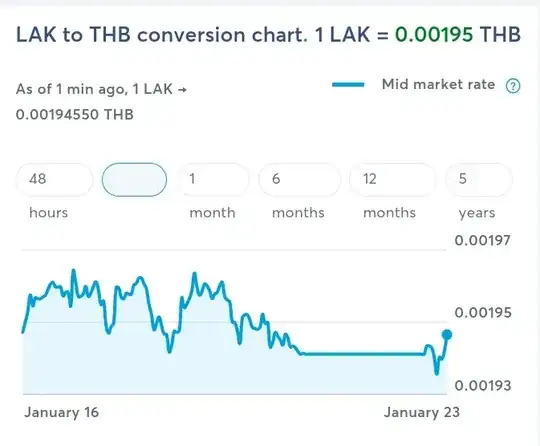
In the sample below, the shown rate is

1.00000 LAK = 0.00195THB

  • Mid-market exchange rate at 06:13 UTC

but if you do a reverse calculation, you will see that 0.0019455 was actually used.

So the shown rate was rounded (or an average from different sources ; or an average of rate fluctuation).

Using a site that shows a rate chart (Track the exchange rate), helps to see the exact rate and possible fluctuations of the previous days.

Laotian Kip to Thai Baht Exchange Rate. Convert LAK/THB - Wise

  • 300000 LAK = 583.65 THB:
    • 0.0019455=583.65/300000 [reversed calculation]
      • 583.65=300000*0.0019455 [original calculation]
  • 585.00=300000*0.0019500 [false result]
    • should return 583.65

Mark Johnson
  • 27,184
  • 3
  • 47
  • 109
  • 3
    It’s also worth noting that when one des the actual conversion, the rate applied will always be slightly worse due to the commission taken by whoever performs the conversion. That’s the reason there are nearly always different “buy” and “sell” rates. – jcaron Jan 23 '23 at 08:05
  • I am sorry, I don't speak English as a native language, what is reverse calculation in that regard? – Toto Jan 23 '23 at 08:51
  • @Toto The opposite of the original calculation (added the terms in the answer). In this case the result of the reversed (0.0019455) calculation must be the same as the value used in the original calculation. With rounded numbers, the result would be different. – Mark Johnson Jan 23 '23 at 09:07
  • @jcaron: "slightly" is possibly misleading here. Depending on the currencies the difference between the buy and sell rate can be dramatic. I have seen a ratio of more than 10 (Argentinian Peso in Uruguay) !! In addition whoever executes the exchange will tag on fees on surcharges. When I got into Brasil recently, all ATMs at the airport were down so I had to exchange cash at 30% below the market price. – Hilmar Jan 23 '23 at 14:08
  • @Himar what does "a ratio of more than ten" mean? Since the market rate for exchanging X to Y is the multiplicative inverse of the market rate for exchanging Y to X, you would expect a ratio of more than 10 if one currency were worth roughly 3.16 of the other, which was in fact the case around the middle of last year for the Argentine and Uruguayan pesos. – phoog Jan 23 '23 at 21:22