58

We are planning to travel to Scotland from Manchester and after looking at the prices for both flights and trains. It's cheaper to fly there than taking a train. I've also noticed the same thing when comparing flights and train prices from London to Manchester.

Why are train tickets so expensive?

For example, on the 6th of February, 2019 a return ticket from Manchester to Aberdeen for 23-24 March costs £133.30.

OFF-PEAK RETURN
Any off-peak train. Return within 1 month.
1 Adult @ £133.30

Flights between Manchester and Aberdeen today for that weekend vary between £30-£66. Flying is also faster including check-in times.

l0b0
  • 1,527
  • 1
  • 10
  • 10
Mcload
  • 1,418
  • 2
  • 11
  • 22
  • 12
    Between airports there is no infrastructure to build and/or maintain. – Weather Vane Feb 06 '19 at 16:23
  • 12
    But airplanes are much more expensive, and you can use the infrastructure for short travels and freight too. – Mcload Feb 06 '19 at 16:31
  • Just looked on google flights, I couldn't get much cheaper. What prices are you seeing for flights? – Philbo Feb 06 '19 at 16:32
  • For it to be a fair comparison you’d have to look at flexible flights surely? And include the cost of travel to/from the airport? Aberdeen airport is about 9 miles outside the city, I believe. Rail fares with fixed departure/return are cheaper than flexible fares if purchased in advance. To compare journey times you’d also need to factor in the time taken to get to/from the airport to the city centre – Traveller Feb 06 '19 at 16:35
  • 17
    @Mcload it's the other way round: British railways were built for freight and passenger services were the icing on the cake. In the days when most freight was moved by rail, it was known that a passenger service could not be run for profit without freight to pay for the infrastructure. Now, that infrastructure is hugely expensive to maintain. – Weather Vane Feb 06 '19 at 16:38
  • 2
    @Traveller I checked and the off peak open return is actually cheapest. But I've put both in (thetrainline for train and google flights for air) and they come out to roughly £130 and £120 respectively. If the OP can get himself an 18-25 or 26-30 railcard (and does this journey more than once a year), they'll probably come out best using rail. – Philbo Feb 06 '19 at 16:42
  • Supply and demand. That's really all there is to it. –  Feb 06 '19 at 17:13
  • Thinking on the demand side (ie. who is paying more for train ticket), train stations are often in the city center whereas airports are on the outskirts of town. It is often easier/cheaper to get to (and from) a train station than it is to get to an airport. From a cursory look at google maps of Manchester and Aberdeen, it appears they hold to that trend. – Dean MacGregor Feb 06 '19 at 20:04
  • 4
    I'm not a UK train ticketing expert, but I believe you should be looking at a different train ticket. Departing 6 Feb and returning on 23 Mar is more than the Return within 1 month quoted in your OP. I'd think your return ticket won't be valid. – FreeMan Feb 06 '19 at 20:42
  • It's the same in Australia, Flight is cheaper than train – Nigel Fds Feb 06 '19 at 22:54
  • 2
    @FreeMan I think 6 Feb is the date of the enquiry, for travel on 23-24 March – AakashM Feb 07 '19 at 09:39
  • 1
    The 30-66 airplane ticket price does not include city-to-airport and back travel, right? – ypercubeᵀᴹ Feb 07 '19 at 10:31
  • @AakashM that makes sense. – FreeMan Feb 07 '19 at 12:58
  • 1
    One facinating detail is the access to aviation fuel without VAT. Unfortunatly I am not an expert in the issue but I know it is a factor. – Thomas Koelle Feb 07 '19 at 14:31
  • May be true, but you also need to get to and fro the airport and that usually costs a bus or train ticket also. – mathreadler Feb 08 '19 at 08:35
  • @ThomasKoelle There's a number of separate duties for air travel. Something similar happens in the US, scheduled airlines don't pay fuel tax and pay a excise tax on the fare instead. Ultimately, the total amount of tax matters more than the exact mechanism. – user71659 Feb 08 '19 at 20:48

10 Answers10

74

UK train tickets are among the most expensive in Europe; this image below from The Telegraph is quoted a lot of times in the press and on social media trying to show the disparity with other European countries for:
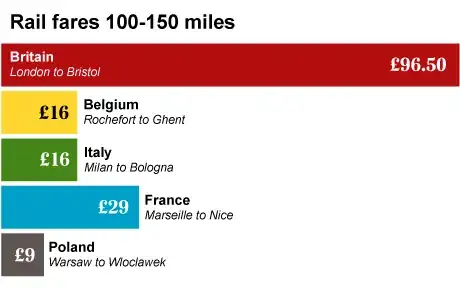
Train fares in Britain

While it does include a lot of cherry-picking, and doesn't really address why train fares are so expensive (which is still up to debate both by politicians and the general public), it does show that high rail prices are something that you can expect in the UK. Also prices are usually increasing each year as well usually with higher rates than inflation.

Air travel in comparison, especially on low cost airlines is still cheap, it's much more common that low and ultra-low-cost airlines like RyanAir or WizzAir will try to charge you on the extras instead of the plain ticket prices. Also don't forget that although the rail system in the UK is privatised there's not really many competition between the rail companies, as each of them only serves part of the country - there's only a handful routes where you actually have the option to pick between multiple train companies - meaning there's also less of a competition between them to decrease prices. Flight companies however do operate on the same route - meaning there's more competition between them that can affect their prices.

However there are some ways you might be able to get cheaper rail fares.

Use routes that are served by one specific train company

Railway in the UK is privatised and there are multiple train companies operating in the country on a franchise basis. Some companies are only providing train travel on a small part of the country, but some others like Virgin, LNER or CrossCountry operate long-distance trains as well.

When checking routes if you are lucky enough that your trip is served by only one company, then you might be lucky, as they usually have advance tickets for sale. However if the route is served by multiple companies (as you have to switch trains at some point) the price will be dependent whether both of the sections have a cheaper advance ticket, or not.

For example a trip from London to Aberdeen would only include travel on LNER trains - meaning LNER alone could give you a bargain price on an advance off-peak single ticket. However a trip from Manchester to Aberdeen includes multiple companies - likely the Transpennine Express from Manchester to Glasgow, then either CrossCountry or ScotRail to Aberdeen.

It's possible in this case that only the section from Manchester to Glasgow is on sale, or only the section from Glasgow to Aberdeen is on sale. It's also possible that there's a cheaper ticket if you wait a few hours in Glasgow - but these options will not show up on a normal booking page, only the more expensive fare. However some sites like trainsplit.com does search differently, and will allow you to buy separate tickets for the separate legs potentially driving costs down even more.

Also note that although you can book tickets on any train company's website (even for routes that are not served by them) when you have a "single company route" booking on that particular company's website might also get you some extra benefits. For example there's free wifi on LNER trains if you book the ticket on the LNER site, otherwise it's around £3

Book in advance

Also book off-peak or super-off-peak tickets, and book non-refundable tickets that are only valid to one specific train. Similarly to plane tickets the more flexible they are the more expensive they get. Also similarly to them the prices of advance rail tickets might also go both up and down, so it might not always be worth booking too far in advance.

Advance tickets might not always be available - some train companies don't sell them for example at all, as they only have plain peak and off-peak tickets. This can be relevant on routes which are only served by changing trains and train companies.

If there are advanced tickets, for both the outward and return journey then they can be cheaper than an anytime return ticket.

Use railcards

Railcards will give you 1/3 off the price of off-peak tickets. For long distances if you travel with someone a two-together railcard might sometimes make the trip cheaper than the cost of the railcard itself (£30, and you can use the railcard for subsequent travels in the year as well).

If you're travelling alone or in a group you might be able to find other railcards that can help you drive the cost down, especially if you're either a Senior, or younger than 30 years old.

Don't forget that air travel is usually not that simple

Because:

  • Airports are usually not centrally located, and the transfer from the airport to the city can easily add a lot to the cost of the ticket. Trains usually depart and arrive to the city centre. The transfer ticket from the airport to the city can easily get into the £10-£20 range in some locations, especially London.

  • Usually only small cabin bags are included in the air fare (and in case of RyanAir they are now only allowing really-really small bags without paying extra). Any additional bags need to be bought separately - which can add to the total cost of your trip. Also no liquids in bottles measuring more than 100ml, unless you pay extra for putting your bags in the hold. On trains both the baggage allowance and what you can bring onboard is much more relaxed.

  • The transfer, check-in, security and baggage reclaim can actually take a substantial time, which might easily eat away a lot of the time gained by the shorter fare time.

Personal

I usually do the Edinburgh-London trip, and usually I have a choice between using an LNER train to London or by finding some cheap tickets from Edinburgh Airport to London Stansted.

I can usually find train tickets in the £60-£120 price range each way, while air fares are usually between £20-£100. When I can find something in the £20-40 range I usually opt for that, but above it, the extra hassle with baggage (£10-£15), airport transfer (£10-£20) and security means I am usually better off with a £80-£100 train ticket.

Time wise they are also comparable: although the plane flight only takes an hour, I also have to get to and from the airport which can take up to an hour in both Edinburgh and London, and there's still check-in, security, and baggage reclaim, which can easily add to a total of 4 hours, which is almost the same as the the 4.5 hours trip for the train - and on the train there's at least free wifi.

And both of them are usually delayed as well.

SztupY
  • 3,245
  • 3
  • 21
  • 32
  • 25
    -1 \ Cherry picking of results for the first graphic. I frequently get a train between Cambridge and Liskeard (Cornwall) for £20--£25. This is 300 miles each way. So we're looking at around 80p/mile, making it potentially the cheaper than all the others on the graphics: half that of Belgium and Italy; a quarter that of France. \ Of course, I have also cherry picked a certain train. – Sam OT Feb 06 '19 at 20:16
  • Comments are not for extended discussion; this conversation has been moved to chat. – JonathanReez Feb 08 '19 at 17:31
58

Your £133 train ticket isn't tied to a specific connection like your cheap plane ticket is. For some random dates in April I was offered a return for £52 (two singles at £25 and £27 each). These tickets are sold out for your dates, so you're only offered the more expensive semi-flexible tickets.

Always keep in mind the varying conditions when comparing prices.

StrangerToKindness
  • 1,521
  • 10
  • 16
  • 8
    Also with flying, baggage is not included, but on the train, you can take as much as you want. – Robin Salih Feb 07 '19 at 11:54
  • There is no quota available for standard class Advance tickets, but using the Hull Trains site to find fares shows there are first class fares available from £44+62=£106. It is unusual for all quota to be unavailable this far in advance, but maybe there is a football match or similar on, and hence the trains are busy. – user1908704 Feb 07 '19 at 20:22
  • 4
    @RobinSalih legally for the train company I use, there is a limit of one suitcase, one backpack and one briefcase. However, I’ve taken more and never been questioned. – Tim Feb 07 '19 at 21:50
  • 2
    @Tim On most short flights these days, a haul like that would require paying some significant fees for economy passengers. But I get your point. – StrangerToKindness Feb 08 '19 at 10:56
26

It's not usually cheaper to fly. But since UK rail ticketing is ridiculously complicated, it is often difficult to find the cheapest option.

In theory, there are 40 different advance fares in second class between Manchester Picadilly and Aberdeen, as you can see through brfares.com, varying in price from £20.50 to £89.50, with each of those advanced fares having its own specific conditions — but most of those will have few or none tickets available, perhaps only for the most unattractive times long in advance. There are three types of single and four types of returns, again with their own conditions. And then you can split your journey. One way to search for splits is via trainsplit.com, which for those dates finds a combination of 5 singles (2 Off-Peak Single and 3 Advance) totalling £100.40, saving £32.90 on the cheapest Off-Peak Return (trainsplit.com (no affiliation) takes a small share of the savings if you book through them). As a bonus, it turns out the cheapest option on the way back is actually in first class. You may be able to manually find even better combinations. I used to travel every fortnight between Reading and Lancaster, and usually I bought seven singles: one off-peak, five advance, and one special evening-only midlands fare.

You may end up spending more time booking than travelling, but with the UK railway ticketing system it usually pays off to shop around and game the system, in particular for long journeys. Anybody who knows their way around, will never buy a single Reading to Birmingham: splitting in Banbury is always cheaper. Ridiculous? Certainly. Permitted? Yes. Downsides? More effort in booking, and in theory, you may be at a disadvantage if you miss connections, if you bought separate tickets. In practice, I've always been allowed on later connections, including Virgin Trains paying for a middle of the night taxi from Banbury to Reading when I missed the final train home, despite having a split of four tickets for my journey south. Only my bike reservation has been an issue a couple of times, requiring some extra work when I missed a connection to a train with mandatory bike reservations, but it was always resolved by train or platform staff.


Edit: Of course, airline ticketing is also very complicated, but for air travel, most travellers are used to shopping around for the cheapest option, rather than turning up at the airport at 08:00 and buying a flexible fare to their destination.

gerrit
  • 56,864
  • 19
  • 169
  • 332
  • 3
    +1 What and inspiring answer, I am glad you have posted it, as it shows alternatives to get a cheaper train ticket – Marcello Miorelli Feb 07 '19 at 20:07
  • 1
    Air ticketing is also quite complicated. Excluding low cost carriers, there are 151 public fares published for travel between these two cities. – Calchas Feb 09 '19 at 12:20
  • 1
    @Calchas True, but tools to find cheapest air tickets are more widely known and available than for trains. Few would expect to turn up at the airport and buy a ticket on the day, yet many do exactly that for trains. And although airline ticketing is complicated in most of the world, many countries have much simpler railway ticketing systems than Great Britain. – gerrit Feb 09 '19 at 14:59
19

One of the big differences between UK and EU rail pricing, is that the UK uses the supply and demand and Willingness To Pay (WTP) pricing model similar to that used by airlines, while many EU train services use a much simpler €/km pricing model.

This way, in the UK you get odd things like a short rail journey costing (say) £9.40 single and just £9.60 return; and you get outlandishly high fares for last minute travel on the next train, but reasonably good discounts if you plan your journey weeks in advance and pay for a specific off-peak departure (bit like an airline in that respect).

As for air travel, passengers across Europe have become accustomed to the business model of low-cost airlines, and have the expectation of being able to fly many hundreds of km for next to no money, so long as they are prepared put up with all the rules and regulations of the airlines and the airports. See for example: this story from early 2016

Nick
  • 206
  • 1
  • 2
  • 2
    Source for that EU uses €/km? Certainly in France, Germany, Spain, and Sweden, if you buy a long-distance train ticket on the day you pay a lot more than if you buy well in advance. – gerrit Feb 07 '19 at 09:03
  • BTW, there are "ryanair style" train companies in Europe too. For example, check out Flixtrain and the very bad reviews they get. – gerrit Feb 07 '19 at 09:18
  • 1
    @gerrit "Source for that EU uses €/km?" One could try to find out empirically. I looked at basically the same train going from Hamburg to Basel on 1st of March starting at 10:20 am and recorded distance (via google maps) and normal price for some stops. (Hamburg - Hannover (131km, 49€), - Kassel (256km, 86€), - Frankfurt (397km, 128€), - Mannheim (468km, 132€), - Basel (684km, 160€)) which is almost perfectly linear up to 400km distance and above kind of increasing more slowly. – NoDataDumpNoContribution Feb 07 '19 at 15:56
  • @Trilarion You must have not looked at Sparpreis, which many people would book at such distances, just like the Advance tickets in the UK. In this case, you should also test the regular Off-Peak prices from Aberdeen to increasingly distant cities in the UK, for a fair comparison. – gerrit Feb 07 '19 at 16:53
  • @Gerrit My source is personal experience travelling in various EU countries by train over the last 30 years. On recent travels in Netherlands and Germany, I specifically noticed that the return fare was exactly double the single fare, and there did not appear to be cheaper fares available if wanting to travel at some future date. However, most of my recent travel has been short distances. I have also seen in France on at least two occasions (admittedly, long ago) that the price was so much per km and that was actually printed on my ticket. – Nick Feb 07 '19 at 16:57
  • @Nick Willingness to pay? It is more "no sensible alternative" to the train. - And while many people hold the stupid believe that driving is, it is not. From the ecological idiocy of moving a 1-2 ton vehicle for a single person to the gridlock in cities twice a day - to the state of roads, the cost of fuel as well as the (in the UK) ridiculous cost of insurance... - "Damned if you do, damned if you don't." - If you want to work/study etc. you need to get from A to B and effectively have no alternative... – DetlevCM Feb 07 '19 at 20:34
  • @Gerrit Yes, one would need to do quite a number of price comparisons to be able to reverse engineer the price algorithms with sufficient statistical certainty. I will probably not be the one who does it, although it sounds interesting. – NoDataDumpNoContribution Feb 07 '19 at 22:12
  • The fixed prices of train travel in Europe have mostly disappeared over the last 10 to 15 years. In Germany, especially with the competition by long distance bus lines, and low budget airlines. The kilometer prices still exist, but are really expensive, for last minute purchase and "stupid" old people, while a cheap offer is a fraction of it. Train prices in Germany are quite similar to what is given here for UK. – Erik Hart Feb 08 '19 at 00:14
  • @ErikHart As I've commented elsewhere, train prices between UK and other countries are similar for (well-planned) incidental travel... but UK is much more expensive for commuters, A season ticket Gelnhausen–Frankfurt (46 km) is €185,90/month, whereas Maidenhead–London (48 km) is £306.10/month, roughly double per km. – gerrit Feb 08 '19 at 08:40
4

While this question is for UK, similar effects occur in continental European countries: low budget airlines appear very cheap, while regular rail service is way more expensive.

I think it has multiple causes:

1. Infrastructure costs

Airlines have much lower maintenance costs for infrastructure. When it comes to building new lines, for rail it's almost impossible, has astronomical costs and takes decades for political and legal struggles, especially when eminent domain is needed. Also, many low budget airlines utilize formerly disused, military airfields from the cold war era, and airports in remote regions. Sometimes with deceptive advertising, which names an airport, 80 kilometers away, or 1 hour to drive, after a major city.

2. Tax advantages, wage undercutting, subsidies

Aircraft fuel has a much lower tax, or no tax at all on it, compared to other goods, and especially fuels for motorized vehicles. In some cases, remote airfields receive heavy subsidies, pushing their charges to airlines below the actual costs. And while many railway companies, especially where privatization hasn't gone as far as in UK, have to pay wages negotiated with unions, budget airlines can undercut them. Looks good for passengers first, but comes back to them in the long term.

3. Cheap opportunities make regular prices higher

As transportation companies make really cheap offers under certain conditions, they must increase prices for regular tickets. This happens especially, where railway companies come under pressure by bus lines and budget airlines. The cheap offers are often planned ahead, with a fixed binding to a certain ride, while the expensive ticket can be purchased in the last moment, and be used in any train.

4. Ripoff

Not to forget: Budget airlines try everything to make passengers pay more afterwards. Monstrous extra charges if bags are overweight, a 70€ "penalty" if a bank card payment fails, try to foist useless insurances during booking, make people pay even for payment, except when they take a very special credit card sold by the airline. Cheap airlines aren't really cheap; it takes a lot of struggle to actually complete a trip with a 10 or 20€ flight.

Erik Hart
  • 141
  • 1
3

The context of this answer is withon the UK. However, in your sample city-pair, flight already exists between them, and you are effectively asking "why can't trains keep up?" The answer is not everything serves everywhere well, however it is much easier for trains to add a stop, so they do better most places. Just this city-pair is a bit of a "ringer". Part of the cost here is in the circuitous rail route needed here.

Keep in mind rail was built to pre-existing British cities, then additional cities popped up around the rail. So rail has an advantage most of the time.

In general, though... (Still topical to UK)

Everybody likes nonstops. Partly, the price reflects the number of seat changes, and concomitant waits. Because those break your workflow/experience. Consider train, 3 seat changes with a luscious uninterrupted 4.5hr to focus on your choice of activity:

  • seat: local transit to train station
  • seat: on train
  • seat: local transit to destination

Versus airline, a hot mess of seat changes and required tasks, all short segments, none longer than an hour.

  • seat: local transit to train station
  • seat: airport connector
  • "seat": queue for airport security, take shoes off, laptop in tray, all that jazz
  • seat: in airport waiting hall
  • seat: in actual airplane
  • "seat": at baggage claim, what fun
  • seat: airport connector
  • seat: local transit to destination

Look at all the buzz. Always active, always doing something, another task you're obliged to do to keep your journey moving, it's hours and hours of "hurry up and wait".

Now maybe you are happy for the task list, if so, there's your choice. But obviously a lot of people think different, because the train is able to command those prices. It's free market, on a 400 seat train, prices are set by the 400th highest bidder.

Harper - Reinstate Monica
  • 35,577
  • 4
  • 65
  • 144
  • 1
    I don’t think the changes thing really holds up - at best you’re overstating it. The route OP highlights in the question has direct flights but requires at least one and sometimes multiple changes going by train, and it’s generally true (at least in my experience) that trains are much more likely to involve connections then air travel over a comparable distance. Your list for air travel includes time in airport waiting rooms, but the train list excludes time at the station waiting for your train. – Chris H Feb 06 '19 at 20:38
  • 2
    @ChrisH because trains go to many more city-pairs, and can get you much closer if you change. If you limit to air-served cities, probably 1-train direct. No wait for the train because you don't need to show up at the train station 2 hours early on the off chance that security screening is backed up. Show up 10 minutes prior and walk right onto the train. Anyway, every airgate has enough seats for any planethat docks there. Train stations simply don't have acres of space like that, trains are huge. – Harper - Reinstate Monica Feb 06 '19 at 20:50
  • 1
    The example in the question is literally between air-served cities and requires 2 or 3 trains. Can’t begin to fathom how you think that train stations not having acres of space means nobody spends a meaningful length of time waiting between connections, that just seems to be an argument that you might not be able to find a seat while doing so (tbf, not being able to find a seat is exactly the experience I had for a large part of the two hours I spent waiting at Berlin Hbf this weekend, though I’m struggling to see how this is a benefit) – Chris H Feb 06 '19 at 21:13
  • 3
    I just ... feel like that particular one is an outlier, though. Maybe even a ringer... like OP chose it because there is air service (which may be a matter of subsidies), and then is asking the train to "catch up". Which isn't a fair comparison, because for every city-pair where air works out, rail can give 10 others where the tables are turned. – Harper - Reinstate Monica Feb 06 '19 at 22:26
  • 2
    I've downvoted this answer. Travelling by train usually requires more changes than by air. London to Berlin? At least three trains, possibly more, but most flights will be direct. Bristol to Belfast? Direct flights, but will need many trains. Don't get me wrong, I will take the train when I reasonably can, and missing a connecting train in a densely trafficked country isn't nearly as bad as missing a (connecting) flight, but among the many advantages of the train, "less changes" is not usually one of them. And even if it were, I would question how it explains the price difference. – gerrit Feb 07 '19 at 11:49
  • Yes, there exist more city pairs with direct trains than flight pairs with direct flights, but this is because there are far more train stations than airports, and most trains have many stops, whereas most flights have exactly two stops. – gerrit Feb 07 '19 at 11:52
  • @gerrit I'll be quite impressed if you find a way to get from Bristol to Belfast by train, changes or not ;) – Chris H Feb 07 '19 at 13:56
  • 1
    @ChrisH They sell train tickets, so you might tell that to the operators ;-) I also have a hand-written CIV ticket from Dublin to Reading, that the ticket gate operator in Reading was staring at for the best part of a minute before deciding it was a real train ticket. I kept it as a souvenir, although this one does say TICÉAD TRAENEACH - LOINGE so they admit it's not only by train. – gerrit Feb 07 '19 at 14:05
  • 1
    @gerrit and when you have to change by air, it sucks. Whereas I have seen so much of many cities simply because I had a rail layover for a couple hours. Even downtown Denver and I didn'teven change trains there! Yes, you are right about the city pair thing and why... That's my point and it's fair. Speaking of fair, the context of this question is within the UK. When someone expects an answer to hold up out of context, it makes me think they are being contrary. – Harper - Reinstate Monica Feb 07 '19 at 17:41
  • @Harper I agree that changing trains may be quite nice (although not all train stations are in nice places). – gerrit Feb 07 '19 at 19:50
  • It's absolutely not a free market and the prices aren't set by the 400th person, for 45% of fares they're set by the regulators. http://researchbriefings.files.parliament.uk/documents/SN01904/SN01904.pdf – pjc50 Feb 08 '19 at 13:37
  • @pjc50 how are they sset for the other 55%? – Harper - Reinstate Monica Feb 08 '19 at 16:27
  • "with a luscious uninterrupted 4.5hr to focus on your choice of activity" are we talking about British trains here? ;) – Calchas Feb 09 '19 at 12:27
1

As already noted, the plane tickets are fixed but the train fare you quoted is flexible. Usually (but not in this case) an advance train fare will be cheaper than flying, especially if there are no changes. The difficulty is finding them

It is certainly possible to make the specific journey in your question for less than the £133 flexible price, if you are prepared to buy individual tickets for the different sectors, which reduces both your time options and routing options. For example the following route via Edinburgh (at the time of answering) available for outbound 23 march, return 24 march

Manchester picadilly - Edinburgh £81.50 off peak return
Advance singles £47.20 combined: 
£27.70 arriving Edinburgh at 11:35 from Manchester (departs 8:26, earlier options are cheaper)
£19.50 leaving Edinburgh at 20:15 for Manchester arrives 23:27

.

Edinburgh - Aberdeen £54.70 off peak return
Advance singles £43.80 combined: 
£18.10 leaving Edinburgh 12:30 (and various other times) for Aberdeen, arrives 14:50
£25.70 arriving Edinburgh 19:35 from Aberdeen (and various later times), departs 17:09 

So you can see that in this case restricting yourself to changing at Edinburgh by buying 2 separate flexible return tickets costs £136.20 (which is in this case slightly more expensive, but on many routes is cheaper.)

There is however some saving to be made for buying separate advance singles on the Edinburgh-Aberdeen leg, and a significant saving on the Manchester - Edinburgh leg. Taking advantage of both of these brings the cost to £47.20 + £43.80 = £91, which is still more expensive than flying, but is city centre to city centre so avoids costs for transfer to the city centre, if that is where you are going. Still not good enough to draw you away from the plane (unless you have a ridiculous amount of luggage.)

Found manually on nationalrail.co.uk , which is quite good if you know where you want to change. Slightly cheaper than the £100.40 fare found by Gerrit and with 4 (direct) tickets instead of 5 so presumably one less change.

Level River St
  • 715
  • 3
  • 11
0

I’d say it could be connected to freight carried by air, which enables the airline to offer lower passenger prices. About 15 years ago I regularly flew with Jet2 between Edinburgh - Manchester for around £30 each way (cheaper than a tank of petrol!). Sometimes the outbound flight on a Sunday was only 20-30% occupied, and I used to wonder how they managed to maintain the route. I found out when Jet2 cancelled it - the freight contract had ended.

Traveller
  • 33,186
  • 3
  • 52
  • 127
  • Why wouldn't the same situation apply to freight trains? – pipe Feb 07 '19 at 09:35
  • @pipe it's practical to do that by air because almost every major airport has both passenger and freight handling capabilities. Not at all true of (UK, perhaps different elsewhere) train stations, so mixed (passenger + freight) rail operation is not a practical option. – Chris H Feb 07 '19 at 09:58
0

Train travel in the UK is indeed dearer, over longer distances, than flying.

Flying is likely to be as cheap as any mode of travel, but long-distance coach travel is often a very good bargain indeed.

It's not clear whether your journey starts in Manchester or whether you're flying into Manchester Airport. If your journey starts in Manchester, check out the cost of coach travel. If you're flying in to Manchester Airport, then you're probably better flying -- if you can find your way through Manchester Airport which can be ridiculously difficult.

John MacLeod
  • 461
  • 3
  • 3
  • Manchester is my home, and I find my way everywhere in this city, including the airport. I don't like road travel for prolonged periods, and especially aware of coach travel, because for me it's personally incredibly uncomfortable. – Mcload Aug 20 '19 at 10:50
-2

In a free market like in the UK, prices are generally governed by demand and supply and customers Willingness To Pay (WTP). Pricing and Analytics is big business with advanced data crunching and thousands of variables.

It’s as simple as that. So far as consumers are willing to pay a certain price there is little motivation to reduce it.

If and when customers are unwilling to pay the price, the price will drop to the point where they are willing to pay for the goods or service. At that point if the price is such that the company’s costs are exceeding its income, the company either go bust or finds cost cutting measures and efficiencies or sometimes subsidized by government.

Bottom line the prices are high because customers still purchase. Although they both transport people, airlines and trains are not perfect competitors. Each has peculiarities that appeal to a segment of the consumer base at a particular price point.

Augustine of Hippo
  • 29,314
  • 7
  • 84
  • 138
  • 12
    Sorry but in this case the UK isn't a free market. Many types of rail fares - including the one listed are set by the government: http://orr.gov.uk/info-for-the-public/fares – skifans Feb 06 '19 at 17:03
  • @skifans I believe my answer already covered that when I talked about government subsidies. – Augustine of Hippo Feb 06 '19 at 17:24
  • 8
    To claim that rail travel in the UK operates in a free market economy is broderline laughable. Look at how the railways are allocated but also look at the reality of the necessity to travel for work. You can pay the fare or not work/study/etc. - So it is not a choice. You pay the price because you have to if you want to live. And if you need to access certain stations you don't have a choice between train operators either. – DetlevCM Feb 06 '19 at 18:59
  • @DetlevCM Perhaps you lack an understanding of what free markets are. You have the option of planes, cars, trains, and buses. The decision to take the train is a choice. Nobody compels you to, and there are alternatives. Perhaps when we say free markets you expect a perfectly free market. Those don't exist. – Augustine of Hippo Feb 06 '19 at 20:23
  • 5
    @HonoraryWorldCitizen the argument that "there are alternatives" is rather weak when national policy is designed to limit the alternatives. Try commuting by car into central London - including the cost of the politically imposed Congestion Charge, and the politically imposed limits (via planning regulations) on available parking. THEN you can tell me it is a viable alternative to a rail season ticket, if you still believe so. – alephzero Feb 07 '19 at 00:05
  • @alephzero I know London, very well. I won’t get caught up in your politics or obvious unhappiness with the status quo. I still insist it’s a free market. You’re not forced to work in the city. – Augustine of Hippo Feb 07 '19 at 00:52
  • 2
    @HonoraryWorldCitizen A free market only exists if there is real choice. For the vast majority of people in the UK there is no alternative to taking trains and in a number of cases even no choice between different train companies either. Unless I guess you consider falling into poverty and dying on meagre social benefits an alternative - this route is always open..... – DetlevCM Feb 07 '19 at 06:10
  • @skifans from your source "We are not the regulator for fares and have no role in relation to penalty fares." or even "Some fares are regulated by government, who controls their price, while others are not" It would be a better argument to say that it's not a free market because only a single company runs a given route - giving them a monopoly. How much they pay for that monopoly from the government doesn't stop it being a monopoly. – UKMonkey Feb 07 '19 at 17:29
  • @alephzero the congestion charge is a fantastic innovation used to ensure that roads are usable rather than permanently congested. If anything, it should be increased as there's still too much traffic in downtown London during rush hour. – JonathanReez Feb 11 '19 at 10:47