31

I'm interested in installing a solar array on my property, and am trying to find tools that can help me do a cost analysis so I can optimize my budget and see how long it will take to balance the upfront cost.

Are there any tools available to help me with these calculations?

bmu
  • 251
  • 1
  • 6
pizza247
  • 1,478
  • 1
  • 10
  • 22
  • 5
    Hi and welcome. At the very least you should specify where you want to install solar panels. It's such a huge difference if you want to install them in Germany, the U.S. or South Africa... – q9f Jan 30 '13 at 21:28
  • 4
    It's OK for this question to be location-agnostic - the laws of physics and economics are pretty consistent worldwide. Prices and government incentives will be local, perhaps too specialized for this site. – Jay Bazuzi Feb 04 '13 at 17:30
  • Unless you want to use it for winter power in Alaska... –  Feb 14 '13 at 14:32

6 Answers6

16

If you are in the U.S. in particular, I would recommend the National Renewable Energy Laboratory's PVWatts calculator, which will provide both likely solar gain (the defaults are reasonable, but you can tweak them to your situation) and potential savings on electricity. For installation costs, again for a US case, LBNL has a great report on installed costs (panels, balance of system, labor, etc.) - the 2011 US-wide average was $6.1/W for small systems (<10kW) Adjust that with local policies and you can get a pretty good ballpark.

AlexanderTD
  • 1,243
  • 8
  • 15
15

You have to get several numbers:

  • payments

    • how much will you pay to obtain the PV system
    • how much will you pay on taxes, recycling fees from the PV system etc.
  • returns

    • how much will you get back from produced power
    • how much will you save on your electricity bill (price of electricity is rising)
    • how much will you be payed from incentives (if any)

Generally the only (almost) objective answer can be given on how much electricity you can produce. Anything else is subject to change depending on country/location, legislation and on time.

Have a look at my answer. It contains a sample calculation of yearly solar gain too.
Just the explanation: the calculator is based on Europe & Africa data, but those can serve as a rough estimate for any place on the Earth if you keep the right latitude. I'd pick somewhere in Spain as a substitute for Colorado, USA.

After dividing total payments by expected yearly returns you'll get the approximate return time.

Peter Ivan
  • 2,489
  • 2
  • 22
  • 36
15

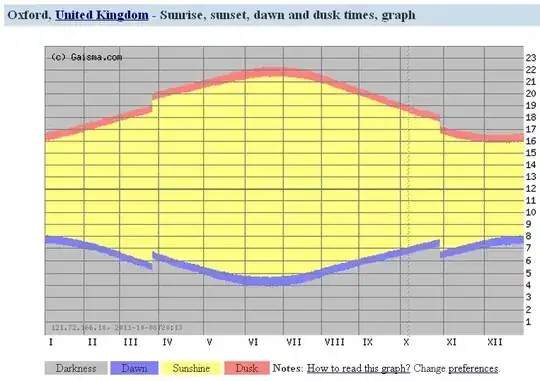
If your want to calculate your own Insolation figures then I would highly recommend having a look at the gaisma website, which provides sunrise, sunset, dusk and dawn times for thousands of locations all over the world.

For our purposes though, it also provides details of average Insolation (kWh/m²/day), along with Clearness, Temperature, Wind speed, Precipitation and Wet days.

For my own location, in Oxford, UK, it provides the following information:
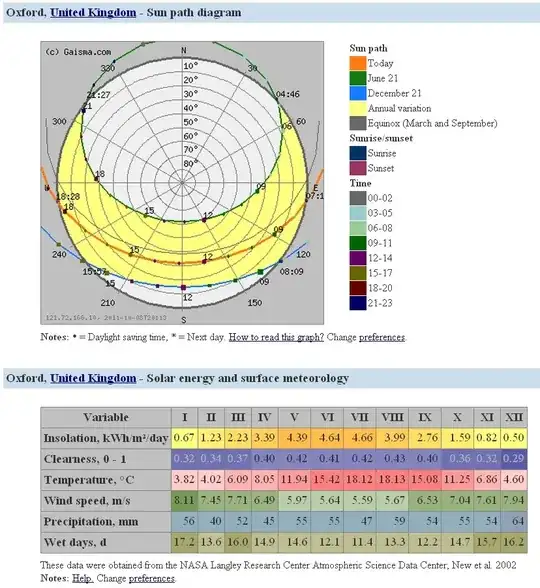
Sun path diagram and Solar energy and surface meteorology Sunrise, sunset, dawn and dusk times graph, Oxford UK

Details of your own location, and prospective PV solar system should allow you to estimate the kWh generated by the system over an average year.

Mark Booth
  • 1,652
  • 1
  • 16
  • 31
  • 2
    -1 as I think the solar irradiance data seems to outdated. You should get better results when using something like PVGIS. – bmu Feb 14 '13 at 10:21
  • According to a 2017 paper @bmu, looking at an actual 2GW solar installation, the NASA-SSE (2002) prediction was within 4.74% of the recorded value, whereas PVGIS-CMSAF (2007) was within 4.26%, so very little improvement. Now if any of the public tools had access to better datasets, this could go down to 2.66%, 1.10% or even 0.35%, but these don't appear to be an option with the tools you suggested in your answer. – Mark Booth Feb 14 '22 at 09:49
6

I think the best tool freely available at the moment is the System Advisor Model (SAM) by the National Renewable Energy Laboratory (NREL) of the US.

For Europe/Afrika a good starting point is PVGIS.

bmu
  • 251
  • 1
  • 6
1

Google's Project Sunroof is fairly basic, but very easy to use.

https://www.google.com/get/sunroof

mblakele
  • 172
  • 4
  • Thanks for the answer; please consider improving it by adding context for the link. Your post should have enough information that people can understand what Project Sunroof does before they click the link. – Nic Mar 12 '20 at 17:25
0

I built shademap.app and you can use it as a tool to do basic solar analysis. ShadeMap can calculate the total hours of direct sunlight for any location in the world. It differs from other tools because it accounts for shading from mountains, hills, buildings and also trees.

This is a direct link to the tool: https://shademap.app/@2m,0t Drag the pin to any location and the analysis will be updated in real-time.

enter image description here

enter image description here

teddybeard
  • 101
  • 1