19

In another question I've been corrected that batteries don't weigh that much in ion drive powered probes. Well, I thought a can of xenon would have a chance to be lighter than a solid block of plutonium, but truth of the matter, I have no clue.

Could someone clue me on what are the proportions of mass between fuel(plus container), power source and the engine itself in ion engines used nowadays to propel probes into regions so distant from the Sun that solar panels are not practical to use there?

SF.
  • 54,970
  • 12
  • 174
  • 343
  • 3
    Ion drives aren't frequently used for outer Solar System missions. Please be more specific on the mission you have in mind, since the mass of fuel would depend on the mission plan (how many gravity assists, for instance). The proportion would be changing also depending on the mass of science payload. – Deer Hunter Jul 29 '13 at 08:56
  • 2
    @DeerHunter: I don't have any specific mission in mind. I wanted to learn the orders of magnitude used in practice, so an answer citing any random mission will be quite satisfactory. – SF. Jul 29 '13 at 11:09
  • @DeerHunter I thought that deep space and ion drives went hand-in-hand because of the long duration and large impulse needed. – AlanSE Jul 29 '13 at 12:13
  • @AlanSE - one reason ion engines are suboptimal is gravity losses because of low thrust. The best place and time for a prograde propulsive maneuver is still in the periapsis, when the velocity is high.. – Deer Hunter Jul 29 '13 at 12:32
  • @DeerHunter: Could you elaborate on that? (I guess comments are not the best option for that, so I'd post that as a separate question if you don't mind.) Honestly, I thought "delta-V is delta-V, thrust is thrust, it doesn't matter much when or where you apply that. Is that's about shedding as much mass when near the bottom of gravity pit and climbing it back up lighter, without the fuel? – SF. Jul 29 '13 at 12:50
  • 4
  • @DeerHunter -- Thank you for the link! I gobbled that wiki up, and now understand what's going on in Heinlein books and Kerbal Space Program! :) – Jesse Smith Aug 01 '13 at 17:26
  • 1
    Rule of thumb: burn at highest velocity and tangentially to the local gravity vector. – Erik Aug 20 '13 at 20:31

1 Answers1

10

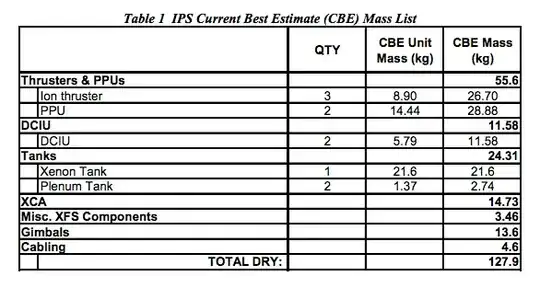
Well, I can give you a couple data points. First, we can look at NASA's Dawn mission, which uses an ion propulsion system (IPS) based on the system demonstrated on Deep Space 1 (which we'll look at next).

This paper gives details of Dawn's IPS. It notes that this system should give the spacecraft a total of about 11 km/s. Here's the break down:

The paper notes that Dawn will carry 450 kg of xenon.

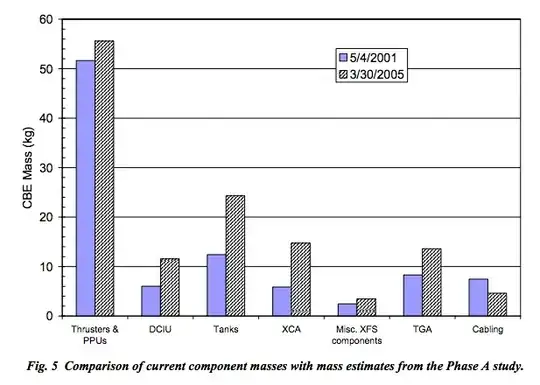
Here's a graphical representation:

Now, this report gives the breakdown for DS1. The total amount of xenon propellant on DS1 was 81.5 kg. Keep in mind, this would be a significantly less mature system:

To answer the title question more directly: the propellant contributes the most total mass by far. Of the hardware, it's typically the PPUs.

Acronyms list:

  • PPU: Power processor unit
  • DCIU: Digital Control and Interface Unit
  • XCA: Xenon Control Assembly
  • TGA: Thruster Gimbal Assembly