7

I know this is just a maths question, but sorry I can't work it out :p

Suppose you wanted to make something like Mr Burns' sun blocker:

But in orbit, not attached to the ground.

This would be a stoopid way to tackle global warming, but it's the era we're living in.

Geostationary orbits, as any kind repondent will know, have to be a specific distance from earth since the speed of the orbit is determined by its distance from the earth.

Given that we know the distance, what circumference would a sun-blocking sphere have to be?

Ne Mo
  • 179
  • 2
  • You should start with looking the required information, you need the distance from Earth(surface) to Sun, the diameter of the Sun and the distance of a geostationary satellite to ground. But you should think if a geostationary orbit is really what you need to shade the Sun. – Uwe Jul 17 '23 at 13:20
  • 5
    It is probably better to place a sun blocker in the position L1 instead of geostationary orbit. See this for more information: https://space.stackexchange.com/questions/34654/realistic-cost-and-feasibility-of-sun-shading – The Rocket fan Jul 17 '23 at 13:27
  • @TheRocketfan I'm not sure I'd use the adjective "better" for something that would cause almost all life on Earth to freeze to death. It would certainly be extremely effective at ending global warming, though. – plasticinsect Jul 18 '23 at 22:28

1 Answers1

16

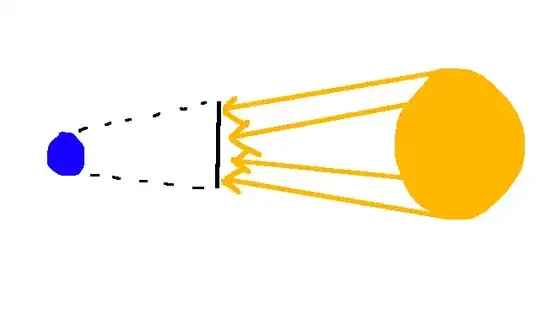
If something is twice as far away, it has to be twice as wide to have the same apparent size.

If it's 10x farther away, it needs to be 10x bigger.

scaling

The Sun is 4250 times farther away than GEO, so the object is 4250 times smaller than the Sun, so very close to 1000 km in circumference

That said, GEO wouldn't be a good place to permanently block the Sun. In GEO, a satellite is orbiting at the same speed as the Earth is rotating, which means that seen from the surface of the Earth, the satellite is motionless in the sky. The Sun is not motionless in the sky, so the occultation doesn't last very long (roughly the same time as a total solar eclipse, which just uses a slightly bigger sphere, slightly further out).

Another consideration is that ~1000km is just enough to make the Sun dark on a single point of the Earth. If you just drive a short distance away, the object will only cover parts of the Sun, and further away still, the Sun is shining like normal.

To block all of the Sun on all of the Earth, you would need something at least the size of the Earth
scaling 2

  • 1
    Sun subtends roughly 0.5 degree, question becomes what distance subtends 0.5 degree at a distance of 36,000 km. 36k * sin(0.5) comes out at about 360km, which is the same ballpark figure. – Mark Morgan Lloyd Jul 18 '23 at 07:42
  • 5
    Ha yeah I forgot that the sun isn't stationary in the sky. I should work for Elon. – Ne Mo Jul 18 '23 at 09:51
  • Follow-on question, then: how many rolls of aluminum foil would it take to cover such a disk? Probably need to wait until they're on sale at Costco... – Ralph J Jul 18 '23 at 16:44
  • 3
    @RalphJ Unfortunately, Costco's business model implies that by the time aluminum foil comes around, you'll have bought enough toilet paper and kitchen rolls to cover lake Ontario! – Peter - Reinstate Monica Jul 18 '23 at 16:47
  • 3
    The right spot is the Earth-Sun L1 point. But then it needs to be bigger. – Mark Foskey Jul 18 '23 at 19:38
  • 1
    @MarkFoskey Only if you make it heavy. If it's light material, like aluminium foil, radiation pressure will throw it off completely. See for instance the sunshade arrangement Paul Birch proposed for Venus: https://www.orionsarm.com/fm_store/TerraformingVenusQuickly.pdf – SE - stop firing the good guys Jul 18 '23 at 21:14
  • @SE-stopfiringthegoodguys I'm not sure that's true - since radiation pressure and gravity from the Sun are both radial and of the form $1/r^2$ as long as the blocker remains perpendicular it's just like the Sun's mass is a... Oh, wait, you're right! OK in that case as long as the blocker can be dynamically tilted for station keeping... – uhoh Jul 19 '23 at 01:22
  • @uhoh and dynamically spun in the process to keep its shape without a dedicated structure. fwiu This thing would travel a"powered orbit" slightly closer to the sun than L1's location, with continuous retrograde solar thrust to fall towards as much as it is pushed away from the sun, while still matching the orbital period it should have further out at L1. – user721108 Jul 20 '23 at 19:22
  • @jkztd sorry I don't know what that means - it's got too many shorthand words "retrograde solar thrust" and "fall forward" and "push away" and no math. I know that spacecraft like SOHO and JWST sit slightly closer to the Sun than their halo orbits would require and use either real thrust or solar photon pressure to balance, but those are halo orbits. Since you're talking static L1 locating in pure CR3BP, I think you can write that as a simple equation rather than prose, which makes it 1) easier to understand and 2) believable beyond doubt. Or just link to that equation somewhere. Thanks! – uhoh Jul 20 '23 at 23:15
  • @jkztd For example, are you agreeing with my ...as long as the blocker can be dynamically tilted for station keeping... (I think that's what "continuous retrograde solar thrust" means, but I'm not sure) or disagreeing with it? – uhoh Jul 20 '23 at 23:17
  • 1
    @uhoh I fully agree, with at least dynamic tilt for station keeping, sorry for the prose, i'd love to prove thoughts using equations but don't understand these well enough. – user721108 Jul 23 '23 at 11:13
  • 1
    @uhoh just found the term it's statite – user721108 Aug 03 '23 at 19:55