3

Jupiter appears to approximately follow Lambert's cosine law as it looks darker towards its limbs when viewed from the same direction as from where the Sun shines on it. Here an image from the article Hubble takes close-up portrait of Jupiter that shows it in opposition:

Now there is the Lommel-Seeliger law which is a good first approximation to diffuse reflection. Here is an image that shows its effects in the middle, while an approximately Lambertian surface is at the bottom:
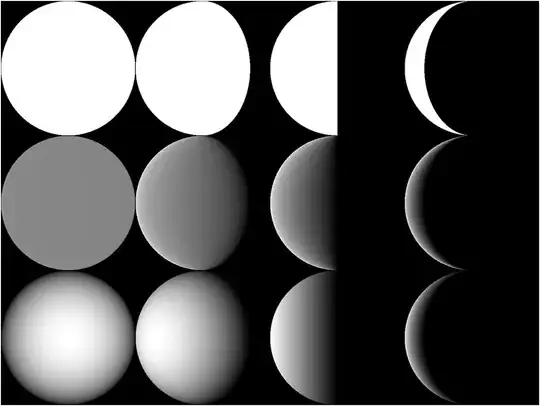
The Lommel-Seeliger sphere appears flat at zero phase angle. The Lommel-Seeliger law is derived by considering what happens to a beam of light that enters a medium. Therefore, my assumption is that it should be a good approximation to atmospheres and gas giants, too. However, Jupiter apparently proves me wrong. Why does it not look flat?

An example of a celestial body that appears flat at zero phase angle is the Moon. It is covered by lunar regolith that is a medium of pulverized particles.

Fred
  • 13,060
  • 4
  • 41
  • 78
akuzminykh
  • 133
  • 5
  • I hope this one is on-topic here and does not belong in Physics SE. – akuzminykh Aug 09 '21 at 07:35
  • 1
    You don't link to the source - which camera took this picture at which distance with which field of view and apparent size of the planet? – asdfex Aug 09 '21 at 07:46
  • @asdfex It's from the Wikipedia article: "This image was taken by the Hubble Space Telescope, using the Wide Field Camera 3, on April 21, 2014. Jupiter's atmosphere and its appearance constantly changes, and hence its current appearance today may not resemble what it was when this image was taken. Depicted in this image, however, are a few features that remain consistent, such as the famous Great Red Spot, featured prominently in the lower right of the image, and the planet's recognizable banded appearance." – akuzminykh Aug 09 '21 at 07:56
  • 2
    Additional info: the angle Sun-Jupiter-Earth was about 11° at that time which explains the asymmetry between left and right. – asdfex Aug 09 '21 at 08:20
  • @asdfex That's a good point .., thank you. I've found a better resource: Hubble takes close-up portrait of Jupiter. This image was taken by Hubble when Jupiter was in opposition. I'll replace the image in my post as 11° is too much. – akuzminykh Aug 09 '21 at 08:26
  • 2
    Question: do any of the models you describe account for the absorption of light passing through (literally) thousands to even tens of thousands of km of atmosphere? The approximations work for the Moon, because the Moon's atmosphere is slightly less dense than Jupiter's – CuteKItty_pleaseStopBArking Aug 09 '21 at 09:27
  • @PcMan To my understanding (I'm studying Computer Science, not Physics) the depth or density of the medium doesn't matter. The Lommel-Seeliger law only expresses the basic principle of what happens with a beam of light in an infinite medium. A beam of light is exponentially attenuated by being scattered or absorbed on particles. The law tells you how much of that light goes in a direction. How strong the absorption is, doesn't affect the shape of the function curve. – akuzminykh Aug 09 '21 at 10:08
  • @PcMan The Lambertian law is actually more of a geometric effect. Energy is projected onto a larger area, depending on the orientation of the receiving area. This projection is proportional to the cosine of the angle between the surface normal and the direction of illumination. This is the Lambertian law. It's also the reason why we have winters. – akuzminykh Aug 09 '21 at 10:11
  • @akuzminykh exactly. And it does not account for the fact that light in the middle of the planet only has to pass through about 100km of hydrogen/helium gas to reach the visible clouds(which is what we see), but light at the extreme limbs have a path of many thousands of km to reach the clouds, then have to return through those same thousands of km. Hydrogen+Helium may be very near to transparent, but it is not 100.000% – CuteKItty_pleaseStopBArking Aug 09 '21 at 10:14

1 Answers1

3

Because the Lommel-Seeliger law and Lambertian surface reflection are both single scattering models, ignoring the optical properties of atmospheres.
That is a bad fit for a planet that is almost purely atmosphere and very little else.

The atmospheric effect observed here is reflective atmospheric limb darkening (not to be confused with radiative limb darkening).
This can intuitively be viewed as light having to pass through more atmosphere near the limb than in the centre.

Wildey and Traeton 1971 discusses the limb darkening of Jupiter specifically. While the observational data has been improved since then, the underlying theory remains the same.

  • It might be implicit that a multiple-scattering atmospheric model wouldn't do this, but another issue is that those models assume a uniform medium, assuming the only thing to care about is the first layer of clouds. A multple-scattering model with the same assumption would still be a poor fit. – Christopher James Huff Aug 09 '21 at 12:45
  • @ChristopherJamesHuff doesn't multiple scattering imply taking into account the scattering between cloud layers? – Ruslan Aug 09 '21 at 15:24
  • @Ruslan multiple scattering in itself only implies taking multiple levels of scattering into account. A multiple scattering model could very well assume a uniform medium. In an atmosphere model, this would account for diffusion of light past the terminator, but not the layered structure. In the context of atmospheric models, I don't know whether anyone's bothered with multiple scattering without a more realistic atmosphere. – Christopher James Huff Aug 09 '21 at 15:42