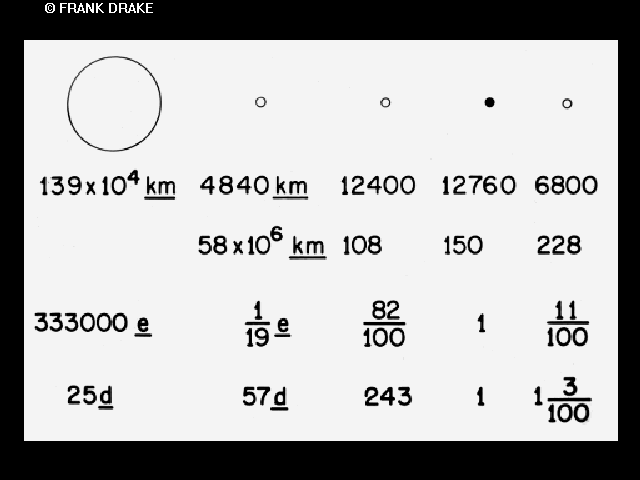
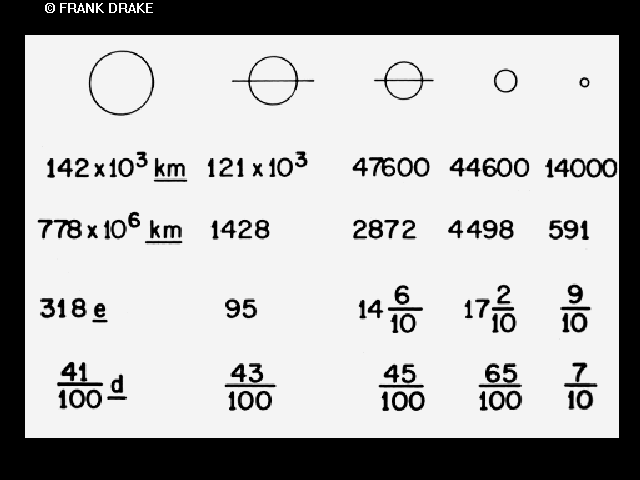
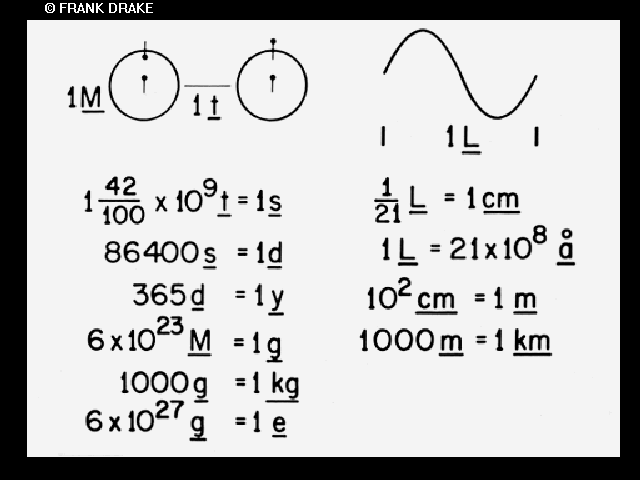
Given historical context, I can map three of the four parameters of the mystery planet on those of Pluto, given what was known about Pluto at the time of the production of the golden record in 1977. Hence, I'm reasonably certain that the mystery planet is supposed to be Pluto, although I cannot explain the fourth parameter.
In summary: the late 1960s and the early 1970s saw much progress in estimates of Pluto's parameters, and the "Mystery planet" parameters seem to be (generous) upper bounds of what was considered certain at the time.
Planet diameter and mass
- Mystery planet diameter: 14000 km
- Mystery planet mass: 0.9 Earth mass
Pluto's diameter has been estimated by direct observations:
While it may seem obvious that by 1977 the size of Pluto was already established at much less than the 14000 km diameter of our mystery planet, this is not the case, due to the discrepancy with its estimated mass. Progress in observations of the outer planets in the 1945-1980 time frame led to many revisions in size and mass estimates of Pluto, many of which contradicted each other. Note that at that time, Pluto's mass was estimated from its influence on Neptune's orbit, but data on that was rare, since Neptune had yet to complete a full orbit at that time and little was known about its interaction with Pluto.
Kuiper's observation on 4-5 November 1949: 0.4 arc seconds diameter. According to NASA Horizons, Pluto was at 36.46 AU, which gives a diameter of 10577 km (!). This would be consistent with then-current estimates of Pluto's mass of approximately 0.8 - 1.0 Earth masses. His observation on 22 March 1950 however resulted in an estimated diameter of 0.23 ± 0.01 arc seconds. Pluto was at 35.56 AU, corresponding to a diameter of 5673 to 6189 km. This lead him to a revised mass estimate of about 0.1 Earth mass, which Kuiper notes to be at odds with observations on Neptune. He admits to have no explanation.
In 1966, the "best" estimate of Pluto's mass is still 0.9 Earth mass, as noted by Halliday et al. They provide an upper bound on on Pluto's diameter of 6800 km, but also note that this results in an unrealistically high density given the 0.9 Earth mass. A more realistic mass estimate would be around 0.14 Earth mass, but the authors also note that this does not match with observational data on Neptune's perturbations. Since Neptune will not come near Pluto for a number of centuries, they hope that observations on Uranus "close" encounter in 1967 can provide insights on what is the right mass estimate.
Duncombe et al. in 1968 and Seidelmann et al. in 1971 take a numerical approach an estimating Pluto's mass. At that time, a diameter of about 6400 km seems to have been widely accepted in the community. The papers arrive at the estimate of Pluto's mass by determining what mass fits the available observations best (least square fit) and conclude that a mass of about 0.1 Earth masses fits the data best. However, in both papers the authors note that observations are not yet sufficient to arrive at a conclusive answer (again, note that in 1971 Neptune had not yet even completed one orbit since its discovery). Note that both papers depend on continuing observations of orbits of Saturn, Uranus and Neptune and use updated mass estimates for those planets to reinterpret results on mass estimations for Pluto.
Only in 1978, after the Voyager launch, Charon was discovered and Pluto's mass estimate was revised to 0.0017 Earth masses. The discovery of Charon allow to resolve many of the conflicts in parameter estimates, but this came too late for the Voyager golden record.
The provided "Mystery planet" parameters of 14000 km diameter and 0.9 Earth masses are (somewhat generous) upper bounds of rapidly changing knowledge of Pluto's parameters in the late 1960s and early 1970s, accommodating contradicting estimates on size and mass. Hence, I conclude that these parameter values are consistent with Pluto at that time in history.
Distance to the sun
- Mystery planet: 591e6 km
- Pluto: average 39.5 au = 591e7 km
As snoopy mentions in his answer, I have no other explanation that that this is a typo, albeit a silly one.
Duration of one sidereal day
- Mystery planet: 0.7 Earth sidereal day = 16.8 hours
- Pluto: 6 days, 9 hours.
Only in 1974 it was conclusively determined that the rotational period of Pluto was 6.38 days. Up to then, some doubt existed, as the data could be mapped onto a rotational period of 1.18 days or 6.39 days. Note however that Walker et al. had established the same number of 6.39 days already in 1955.
If the mystery planet is Pluto, the only explanation I can think of is that the parameter was supposed to read 7 (as a rounded-up value for 6.39), but that seems far fetched.
References:
- G.P. Kuiper, "The diameter of Pluto", 1950
- M.F. Walker et al. "A photometric determination of the rotational period of Pluto", 1955
- I. Halliday et al., "An upper limit for the diameter of Pluto", 1966
- R.L. Duncombe et al., "Orbit of Neptune and the mass of Pluto", 1968
- P.K. Seidelmann et al., "Determination of the mass of Pluto", 1971
- J.S. Neff et al., "An investigation of the rotational period of the planet Pluto", 1974
- J.W. Christy et al., "The satellite of Pluto", 1978
- S.A. Stern, "The Pluto-Charon system", 1992
- F. Nimmo et al., "Mean radius and shape of Pluto and Charon from New Horizons images", 2016