4

Say a generation ship arriving at Alpha Centauri A system wants to get into orbit (or land) on an exoplanet there. After decelerating for the 2nd half of the journey, their approach velocity is still too high to land on the surface safely. They need to decelerate more than their ship thrusters can provide.

Can gravity assist slingshots provide enough braking? Say from 40+ kps to 8kps velocities.

I hope ~40kps should be slow enough entry to the system give ample time to calculate the orbits of other exoplanets needed for lining up gravity assists. I see only 1 unconfirmed planet for Alpha Centauri A that is 20-50 M⊕. But, there could be more. Hopefully that planet helps for the calculation though.

Let's also assume that the exoplanet the ship wants to visit is (fictionally) so similar to Earth that we have the same mass and the atmosphere of the Archeaen Earth (lacks the O2. I'm not sure if/how that effects atmos entry). Typical low earth orbit re-entry speeds are near 17,500 mph, or 7823.2 m/s. Let's assume the ship is at least 200,000kg. It is designed for this entry velocity in 1 piece, or breaking up into multiple entry cones with heat shields. Perhaps breaking up into modular smaller masses would help the gravity assist decel as well... I'm only guessing.

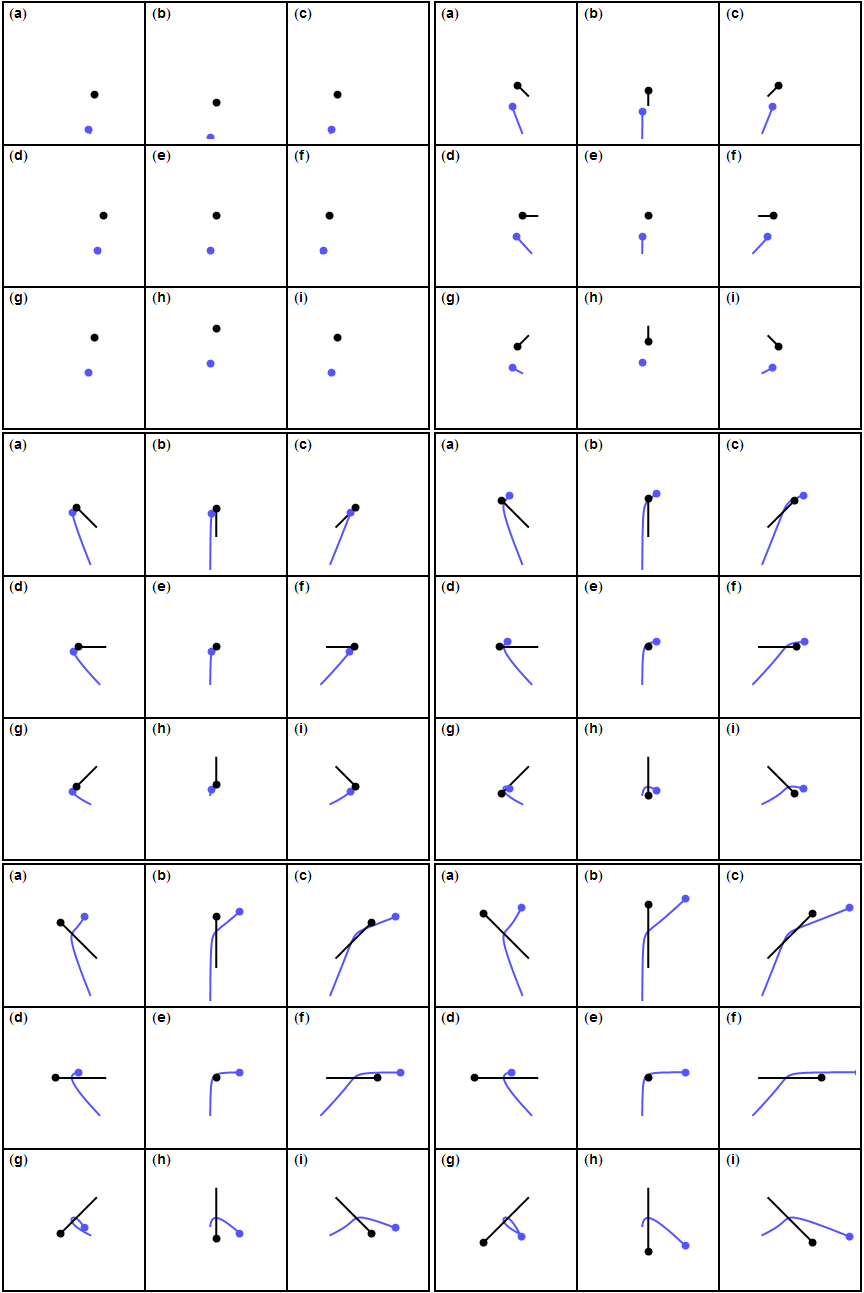
I'm curious about figure (g) in: https://upload.wikimedia.org/wikipedia/commons/7/7e/GravPoss.gif As it seems to reverse the vector... perhaps this is a good approach angle to max decel.

Looking on this site and in research, I mostly see gravity assists for accelerating, or minor adjustments for small probes into orbits, not larger deceleration. Thank you!

Koon W
  • 263
  • 1
  • 8
  • 2
    BTW, 200 tons is pretty small for a generation ship. Also, if its top speed is 40 km/s, it'll take over 32,000 years to get there from here. – PM 2Ring Apr 04 '21 at 19:56
  • 2
    @OrganicMarble no it doesn't since the question and its answers only cover trajectories about a single body and the "Alpha Centauri system" offers n-body goodies that may allow at least temporary capture. This question should not be closed as duplicate just because a few words overlap with the other question. Look at the care with which this question is written and the thought put into n-body dynamics. There may be some duplicate but that's not one. – uhoh Apr 04 '21 at 22:02
  • 4
    Taking 32,000 years to arrive and not bringing enough delta-V to brake at the destination seems like one heck of a gamble to run with your generation ship. You'll probably be overtaken in transit. Maybe the people who got there thirty thousand years ago, terraformed the planet, and populated it, can send out tugs to help you.=) – notovny Apr 04 '21 at 22:38
  • 1
    The question asks specifically "How difficult to gravity assist brake on entry to Alpha Centauri system?" It's a detailed question about a particular and well-studied system; HopDavid's answer offers no specific guidance here. I just don't think it is good to block all users from an opportunity to answer this question. Nobody is going to spontaneously add an answer about the Alpha Centauri system there. – uhoh Apr 04 '21 at 23:07
  • @PM2Ring I didnt specify 40kps at top speed, just approach speed into the system. this is after the ship has decelerated for the 2nd half of the 4 lightyear journey. I'm trying to have the entire journey happen in 110 years. But due to events not related to the scope of this question, they have excessively high velocity without enough fuel to slow by thrusters alone... – Koon W Apr 06 '21 at 01:27
  • @notovny I didnt specify 40kps at top speed, just approach speed into the system. this is after the ship has decelerated for the 2nd half of the 4 lightyear journey. I'm trying to have the entire journey happen in 110 years. But due to events not related to the scope of this question, they have excessively high velocity without enough fuel to slow by thrusters alone... – Koon W Apr 06 '21 at 01:28
  • @uhoh im also bummed it got closed, because i wasnt finding the other posts all that helpful to this specific scenario or even just into the alpha centauri system, when perhaps there are people out there with expertise in this realm that could help a lot, when im a bit lacking in astrophysics understanding of how these equations are set up from physical attributes. – Koon W Apr 06 '21 at 03:35
  • 1
    @KoonW there is a reopen procedure. What you can do is edit the post which can trigger a process by which it can be reopened. I'll recommend you do the following. 1) mention the proposed duplicate in the beginning of your question, explain what you've learned from it and then discuss your specific problem. 2) Ask how this basic discussion can be applied in your case. 3) Decide if you want to have both A and B components of the alpha Centauri binary system in play gravitationally, or just want to use planets from one of them. 4) delete extraneous stuff like cones, heat shields and afterward. – uhoh Apr 06 '21 at 03:57
  • 1
    @KoonW For this question just ask about the trajectories available in the system, and if the big planet around A or the B star can provide deceleration to land on an (as-yet undiscovered) low mass planet orbiting A. Ask for how to calculate; what equations, and how much is possibly available. Keep the question short, constrained, and omit anything superfluous to orbital mechanics for now. If the answer is that there is a solution, you can ask a new question with more details. Good luck and ping me if you like after you've made the edits. – uhoh Apr 06 '21 at 04:01
  • 1
    Ok. I posted my previous comment hoping that you'd clarify those details. The total distance is ~4.367 LY. If the ship has constant acceleration $a$, flipping to $-a$ at the midpoint, then from $s=\frac12at^2, a\approx0.0137,m/s^2$, roughly 0.0015 $g$, and the speed at the midpoint is ~23,800 km/s. It takes 27 days to lose 32 km/s. The Lorentz factor $\gamma$ at the midpoint is ~1.003, so we can mostly ignore relativistic effects. – PM 2Ring Apr 06 '21 at 06:55
  • Google Calculator is useful for stuff like this. I did that acceleration calculation using (4.367 lightyears)/(55 years)^2 in the Google search bar. – PM 2Ring Apr 06 '21 at 07:02

1 Answers1

5

To start, I want to make sure that you are aware that the magnitude of a gravity assist can just as easily be in the positive (accelerating) direction as it can in the negative (decelerating) direction. So the ballpark numbers you see for what delta V you can get from a gravity assist when accelerating are the same for decelerating.

Next, I think the magnitude of your velocity is extremely low. You assume we're starting at around 40 km/s. To travel from our solar system to Alpha Centauri, a distance of around 4.13e13 km, at 40 km/s, it would take around 32700 years to get there. Practically speaking, anything we send there will be traveling much faster. As in, a non-negligible fraction of the speed of light. If you're working with a propulsion system that can accelerate you to such a speed, and it can decelerate you down to 40 km/s, it's almost negligible at that point to assume it could slow you down just a bit more to be able to capture at Alpha Centauri.

Also, if you're working with 1 planet that has 20-50 times the mass of Earth, you're probably out of luck. For reference, Jupiter has around 318 times the mass of Earth. Voyager 2 got around 10 km/s of delta V from Jupiter, going from 10 km/s to 20 km/s.

So gravity assist braking probably won't be very useful when entering the Alpha Centauri system in terms of decelerating from an interstellar trajectory.

Paul W
  • 721
  • 3
  • 8
  • I didnt specify 40kps at top speed, just approach speed into the system. this is after the ship has decelerated for the 2nd half of the 4 lightyear journey. I'm trying to have the entire journey happen in 110 years. But due to events not related to the scope of this question, they have excessively high velocity without enough fuel to slow by thrusters alone... – Koon W Apr 06 '21 at 01:28
  • would a super earth allow a closer slingshot than a gas giant? therefore making up in the mass difference? did voyager not get too close, due to safety concerns of jupiter's radiation? seems like a lot of variables beyond mass involved – Koon W Apr 06 '21 at 01:50