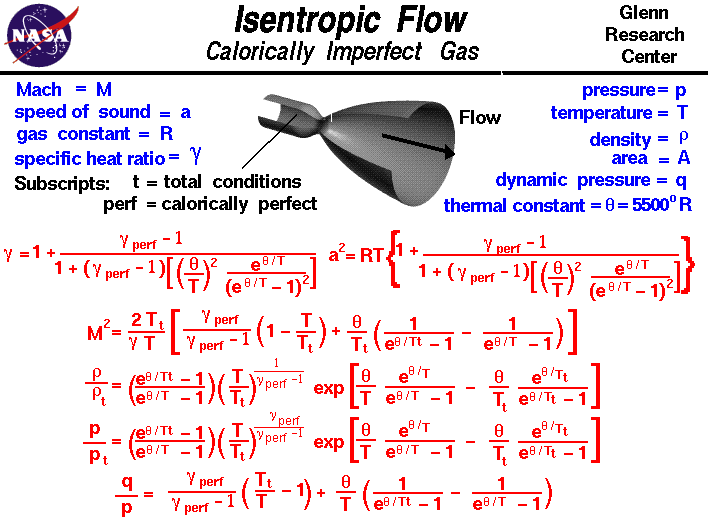
Ideally, a rocket-nozzle behaves isentropic. That's the case if a fluid (=exhaust) experiences changes so rapidly, it can't equilibrate with it's environment. (I.e. it doesn't lose a lot of heat to nozzle walls.)
Supersonic flow has the advantage of having "simple" equations. "Simple" in the sense that once you know the mach-number, you can calculate most properties independently.
That is the case for pressure and area as well. In your specific case, I'd suggest determining the burn chamber pressure and from the ratio chamber pressure to ambient pressure calculating the mach number. That furthermore allows to calculate the ideal area ratio and thereby the ratio of outer to inner diameter.
If you combine the expression for pressure ratio and area ratio to one, it comes out as:
$$ \frac{A_e}{A_t} = \frac{ (\frac{p_t}{p_e})^{\frac{k+1}{2 k}}}{\sqrt{\frac{2}{k-1}((\frac{p_t}{p_e})^{\frac{k-1}{k}}-1)}} * (\frac{k+1}{2})^{-\frac{k+1}{2(k-1)}} $$
with index e for exit and index t for throat. k is the ratio of specific heats, NASA denotes that as $\gamma$. The square root of the area-ratio will deliver the diameter-ratio.
Big thanks to @Christoph for mentioning this handy tool to calculate exhaust conditions based on chemical reactions.
This tool to calculate rocket exhaust based on chemical reactions (Big thanks to @Christoph for bringing it to my attention) will show a Cp/Cv ratio as well as a gamma. I do no know what that gamma is, you want to use the Cp/Cv value.
In order to calculate the correct exit area, you need to know this ratio of the exhaust and assume it's constant while traveling through the nozzle or it gets even messier.