28

If there was an urgent need to launch a rocket to the ISS, how long would it take to have a rocket ready to launch?

I am trying to understand what factors take up the time to prepare for a rocket launch.

Updated:

Here are some clarifications to limit scope. I am curious how long it takes to prep an emergency launch from a rocketry perspective.

  • Assume there was an urgent need to deliver a small, lightweight package with something vital such as medicine or a replacement circuit board that is available.

  • Assume we CAN use an existing rocket.

  • Assume the rocket is NOT sitting ready on a launchpad.

  • Assume travel to the ISS is within the capabilities of the rocket.

Dan Sorensen
  • 3,551
  • 3
  • 25
  • 44
  • 17
    What are you sending to the ISS? Cargo? Human passengers? Empty seats? – Dragongeek Feb 26 '20 at 19:59
  • Is there a rocket ready for fueling on the launch pad or is a final assembley of the stages neccessary? – Uwe Feb 26 '20 at 20:11
  • 3
    @Dragongeek: good questions. It is just a hypothetical example that eliminates schedule backlog. Schedule is real, but transcends rocketry. Assume the needed cargo was small and ready to go. If we were able to bump a rocket to the front of the schedule. How long would it take to prepare for a launch as far as rocketry is concerned? Are we talking months, weeks, days, hours? – Dan Sorensen Feb 26 '20 at 20:17
  • 2
    I picked the ISS example as it's a known, regular mission. Nothing exotic. I am curious if the long times between launches are related to particular needs of rocketry or outside factors such as waiting on completion of a payload. – Dan Sorensen Feb 26 '20 at 20:22
  • Some clarification in your question would be helpful, spelling out your assumptions / requirements. If it's a small cargo, throw it in the next Dragon, but I don't think that's what you mean. Is your question "How long would it take to stand up a completely new mission to the ISS" or something else? – Organic Marble Feb 26 '20 at 23:27
  • @uhoh your interpretation of the question may be valid but it's different from mine. That's why I requested clarification. – Organic Marble Feb 27 '20 at 00:57
  • @OrganicMarble now I see that the edit was made after your comment, my mistake – uhoh Feb 27 '20 at 01:26
  • 2
    @uhoh no problem! I'm still confused. – Organic Marble Feb 27 '20 at 01:32
  • 1
    I was curious how long the ISS had before help could arrive in the absolute best case scenario. This would be the minimum time required to technically prepare a rocket for launch. Additional variables just add time beyond that. I am happy to remove the question if it's not clear enough to proceed. I am not trying to confuse. I appreciate the technical excellence you put into your answers. :-) – Dan Sorensen Feb 27 '20 at 04:38
  • 1
    You're really asking how long would it take to get a small, lightweight package with something vital to it. If you had worded it like that instead "get a rocket to it" the whole "what kind of rocket?" discussion wouldn't have happened. Never over-constrain or pre-constrain an answer if not necessary. Technically one can call this an XY problem; X is the rocket you asked for, but Y is getting the package to the ISS which is what you really want to ask.What is the XY problem?(found in MetaFAQ) – uhoh Feb 27 '20 at 11:33
  • 1
    Related: https://space.stackexchange.com/questions/21742/could-dragon-1-0-be-used-as-an-emergency-earth-return-vehicle – Machavity Feb 27 '20 at 14:26
  • 15
    I would exclude "medicine" from the list of emergency supplies. If someone on the ISS is that urgently in need of something medicinal, it's more likely the crew would leave the station and return to Earth than wait for medicinal supplies to be brought up to them. That can be done in a matter of hours rather than weeks. – Darrel Hoffman Feb 27 '20 at 14:47
  • 1
    I believe the clarifications, while vital a real scenario, are adding complexity and time to the basic best case question: how fast can they get a rocket out of the shed, upright it on a pad, and get it into the sky towards the ISS? A real scenario will be some time greater depending on the additional criteria. – Dan Sorensen Feb 27 '20 at 15:44
  • 2
    My 'how long to get a rocket there?' question is seeking a general baseline along the lines of: How long would it take for a firetruck to respond to a fire? Traffic, distance, and the nature of the emergency only add time to the baseline answer which could be: They can have the trucks out the door in 4 minutes + drive time which depends on traffic and distance. – Dan Sorensen Feb 27 '20 at 15:54
  • 2
    Also related: https://space.stackexchange.com/questions/6279/what-country-or-flight-team-would-be-the-most-likely-to-rescue-me-from-space/ – Andy Feb 27 '20 at 17:36
  • 2
    @Dan Sorensen: Then add the complication that every time you go out on a call, you need to order a new fire truck from the factory, or at least refurbish your reusable FireX one. – jamesqf Feb 27 '20 at 18:14
  • It's worth considering what kind of different things can be done in space if help is a day or two away, rather than months. – Chris B. Behrens Dec 22 '20 at 17:06

5 Answers5

55

A brand new rocket to be launched will have to be assembled, and that's a long process, though I do not know how long.

But if it's for an emergency, you may find ready rockets.

After the Columbia disaster, space shuttle missions all had a contingency mission in case they found issues with the orbiter before reentry.

The planning and training processes for a rescue flight would allow NASA to launch the mission within a period of 40 days of its being called up. During that time the damaged (or disabled) shuttle's crew would have to take refuge on the International Space Station.

You even had two shuttles on pad at the same time for a Hubble servicing mission, as the crew wouldn't be able to reach the space station for a safe haven, and would need to be rescued before the three weeks of consumables on board were exhausted.
The rescue mission would have been launched only three days after call-up.
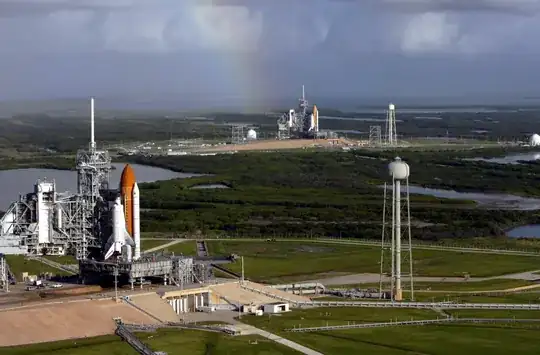
Space shuttles Atlantis and Endeavour on launch pads

That said the space shuttle isn't operating anymore, and until Spacex' Crew Dragon or Boeing's Starliner are operational (probably sometime soon), the Russian Soyuz is the only option to send people, and it seems to launch a new crew to the ISS roughly every 6 months (if there are no emergencies).
For the last flight of the space shuttle, there was no contingency mission prepared, but instead the mission had only 4 astronauts, and in the case that Atlantis couldn't make the reentry, the astronauts would stay on board the ISS and come back to earth in Soyuz capsules over the following year.

If your emergency doesn't require people to go to the ISS to help, but specific, unplanned cargo is still needed, a spacecraft (cargo or not) goes to the ISS every month or so, so if your emergency can wait between a week and a bit more than a month or so (to account for weather delays, mounting time of the payload and orbit maneuvers) you can just sneak it in one of those resupply missions, or replace some less vital cargo.

If your emergency can't wait at all, and you absolutely need to send something to the ISS on short notice, and there are no upcoming resupply missions, you may be able to hijack another vehicle with sufficient authority.
For March alone there are 10 planned rocket launches from the US, ESA or Roscosmos, so you could probably get emergency cargo to the ISS in around a bit more than a week (this is a guess, assuming the orbital maneuvers take around 3 days, and mounting the payload and waiting for a launch window take a few days too).
Note that if you don't have a proper cargo spacecraft to put the cargo into, maneuvering up to the ISS might prove to be difficult, and the cargo will not be able to mate with the ISS, so astronauts may have to perform an EVA to secure the cargo outside.

Speedphoenix
  • 5,324
  • 4
  • 25
  • 55
  • 7
    That is some fantastic information! I did not know about the shuttle contingencies post Columbia. Seems your answer boils down to it being faster to wait for a planned mission than to re-purpose a rocket for an emergency if one arose. – Dan Sorensen Feb 27 '20 at 00:28
  • 2
    @DanSorensen Yes but a lot of what I put in my answer is guesswork and extrapolation from that link on the launch schedule. There might exist some rockets ready at all times, maybe initially meant to carry small payloads or satellites – Speedphoenix Feb 27 '20 at 00:35
  • 19
    What a great photo... – T.J.L. Feb 27 '20 at 15:56
  • 2
    From launch to ISS has been done in 4 hours https://www.nasaspaceflight.com/2018/07/progress-ms-09-super-fast-4-hour-rendezvous/ so your 3 days of orbital manoeuvrers would seem to be a bit high for an emergency mission. Obviously, the launch window was carefully chosen to minimise the mission duration. Edit: The article states missing the window "would have resulted in the craft having to fly a two-day [...] phasing profile to the ISS on a realigned launch date later this week" so I guess less than a week to launch, with a two day intercept? – Baldrickk Feb 27 '20 at 16:53
  • 1
    Will upcoming technologies change this answer? SpaceX wants to be able to turn around a rocket in a day. While that is a lofty goal, perhaps soon we'd be able to launch a dedicated mission within days. – BillThePlatypus Feb 27 '20 at 21:16
  • 4
    So, it's basically risk management. "We have a launch scheduled to depart in two weeks. We could launch it in one week instead, but it will have a much higher chance to explode, and then we have to wait months for the next one. Do we want to risk it?" – vsz Feb 28 '20 at 05:06
  • 1
    Soyuz launches 2 or 3 people roughly every 3 months. Each Soyuz capsule has just over 6 months of flight endurance before needing to return to Earth, so at present there are normally 2 Soyuz capsules docked at the ISS. Once SpaceX and/or Boeing begin flying crew to the ISS for 6 month duration's and the US stops buying seats from Roscosmos the baseline will drop to 1 Soyuz at a time. – Dan Is Fiddling By Firelight Feb 28 '20 at 12:13
14

The ISS does not have emergency's that require a rocket to bring supplies. It can have an urgent need of something. Either everyone stays on the ISS or some/all crew leave. It is downhill all the way to Earth, and the crew can leave anytime. Worst case the crew abandons the ISS and it burns up on re-entry.

There are a couple of good answers on this question, that talk about some of the challenges. But in the end the answer is "It depends, how much do you want to spend?"

There are also a couple of good posts that talk about real emergencies.

Would all crew leave the ISS if one had a medical emergency?

How long can a 2 person crew survive on ISS totally cut from Earth?

James Jenkins
  • 27,067
  • 22
  • 104
  • 238
  • Would the ISS actually burn up completely? It's pretty big. – Fabian Röling Feb 28 '20 at 02:35
  • 4
    @FabianRöling No, the Mir was much smaller and about 40 tons of debris ended up in the seas somewhere when it was decommissioned. – smcs Feb 28 '20 at 10:33
  • "It is downhill all the way to Earth, and the crew can leave anytime." Can you please clarify this? Can they all leave AND survive? – Tomáš Zato Feb 28 '20 at 12:32
  • 1
    @TomášZato-ReinstateMonica read the Q&A "Would all crew leave the ISS if one had a medical emergency?" I linked in my answer. It should answer your question, and give you more detail. – James Jenkins Feb 28 '20 at 14:30
  • @TomášZato-ReinstateMonica It depends on how many capsules are docked at the station. For safety, it always retains capacity to remove everybody aboard. If there are three astronauts and one Soyuz (capacity 3), they would all leave together - they would not leave one or more persons aboard without return-to-Earth capability. Crew Dragon seats more, and will not always fly with a full crew. It's possible to have a combination of capsules with more seats than crew, but less is never allowed. – T.J.L. Dec 23 '20 at 13:56
9

It depends on readiness of a rocket. Rocket assembly is rather long process. If you compare the dates of rocket delivery to launch facility and the launch you'll find that usually it takes about month or more.

So if some rocket is ready to launch to ISS in coming days it's rather easy - just throw out some of less significant things and replace it by the emergency cargo. Well, maybe the cargo should be qualified for spaceflight (e.g. toxicity, srtength for 5-g accelerations, weightlessness behaviour, radiofrequency interference, etc), but for high emergency some of qualifications could be lifted, I think.

But if no any rocket is planned to launch to ISS in next month or two - there is a big problem, and I would say it'll be close to impossible to accelerate the launch so much. Most of the time is spent on tests and checks of rocket and launchpad, so theoretically most of them could be skipped, but... List of rocket disasters tells us why the checks are so rigorous. Also, modern rockets (Falcon, Atlas V, Soyuz-2, H-IIB) make automatic self-checks before launch, and the countdown will be stopped by the rocket itself if something wrong found. Maybe the self-checks can be swithed off, too, but it's already a management nightmare without guarantee of success. All the lauch personnel was teached to follow the rules, and now they should skip most of them but make the thing flying...

It's hard for me to imagine a scenario where emergency delivery to ISS can't wait at least a month. ISS have a lot of spares for this case. The crew can be evacuated if they can't stay. So the danger should be for the whole of ISS structure. Maybe some thermal regulation problem that can result in major overheat or freezing, so most of the equipment and interiors will be irreparable. In such improbable case the risky launch acceleration can be justified - try to fly now or there'll be nothing to save.

Disclaimer: I'm not a space technology specialist, so take my post with grain of salt.

Heopps
  • 9,061
  • 1
  • 20
  • 52
6

NASA has priority over almost any customer from SpaceX, so if a Dragon capsule was available, it could be done on short notice. Assuming that it would be something that fits in to a dragon capsule, it could potentially be done in a matter of a few weeks. If the hardware isn't available, it would be a few months.

But realistically, this isn't very likely to happen. If there was an emergency on the ISS, the astronauts would go home.

PearsonArtPhoto
  • 121,132
  • 22
  • 347
  • 614
  • 7
    Source for "NASA has priority over almost any customer from SpaceX" ? What is the customer with higher priority that justifies the "almost"? – Organic Marble Feb 27 '20 at 18:37
  • 1
    @OrganicMarble Isn't DOD a customer? – chrylis -cautiouslyoptimistic- Feb 27 '20 at 18:57
  • 3
    I do know that the Zuma launch actually bumped a NASA launch. I think in an emergency NASA would probably be a priority, but that is the justification for the statement. https://space.stackexchange.com/a/23722/25 – PearsonArtPhoto Feb 27 '20 at 22:05
  • 1
    @PearsonArtPhoto: thank you for the rough time frame. That answers my question. I realize it isn't likely to happen -- but that time frame (and the cost behind it) is the real reason why it can't happen. Appreciate it. – Dan Sorensen Feb 27 '20 at 22:09
-2

Considering spacex is now launching every week with several stage1’s ready to go (on pre launch preps and fuelling needed) i would say they can interchange the stage 2 with dragon capsule and run all the checks in a day or two. Since its an emergency, there will be nothing holding them off like air-traffic, permit and other documentation so basically they can do it in 2days(my guess) again considering they are launching every week now.

  • 1
    While probably reasonable there are a lot if 'guess' in this answer. It would be good to chase down for example how many dragon capsules exist and any information on the non re- usable parts being made (trunks?). The rest probably propriety unfortunately. – GremlinWranger Apr 20 '23 at 11:31
  • 1
    Your answer could be improved with additional supporting information. Please [edit] to add further details, such as citations or documentation, so that others can confirm that your answer is correct. You can find more information on how to write good answers in the help center. – Community Apr 20 '23 at 12:47
  • 1
    Better to post supported answers than guesses. – Organic Marble Apr 20 '23 at 13:21