3

It's been proposed to put optical elements in space to reduce sunlight coming to the earth: Realistic cost and feasibility of sun-shading?

That question states that the studies have all hypothesized putting these things at L1. Why? L1 is quite far from Earth, so very little of the sunlight that passes through L1 would ever have gotten to Earth anyway. Wouldn't you get more bang for the buck by putting things in low earth orbit?

[EDIT] The source of my confusion was that I'd been thinking of L1 as the earth-moon L1 point. It hadn't occurred to me that they were talking about the earth-sun L1 point.

2 Answers2

5

Because at L1, you can place a single sunshade. Sun-Earth L1 is stationary between Sun and Earth.

Any object in LEO is not stationary between Sun and Earth. It rotates around the planet in about 90 minutes. So to get continuous coverage, you can't just place one object, you have to fill the entire circle around the Earth with sunshades.

IOW, L1 is the cheapest option.

This study estimates that

For randomly distributed flyers with the design parameters established above, namely a residual on-axis transmission of 10% and 1.85 Gm of distance, the optimum cloud cross-section size is a 6,200 × 7,200-km ellipse.

A similar cloud in LEO would still be 6200 km high, but over 40,000 km wide.

Hobbes
  • 127,529
  • 4
  • 396
  • 565
  • I see. I'd been envisioning a swarm of smaller objects, not one huge sun shade. For example, one could put a bunch of black chaff or dust in LEO, or on a slightly larger scale maybe a swarm of small, spinning mylar disks. Is there some reason that this technique inherently requires a single monolithic object? –  Oct 20 '19 at 17:39
  • 2
    Single object or a swarm doesn't matter. You still need a smaller area in L1 than in LEO. – Hobbes Oct 20 '19 at 17:42
  • Single object or a swarm doesn't matter. You still need a smaller area in L1 than in LEO. Sorry, I don't understand this comment. Could you edit your answer to explain this? I would think you would need a much larger area at L1, for the reasons stated in the question. –  Oct 20 '19 at 17:44
  • 1
    @BenCrowell Because you'd have to coat the whole globe instead of put one sunshade. L1 would be stationary inbetween the sun and the Earth, allowing it to constantly shade. In LEO whatever shade you have is whipping around the earth at 90 minutes per second, so you'll need a shade for every possible orbit, even multiple per orbit if you want any sort of consistency as the Earth is spinning below you as you orbit. Imho, neither are feasible. – Magic Octopus Urn Oct 20 '19 at 18:36
  • 1
    @MagicOctopusUrn: Ah, I see. I'd been thinking of L1 as the earth-moon L1 point. It hadn't occurred to me that they were talking about the earth-sun L1 point. –  Oct 20 '19 at 18:38
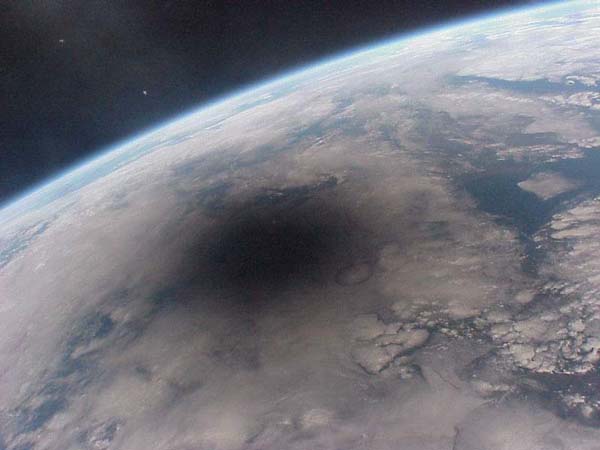
  • @bencrowell Here's an example of the moon acting like a sun shield during a traversal, you'd need something amazingly huge regardless of the implementation: Picture of moon's shadow cast on Earth – Magic Octopus Urn Oct 20 '19 at 18:40
  • @MagicOctopusUrn: Yes, that's why it hadn't made sense to me when I'd been thinking it was the earth-moon L1. –  Oct 20 '19 at 18:41
  • My question was basically answered by Magic Octopus Urn's comment. I still don't understand the statements in this answer that "the object has to be rigid" or that "you'd have to build a continuous ribbon." –  Oct 20 '19 at 18:43
  • 1
    @BenCrowell The ISS zips around the earth at 90mins/revolution. If you wanted the ISS to shade a single area constantly, you'd need it to be, well everywhere on its orbit at once, right? And, because orbits can only be around the central point of a body, you'd also need them for every possible inclination around the "sphere". To have global coverage at LEO you'd essentially have to build something like Elon Musk is trying to build with StarLink. Something that has global coverage constantly. It's a very daunting task. At the L1 we could just throw a new moon there, well, not really. – Magic Octopus Urn Oct 20 '19 at 18:48
  • @Ben Crowell - "...one could put a bunch of black chaff or dust in LEO".

    These would not stay where you put them. Even objects at L1 will drift due to variations in gravitation and then there is radiation pressure; any sun shades used have to have some way to maintain position and (probably) orientation, ie they cannot be passive objects, but will need to have an active drive system and station-keeping navigation (astrogation?). This will cost more than chaff or dust. https://en.wikipedia.org/wiki/Radiation_pressure

    – Ken Fabian Oct 20 '19 at 23:55
2

Thank you @notovny for your comments, I see what you mean, I've fixed my post.

Because the sun has a much bigger diameter than the earth, a sunshade shades more as it moves away from the earth, only for the first 1.3 million km starting from the surface of the earth, then thereafter shades less as you move towards the sun for the rest of the 150 million km. It's more convenient to orbit around L1 at 1.1 million km from earth, rather than try to constantly adjust an orbit to stay at 1.3 million km from earth.

A shade satellite will be relatively lightweight and has a large surface area, the pressure from solar wind and occasional flares will mean that to keep a stable orbit around L1, will mean some challenging "sailing" will be required, at a distance further than L1 from the earth.

Eventually we'll have to control the amount of sunlight that falls on the surface of the earth, to counter long-term milankovich cycles and volcanic events and other events, that cause our ocean levels to oscillate wildly over geologic time, if we want to keep sea levels constant for our coastal cities.

L1 is relatively close to earth, so the shadows a cloud of shade satellites cast can be positioned to favor shading select targeted areas on earth, if there's an advantage to doing so.

For volcanic events that cool the earth, can increase the diameter of the orbits of the sun shades around L1, and position them to bounce more light towards the earth.

Jacquez
  • 21
  • 2
  • Actually, the closer you get to the sun, the less area of the sun your shade covers. and it must be larger proportionally to do the same amount of shading, because the Sun is not a point-source of light, but a miasma of incandescent plasma more than a million kilometers in diameter. – notovny Jul 26 '22 at 16:51