2

After few seconds, post liftoff(anywhere between 60s and 90s), the exhaust plume of PSLV turns into a bluish colour. This is quite evident in night launches than day launches(obviously because the brilliance of sky overwhelms the exhaust plume intensity).

Drop in atomospheric pressure must play a role but what exactly causes this cause to happen?

Why does this happen? Is it common for all solid motors?

Picture for reference from PSLV C28 launch: enter link description here
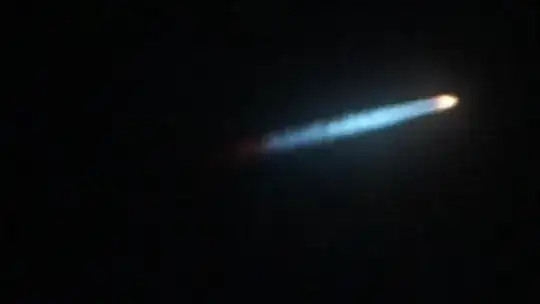
And a video reference of PSLV C44 is here. Time mark 1:30

karthikeyan
  • 4,469
  • 1
  • 24
  • 42
  • Exhaust from a solid rocket will certainly have plenty of left-over carbon atoms and molecules. C-H and C2 molecules have strong blue (and green) emission lines though I can't guess why there would be a change from the bright white incandescence at lower altitudes. Next time bring a piece of plastic transmission diffraction grating and hold it over part of your lens, and you can see if there are distinct emission lines. – uhoh Jan 26 '19 at 13:08
  • This is blue engine exhaust, but it's different chemistry: What is the cause of the blue light from LH2/LOX rocket engines? – uhoh Jan 26 '19 at 13:10
  • Any recommendations for the wavelengths I have to look for in the narrow-band pass filters? I think that will also do a neat job right? – karthikeyan Jan 26 '19 at 13:12
  • Let me just do a bad guess. HTPB + Ammonium Perchlorate is the solid rocket fuel, which is supposed to burn with bright whitish/yellowish flame. Well could it be by any chance blue for the same reason why sky is blue? – zephyr0110 Jan 26 '19 at 14:15
  • @karthikeyan unless you have a super-fast filter wheel or a bunch of cameras each with a different filter, I think the filter is a bad idea. How can you know if you have a line? Use a blue filter, and everything will look blue. Get a grating. Even something like this or this (these are just examples) and experiment with flames or neon lights (if you can still find them) or various LEDs before your next launch. – uhoh Jan 26 '19 at 14:35
  • The pitch should be pretty reliable so you can just use the grating equation to convert angle to wavelength conversion, and photograph a ruler to get pixel to angle conversion. You can also use a CD or DVD in reflection mode, but they are curved so it's much harder to do the calibration. Here's something fancy from here and here's something else. – uhoh Jan 26 '19 at 14:43
  • Once you're done you can leave an answer here ;-) – uhoh Jan 26 '19 at 14:45
  • Any possibility that the exhaust gas condenses and scatters light from the flame itself? Because sunlight cannot be the cause as midnight launch has also created similar effect. – karthikeyan Jan 28 '19 at 11:54

0 Answers0