One of the major hurdles of space exploration is cosmic radiation. How did the Apollo missions solve the radiation problem?
NASA would have shielded the astronauts to some level by some material. How did they try to at least minimalise the effect?
One of the major hurdles of space exploration is cosmic radiation. How did the Apollo missions solve the radiation problem?
NASA would have shielded the astronauts to some level by some material. How did they try to at least minimalise the effect?


While cosmic radiation is a problem, it's the same as with radiation on Earth: the risk is cumulative. The levels were low enough that missions of 1-2 weeks at this level did not pose a big health risk, so no shielding was necessary.
The big remaining problem was radiation from solar flares and CMEs. These produce so much radiation it wasn't possible to build a shield thick enough to protect from them (within the weight budgets available for Apollo). So NASA looked at solar activity, launched during periods when activity was low and hoped a CME wouldn't occur.
The Apollo spacecraft had a thin aluminium hull. This blocks some of the radiation, but not much.
They didn't, which is why the Apollo astronauts saw blinding flashes inside their eyes during the mission and then had a much higher probability of suffering from cataracts later in life.
The flashes were from Cerenkov radiation passing though their eyeballs, occurring as often as 2 per minute on the Apollo missions.
Of the 39 astronauts to suffer from cataracts later in life 36 had flown on Apollo missions. On near Earth missions such as visits to space stations, the Earth's magnetic field provides some protection.

Apollo solved the cosmic radiation problem in a counter-intuitive manner: by minimizing shielding.
Most cosmic rays are very-high-energy atomic nuclei; the rest are very-high-energy protons. When these particles strike something (eg. a sheet of aluminum), they generate a shower of secondary radiation. Any effective shield needs to be thick enough to both trigger the secondary radiation and then absorb it. If the shield just triggers the secondary radiation, it makes things worse, because the secondary radiation is likely to be absorbed by the human body, where the primary radiation is likely to just pass through without interacting.
There are some materials, such as water or hydrogen-rich plastics, that can absorb cosmic rays without triggering the secondary radiation, but Apollo didn't carry enough water to provide a meaningful shield, and the mass limitations didn't permit a plastic shield.

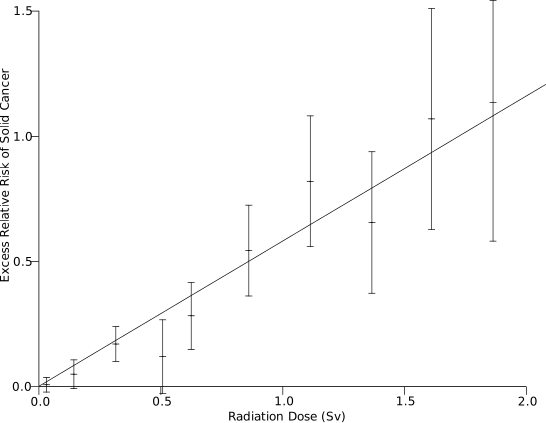
Cosmic radiation is not an acute problem, if you ignore the sun weather and gamma bursts which occassionally occurs. Keep in mind that the life time likelyhood for cancer is anyway around 40 %. The additional radiation per year in the ISS is e.g. 44 to 105 milli Gy. According to the wikipedia graphic below, the increase in cancer-chance is neglectable. Moreover, small radiation doses induce up-regulation of anti-oxidative molecules in cells, which lowers cancer chance even more over longer time-spans.
The other case, if the radiation is so high that astronauts would be killed instantly, is also neglectable. In such a case the electronics would fail too even if hardened.
In conclusion. Is radiation a problem? No, not really. Especially if you compare cancer rates to smoking. However, one can always try to make things better. One way would be to use water or the fuel to shield the astronauts. Unfortunately, this is not always achievable with current payloads.
https://upload.wikimedia.org/wikipedia/commons/a/a1/Increased_risk_with_dose.svg

The "shielding" on the Command module, i.e. outer skin component, was actually stainless steel. Aluminum and other alloys were used for the basic spacecraft structure. Materials were chosen which minimized radiation effects as much as possible. Alpha and beta particles such as are common in the Van Allen belts are easily stopped by thin layers of metal. Cosmic rays are extremely energetic and would not be stopped by lead sheeting.
The Command Module (CM) consisted of two basic structures joined together: the inner structure (pressure shell) and the outer structure.
The inner structure was an aluminum sandwich construction which consisted of a welded aluminum inner skin, adhesively bonded aluminum honeycomb core, and outer face sheet. The thickness of the honeycomb varied from about 1.5 inches (3.8 cm) at the base, to about 0.25 inches (0.64 cm) at the forward access tunnel. This inner structure was the pressurized crew compartment.
The outer structure was made of stainless steel brazed honeycomb brazed between steel alloy face sheets. It varied in thickness from 0.5 inch to 2.5 inches. Part of the area between the inner and outer shells was filled with a layer of fiberglass insulation as additional heat protection.