14

Back in my ZX Spectrum days, it was normal to do manual fine adjustment of a cassette tape position using a hexagonal pencil or a cheap Biro pen. It's almost like the hub is designed to be twiddled that way.

Shown here: https://www.youtube.com/watch?v=VtLpc_71vtA

Adjusting a cassette using a pen

Do we know if that was actually a factor in their design? Or was it just chance?

SusanW
  • 251
  • 1
  • 7
  • 2
    (I'm conscious that this is borderline for relevance on retrocomputing - it's the context in which I'm aware of using the technique. Suggestions for alternative places to post are welcome. OTOH, it seems not everyone knows about this, so it's a good PSA :-) ) – SusanW Nov 02 '23 at 09:26
  • Definitely chance, since the cassette tape was invented around 1965 in the format that it still has. Long before anyone would think about using it as storage for microcomputers, which no-one could even foresee at that time. – chthon Nov 02 '23 at 09:44
  • @chthon sure, that was my use case. But people were splicing audio tapes etc far back before cassettes, and this would have been a useful capability. – SusanW Nov 02 '23 at 10:09
  • 4
    Very, very unlikely. One of the main reasons the compact cassette was introduced over traditional tape machines was to not have the user have to fiddle around with the tape spools. That design idea would have been a bit counter-intuitive at that point in time. – tofro Nov 02 '23 at 12:52
  • @tofro fair point! – SusanW Nov 02 '23 at 13:23
  • 2
    I had a friend who used to argue that the perfect fit of a biro into a cassette despite the two clearly having been designed completely in isolation was proof of God. – Tommy Nov 02 '23 at 14:34
  • 1
    @tofro: A few formats emerged between the home audio reigns of reel-to-reel tapes and the Phillips Compact Cassette, including "8-track" cartridges, and with those the inability to manually tension a tape was a disadvantage. – supercat Nov 02 '23 at 21:04
  • 3
    No. Most pencils do not even fit correctly (Bic pen do). There was a video from VWestlif (https://www.youtube.com/watch?v=vaSN4J3a_60&t=376s) who had shown that only one specific japanese pencil brand fit. – Patrick Schlüter Nov 03 '23 at 15:20
  • 1
    This isn't specific to computing. When recording audio on tape, the pencil/biro would be used to position the tape just past the leader, so that when you pressed 'record' and 'play' together nothing would be lost. Obviously, you would have already 'wiped' the first few seconds of the tape. Oh, and if the only available tool to hand is too small, then you angle it. It's not exactly high precision. – Weather Vane Nov 04 '23 at 20:45
  • @supercat Yes of course - thanks for the reminder, I now recall that the first tape recorder I used to use with my Spectrum would pull a loop of tape when you extracted the cassette, and re-tensioning was a regular thing. That's where my memories of biro-assisted respooling come from. My dad bought me a replacement after a while, with a tape counter - luxury! – SusanW Nov 05 '23 at 12:16
  • 1
    @WeatherVane: I remember a CP/M-based computer which was designed for use with a three-head tape recorder, and would record leader tone until it heard an echo, and would think purpose-designed tape decks could have achieved similar functionality using only an erase head and combined record/erase head along with suitable switching electronics. – supercat Nov 05 '23 at 17:52
  • @supercat in those days I was using a standard cheap domestic tape cassette recorder for both music and computer data. Some cassete tapes, annoyingly, did not have a leader section, so it might be possible to have the beginning of a previous recording that could not be erased. – Weather Vane Nov 05 '23 at 18:05
  • Some people could adjust the tape with their little finger. Hence the phrase: "wrapped around their little finger" (joke). – badjohn Nov 06 '23 at 05:35

3 Answers3

15

I can't give a definitive answer. But it seems empirically clear to me that it's: no.

A common pencil or Bic-type ballpoint pen was not a good fit for a cassette tape sprocket wheel. It slips if inserted directly and just abrades the wheel teeth.

By 'directly', I mean near-enough at a right angle to the cassette body. To spin the tape, the inserted pencil/pen has to be held at quite a sloping angle to engage with the teeth, and it still slips unless held carefully. That's evidence that it's just people improvising.

Spinning the wheel without care can yank the tape-supplying reel and bring tape loops into the drawing reel. So, if anything, that's a reason for the manufacturers to discourage winding by hand: they don't want their product getting a bad reputation. They'd have certainly found that one for themselves during development and testing.

TonyM
  • 3,704
  • 1
  • 19
  • 31
  • 4
    Ok, if the fit is poor, then that makes sense that it's coincidence. But ... my recollection is that the fit was pretty good - I don't recall any of the difficulties you describe at all in keeping the pencil engaged, and I can remember it seeming like the obvious way to do it. I feel an experiment coming on! – SusanW Nov 02 '23 at 11:11
  • 3
    @SusanW It really depends on the specific pencil you pick. In my area the most popular brand of pencil is just too thin. What we ended up doing is to find use the cone of a thicker ball pen and press it into the wheel and turn it with friction. – user3528438 Nov 02 '23 at 11:15
  • 3
    @SusanW, I did it a good number of times, with pencils/pens at home and those from work, spread thin over a lot of years. Pencils stay pretty samesy. I was an avid ZX Spectrum user in the 80s and used a personal cassette player close to every day from about 1987 to 1995, walking and sometimes working. Tightening the tape with a pen (rather than winding) it was a fairly regular thing, walking vibration seemed to shake the ones I owned to a bit loopy. Handle of metal fork was a better fit. But all supports: no, they didn't design cassette sprockets/wheels for use with common pens/pencils :-) – TonyM Nov 02 '23 at 11:25
  • 1
    @TonyM - using the tip of a mechanical pencil engaged into the slot of the wheel worked quite well. – Jon Custer Nov 02 '23 at 12:31
  • 2
    @JonCuster, sure and we could put a list together of all sorts of objects that might do the same :-) But they're not typical, common-or-garden hexagonal pencils or a cheap Biro pen that a manufacturer might design for, which was the question. – TonyM Nov 02 '23 at 13:09
  • 1
    @TonyM - agree, I think we each had our go-to way, none of which were envisioned by the inventors of the cassette. Maybe we need a Biro vs Bic competition... – Jon Custer Nov 02 '23 at 13:11
  • 1
    @JonCuster, spot on. – TonyM Nov 02 '23 at 13:11
  • 2
    @TonyM Uhoh - it started as an experiment, but it's turned into a tournament!! :-D Just to confirm, literally all my old tapes are in storage at the mo' so the experiment will have to wait, sigh. But I'm suspecting my recollection of "no difficulty" might come from having particular pens that did work well, and selectively forgetting about the rest... – SusanW Nov 02 '23 at 13:20
  • 6
    According to a YouTube video I saw recently (I forget whether by Techmoan or someone else), common pencils in Japan, where the Philips Compact Cassette was invented, were just the right size to operate the tape, and while it was intended that such cassettes minimize the need to manually turn the spools, it was definitely recognized that if any slack appeared in the tape, spools should be manually turned to remove it before inserting the tape into a recorder (or player). – supercat Nov 02 '23 at 15:55
  • @supercat Philips is a Dutch company, and the team that invented the compact cassette was based around Eindhoven, Netherlands. – 8bittree Nov 02 '23 at 20:20
  • 1
    @8bittree: It's possible I'm not remembering everything perfectly, but the fact that pencils in Japan are often bigger than in the US at minimum played into the fact that many cassette players' instructions say to use pencils to take up any slack tape prior to use. – supercat Nov 02 '23 at 20:39
  • @8bittree The CC was actually invented at Philips in Belgium. Look up the patent holder in my answer. – tofro Nov 02 '23 at 23:31
  • @tofro I said "around" Eindhoven because I was having trouble finding any specific locations, but I did find this interview of the team lead in which he mentions that easy access to the Eindhoven facilities and knowledge 40 miles away was quite fortunate. But anyway, point is, it was invented nowhere near Japan. – 8bittree Nov 03 '23 at 15:14
  • @supercat Interesting point: "many cassette players' instructions say to use pencils to take up any slack tape prior to use" ... really? Ok, so even if was not a design feature (or even an antipattern), there were grown-ups in the cassette industry advocating it. – SusanW Nov 05 '23 at 12:23
  • @SusanW, I have no memory of many players' instructions saying use a pencil specifically. They did say to take up any slack before use. Incidentally, there are almost certainly car repair websites that recommend banging a part with a hammer to loosen it but the designers don't. In your case, you asked if it was a factor in its design, not common practice afterwards. People used pens etc. because there was little else commonly available to them of the shape they need. They were still a poor tool. I know, I rewound a good few and fixed some scrunched-over tapes (as best I could) :-) – TonyM Nov 05 '23 at 17:28
  • 1
    @TonyM I found a tape, and did the experiment! And... I concur, my "normal" pencils do not fit well at all, but I found that a cheap Bic biro was an unexpectedly good fit. That's probably what I used way back then. Anyway, yes point taken, sounds like the usage followed the design, not the other way around. Thanks! – SusanW Nov 16 '23 at 13:24
9

In the original patent filing document of the Philips Compact Cassette, no mention is made that the winding cores could be operated manually (not with a pen or otherwise). So, it is unlikely that this would have been one of the design goals. Also, as mentioned in a comment, the CC was actually intended to replace traditional tape machines that had you fiddle with the tape and spools. As such, it was an important design goal of the CC that it was not to be operated manually.

tofro
  • 34,832
  • 4
  • 89
  • 170
5

TL;DR: No. Pure Coincidence

All measurements are derivative straight of the turning mechanic's 10 mm diameter.

Also, everyone who has ever produced Bandsalat discovers this. It was an every day issue back then an I would know no school kid not going that way.


Basic Design Considerations
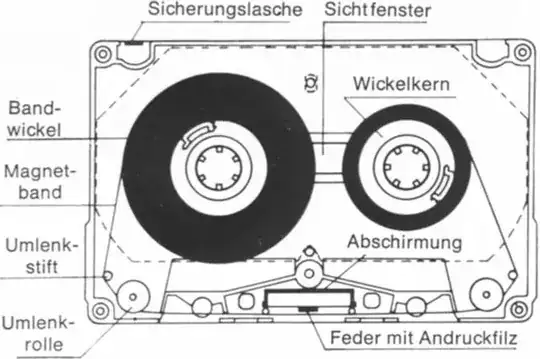
enter image description here

The 'hub' is not designed for a 6 sided transport pin, but for a round one pin with two 'spokes'. The hub being 7.5 mm and the spokes 10mm diameter.

The cassette side could have been made the same way(*3), but that would have resulted in a quite inconvenient handling if they weren't aligned - which they are never. To solve this the cassette got not one but three positions the transport spokes could fit when it got mounted, which equals to 6 'slots' he cassette wheel needs (3 times 2 slots).

For more we may need some guesstimate math:

With the given diameter of 10 mm this comes down to roughly 5 mm per section at the outer rim. Making the spokes of those slots about 1-2 mm in length the inner diameter comes down to ca. 24mm or 4 mm per section. With ca. 1mm wide spokes on the cassette side and 2mm wide on the drive side this comes to a 2 in 3 (66%) chance that a cassette will fit right out without any alignment issue and a slack of at maximum 15 degree (1/24th). For the remaining 33% the cassette wheel had to move a maximum of 7.5 degrees or half a millimeter.

A calculation laying the foundation for a successful hassle free consumer product ... that is ignoring all the issues bad manufacturing of cheap recorders and even cheaper cassettes brought.


Why Do Pen(cils) Then Fit That Nicely?

The fact that a pen can make a good tool to turning the tape is pure coincidental. Any hexagonal shape with diameter between 7 and 10 mm, or roughly 1/3rd of an inch, will do the trick. And that's simply what most pens feature - as it's what the human hand holds best when it's about fine control with one's finger tips. No matter if an paint brush, pencil or a bruin.

Likewise the hexagonal form of pencils is due to this being the least complex, non square form to be manufactured from a board(*3). A development dating back to the late 19th century.

Plastic pens, like Brio or BIC, in turn took that shape to sell a product that fits the expectation formed at users by pencils.


*1 - Engineers love nice strait decimal values and being developed in Europe its of course metric :))

*2 - Classic magnet tape reels had such a 3 prong design - but also no restrictions by being hard connected to another reel or in a case.

*3 - Square pencils are unpleasant to handle.

Raffzahn
  • 222,541
  • 22
  • 631
  • 918