20

I've had a Hayes Micromodem II for the Apple ][ a very, very long time. I've seen a lot of interface cards over the years since then and have never seen anything quite like it: there are giant orange, bulbous chips on the board:

Hayes Micromodem II interface card for Apple II

So my question is, what is the deal with these chips and why do they seem unique to this particular interface card? It almost looks like they were an epoxy protection scheme, but I don't think there was anything really top secret about the device. As well, I would think there were non-blobulous versions of what they needed available at the time?

I would be interested if anyone ever "decapped" (or just melted them down) to see what was inside.

bjb
  • 16,259
  • 46
  • 141

3 Answers3

28

The 207C300 and 207C400 are "active filters for use with modems." They were manufactured by Sprague.

I found an advertisement for them in Electronic Design magazine, volume 26, number 4, Feb. 15, 1978, on p. 163

The advertisement claims:

  • Designed for low speed modem applications
  • Provides all necessary filtering for originate only, answer only, or answer/originate operation
  • Series 207C300 transmit modules feature 6-pole filter to suppress output sidebands, reduce harmonic distortion.
  • Series 207C400 receive modules include 10-pole filter to eliminate noise and local carrier signals

enter image description here

Wayne Conrad
  • 2,706
  • 17
  • 25
  • 3
    so: they are blobbed because that allows them to be sold as one part – user253751 Oct 21 '22 at 18:16
  • 9
    The technology is known as ‘thick film hybrid’. SMT chips and other components, sometimes bare silicon dice are reflowed onto a (typically) ceramic board which may have copper tracks and/or conductive ink. Resistors can be implemented using a not-so-conductive silkscreen layer. – Frog Oct 21 '22 at 18:41
  • @Frog That's good information, thanks. It would be good as its own answer, too. – Wayne Conrad Oct 21 '22 at 19:01
  • 3
    Another common place you might run into a hybrid like this is the VIDIOT (Video-Hybrid) in various Amiga computer models which performs digital-to-analog conversion for the RGB output. Like this example it's a number of discrete components (transistors, capacitors, and resistors) mounted on a single ceramic board with a hard film covering to form a unified package, although in the Amiga's case it takes the form of a 22-pin SIP footprint and the "lumps" under the surface are a little less obvious as the film material is a dark grey colour. – mnem Oct 21 '22 at 20:00
14

So my question is, what is the deal with these chips and why do they seem unique to this particular interface card?

While the orange colouring is quite flamboyant, the use of hybrid circuits/modules was, and sill is quite common. Although, the colour was not specific to Hayes, but of Sprague Electric (today part of Vishay). Also, they were used on several variants, including IBM-PC or S100:
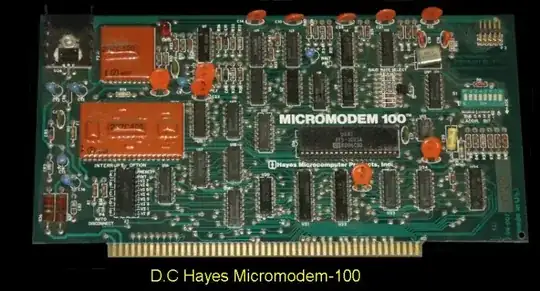
Hayes Micromodem 100

(Taken from the S100 Computer site)

It almost looks like they were an epoxy protection scheme, but I don't think there was anything really top secret about the device.

No, it wasn't. The lacquer layer is to protect the components placed on the ceramic substrate against mechanical and electrical damage.

enter image description here

(Taken from Wikipedia)

Hybrid devices are all about miniaturization. In fact, they are the genuine Integrated Circuits, or ICs, predating today's use of IC, which were called Monolithic IC at first (*1). IBM's Solid Logic Technology (SLT) for example used hybrids to package several transistors and resistors into ... well ... integrated circuits for their new /360 series. Enabling extreme compact boards and as well to reduce cost.

For digital functions, monolithic ICs did take over soon, most notably with James Buie's TTL design, popularized by TI 54/74xx series. For analogue devices, hybrid technology was and still is the way to reach higher integration - although development of ever finer board production and advancement of SMD with devices as small as 0401 is taking of more and more areas originally held by hybrid.

As well, I would think there were non-blobulous versions of what they needed available at the time?

A rough comparison can be made when looking at the stand alone Micromodem:

Micromodem Board

(Taken from Wikipedia)

Comparing the external Micromodem to the Apple II version of less than half the board size (note: pictures are not scaled accordingly) shows how crucial the use of hybrid circuits was to make it fit.

Micromodem Board

(Taken from the question)

I would be interested if anyone ever "decapped" (or just melted them down) to see what was inside.

Since the content was part of the description, it's less work to just look at the schematics.


*1 - Hence several early IC makers carrying the word 'Monolithic' in their names and all of them on their data catalogues.

Raffzahn
  • 222,541
  • 22
  • 631
  • 918
  • Of course, plenty of modern ICs aren't monolithic anymore either, what with the things companies like AMD do to improve yield by splitting functions across multiple "chiplets". It's come full circle! – Hearth Oct 22 '22 at 23:03
  • @Hearth :)) don't forget that next to all modern CPUs since 10+ years are in fact little boards with resistors and diodes added - even if the CPU is a single die. An interesting variant were also some Athlon variants with connective traces on top to be cut by laser according to selected speed grade. – Raffzahn Oct 22 '22 at 23:38
  • 1
    @Raffzahn, ...and then you could change the speed grade with conductive paint and a steady hand. – Mark Oct 23 '22 at 05:18
  • 1
    @Mark Oh, serious? Who on earth would want to buy a low end model, do this, only to get performance of a several times more expensive CPU? For sure not me :)) – Raffzahn Oct 23 '22 at 14:24
  • 1
    I was a big fan of S-100 in the day, and I never knew Hayes made a modem board for it. Serial ports were easy to come by, and external modems worked well enough. – Mark Ransom Oct 23 '22 at 16:24
  • @MarkRansom Not sure, but I do think the S100 Micromodem predates the first external Hayes modem. The external variant was developed to get rid of all the specific cards - IIRC. – Raffzahn Oct 23 '22 at 16:26
  • In general serial ports and external modems worked better. - real blinkenlights were a useful feature. – Jasen Oct 23 '22 at 21:51
  • 1
    @Raffzahn - or graphite pencil – Michael Harvey Oct 23 '22 at 22:02
9

Promoting this to an answer: The technology is known as ‘thick film hybrid’. SMT chips and other components, sometimes bare silicon dice are reflowed onto a (typically) ceramic board which may have copper tracks and/or conductive ink. Resistors can be implemented using a not-so-conductive silkscreen layer.

Frog
  • 1,385
  • 4
  • 7