-9

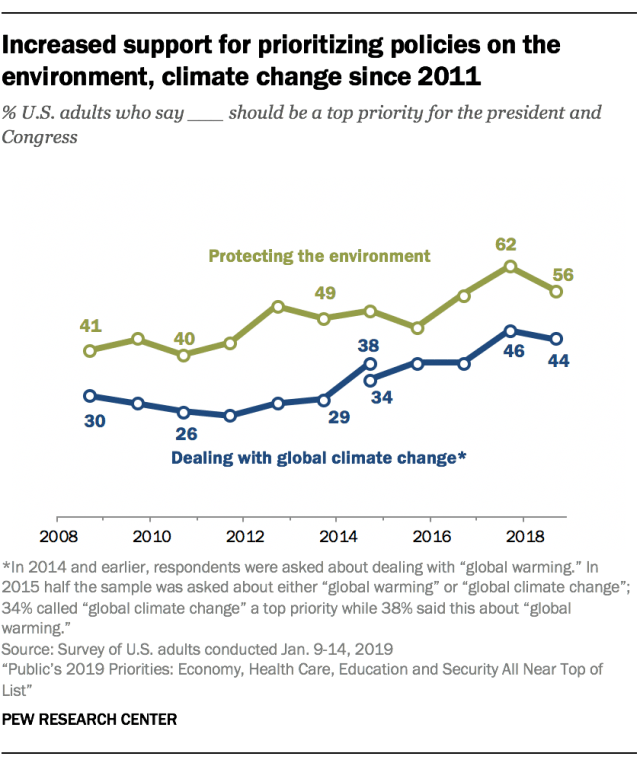
Some people believe in climate change, others don't. Some want to do something about it, some don't. For the purposes of this question, let us limit ourselves to the States. This data suggests that roughly half of Americans do not consider eco-friendly politics a top priority.

The other half of course tries to endorse eco-friendly policies and politicians, and it's a hard battle, and one that, clearly, doesn't seem to be going so well given that the current president of the nation is a climate change denier and his approval rating is still well above 40 procent. And, indeed, the scientific consensus is that our fight against climate change is too slow and too much damage has already been done.

With all that in mind, why don't the half of people that believe in climate change and want to do something about it ... why don't they just .... do it?

If it is indeed true that half of Americans want to do something climate change, then I'd wager that if they all dropped their consumption, that would have an almost immeasurable impact on the climate change prevention process. But that clearly hasn't happened: at most you hear stories about people not using an airplane for their vacation (because yeah dude, now you're totally saving the planet) or eating less meat than usual.

But the truth is that if these people, who seem to believe that climate change is the biggest threat to humanity, really made a change, then climate change would be significantly halted. But we do not see such behavior from these people. We aren't seeing mass boycotts of the most polluting consumer products from this part of the population.

Why? Isn't that a bit hypocritical? Does this reveal that they themselves do not consider climate change a serious threat?

Stormblessed
  • 4,729
  • 2
  • 28
  • 54
Stara
  • 19
  • 10
    And what's your evidence that they aren't, other than your own perception? – F1Krazy Aug 18 '19 at 13:37
  • 5
    I've voted to close this question as off topic, because it appears to be stumping for a specific condition.
    Welcome to SE. Have you taken the tour, or considered if this is an objective question. It appears to be better suited for a discussion site.
    – Drunk Cynic Aug 18 '19 at 13:47
  • Aren't you mixing up a bit terminology? I mean by your definition I do "believe" in existence of anthropogenic climate change but do not treat emission reduction by developed world as a some top priority. Yes, I know this issue tends to be mixed up in public debate, but please specify which exactly issue you are asking about. Possibly also try to rephrase it in a bit less emotionally charged language. – Shadow1024 Aug 18 '19 at 13:47
  • 1
    Let's apply this logic to other issues, like abortion. In the US, it is pretty evenly divided between pro-choice and pro-life, so why get the government involved? The pro-lifers can "take matters into their own hands" by just abstaining from abortions, and the pro-choicers can continue on unmolested while they get abortions. Pro-choicers get abortions without worrying about pro-lifers harping on about it and trying to change laws, and climate-change deniers can go on polluting without worrying about advocates bothering them or trying to change laws. Then everyone's happy, right? – cpcodes Aug 19 '19 at 16:34
  • 2
    @cpcodes The important difference there being that what someone does with their body doesn't really impact the people around them, but if someone pollutes the environment that does affect the people around them. – AquaticFire Aug 20 '19 at 01:38
  • @AquaticFire Continuing my role as devils' advocate, Pro-Life folks consider abortion murder, and so it isn't merely a person exerting control over their own body, like getting a tattoo, but performing an act that is offensive to them at its core. The point I was making is that saying that people who disagree in this case can just do their own thing is inept as a solution, for the reasons I lampooned, as well as those you mention. Law, society, and government simply do not work that way, and it is naive (or disingenuous) to propose such solutions. – cpcodes Aug 20 '19 at 16:54
  • 1
    @cpcodes The counterpoint being that belief is a choice. Contrast that with water being polluted. You can't just choose to believe the water is safe to drink, so nothing will happen if you drink it. – AquaticFire Aug 20 '19 at 21:07
  • @AquaticFire The reality distortion field was a funny joke when people were talking about Apple and Steve Jobs, but it is now a powerful force in politics not funny at all. People may not be able to make water safe to drink by believing it so, but they can certainly assign blame how they choose. If they say that people are not the cause, then there will be a not insignificant part of the population that will buy in to that, and it then becomes a kind of truth. The end result is the same - the water is still unsafe, and nothing is done about it. – cpcodes Aug 21 '19 at 16:10
  • Which brings us back to the fallacy espoused by the OP. If only half of the people choose not to pollute the water, the water is still polluted, making it a poor solution to a problem, hence why anarchy (which boils down to people choosing to do their own thing) fails as a form of government, and is precisely what was being proposed. Since environmental issues tend to be a left wing concern, the argument of the OP reeks of right-wing bias, so I chose to reverse the issue using a right-wing sacred cow to illustrate why the idea was laughable. Was the analogy perfect? No, but it was adequate. – cpcodes Aug 21 '19 at 16:12

1 Answers1

12

A meaningful solution to climate change will require a lot of political will and state action. It simply cannot be solved through the consumption choices of individuals and households. Transportation, electricity genration and industrial production together account for the vast majority of carbon emissions. In each of these areas, key decisions are shaped by the decisions of businesses and policymakers and are only very indirectly influenced by the preferences of consumers.

I will briefly illustrate what I mean with reference to transportion but the same idea applies to the other sectors. Climate-conciouss consumers are buying hybrids and electric cars. Some are gravitating away from the suburbs and into the cities. They are biking more, etc. But it is not economically feasible for most consumers to avoid fossil-fuel based transportation. They choose where to live and work based on conditions outside their immediate control. But the corporate and government entities that hold economic and political power do have much greater ability to shape the conditions under which consumers make choices---where housing and jobs are located, what modes of transport is available at what cost, etc.

Almost by definition, this is exactly what we mean when we say that climate change is a political issue.

Brian Z
  • 17,198
  • 1
  • 49
  • 70