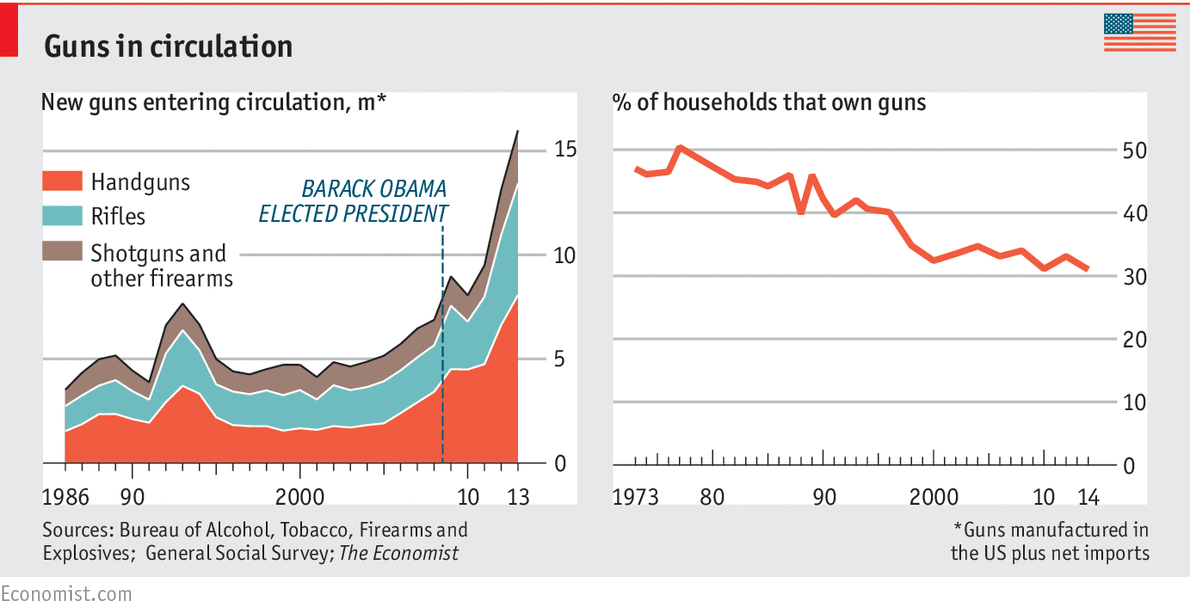
Based on the number of questions that come up about gun control (c.f. Has gun violence decreased in states with open carry laws?, Gun prevalence vs homicide rates - correlation and causation, and Same amount of weapons per person in Canada as in USA, far less murders. A political reason?) empirical questions surrounding gun ownership perennially arise. Unfortunately, almost all of the data bantered about are limited to total numbers, or mean possession.
As anyone who passed beginning stats can tell you, though, means are limited in their usefulness and need to be paired with the distribution. Absent true distributional models, information like medians, modes, and standard deviations would be useful. Unfortunately, I haven't be able to uncover this for civil small arms ownership at any level of aggregation.
For an example of why this is important: If we imagine Franconia and Sylvania both have average home sizes of 4 people, and average gun ownership of %25 of the population (1 for every 4 people) it might seem like their gun environments are comparable. But if in Franconia, every person who owned a gun owned only one and in Sylvania every person who owned a gun owned five, the reality would be much different, and their small arms ownership rate by household would be even more dramatic, with Franconia having a gun in every home, whereas only 20% of homes in Sylvania have guns.
To put it more empirically, much of the debate surrounding gun violence in the U.S.—and elsewhere—revolves around rates of civil small arms ownership. Advocates of gun control contend, rightly—according to the best available data, that the mean ownership of firearms in the U.S. higher than in any other country. Advocates of gun rights claim non-comparability for other reasons, or argue for comparability in other areas (e.g. compare homicide rate by blunt instrument, which are nearly universally available) for explanatory power. However, we know that while the number of guns in the country has increased, the number of homes with guns has actually decreased, meaning that net access to firearms could have gone down. In fact, the modal number of guns in households in the U.S. could actually be 0, much as with many other countries, throwing the causal logic of many explanations of gun violence into question.
As such, I return to the original question, which is:
Are there any data on the distribution of small arms, preferably grouped by country, but if not within country, but grouped by second tier political body (i.e. states, provinces) would be acceptable?
If no such data exists, what would the best way to estimate it from existing data, short of conducting original research?
If no such data exist, and there is no easy way to estimate it from existing data, are there any organizations which collect such data where adding this kind of information would be plausible (e.g. something like the General Social Survey, which could just add a question or two)?