1

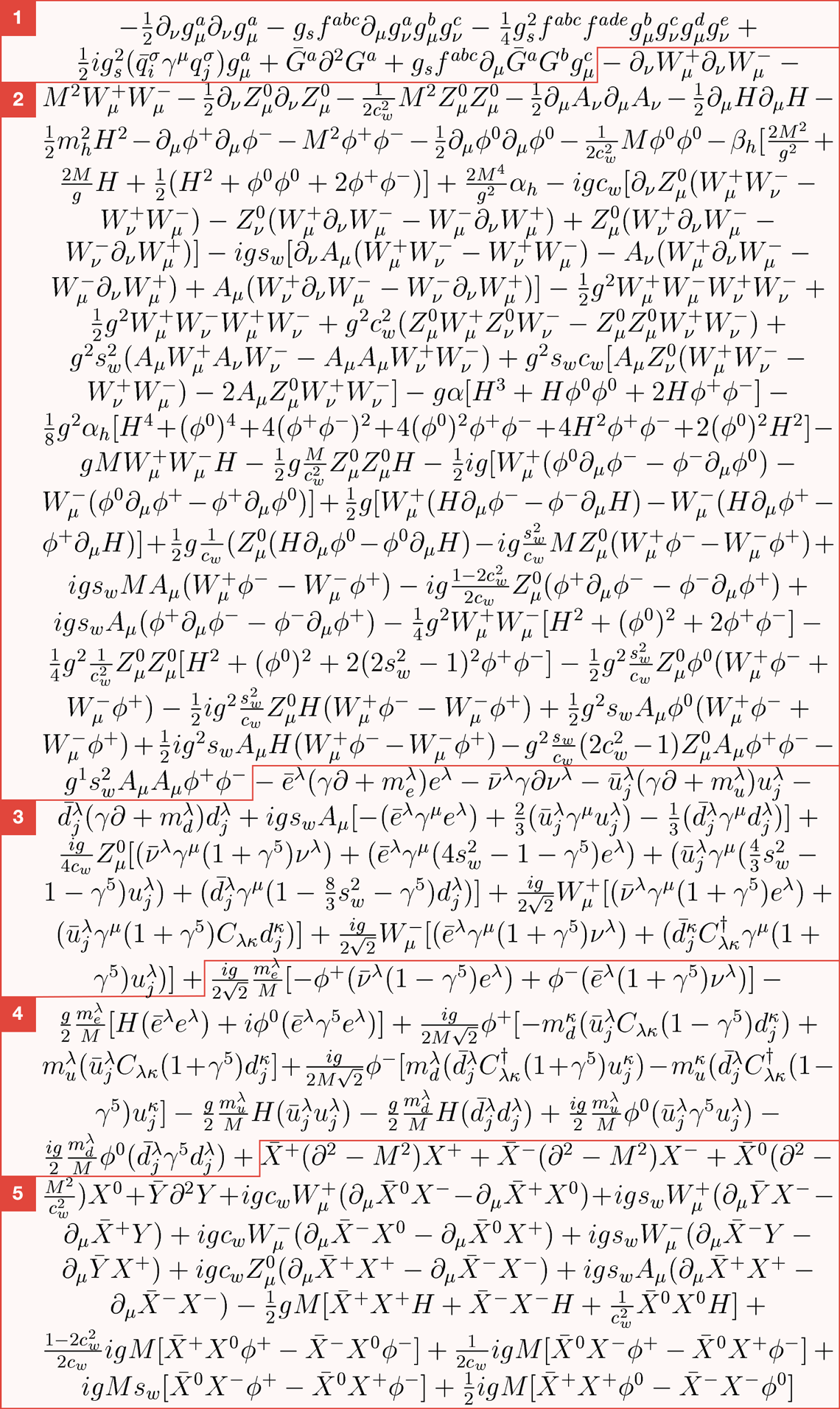
I read the total equation for the standard model is something like this https://www.symmetrymagazine.org/sites/default/files/images/standard/sml.png

It's quite complicated. My understanding is that the fields representing each particle can be modeled separately in a fairly straightforward* way (to give an incomplete / non physical theory).

Is this correct, and can a model of a simpler universe containing just one type of particle be described in this way? If so, which particle in the Standard Model would be the simplest? I realise this could be a subjective question but I am hoping it may not be. Please assume no existing knowledge of physics (only maths) and no real-world experience, just assess the simplicity from a mathematical perspective.

You don't have to give a justification (unless it is contentious) or the mathematical form of the field, unless you would like to. I hope to address those kind of topics in future.

*Mathematically but not conceptually! It can be argued whether interaction terms are intrinsic or extrinsic to an individual field. For this question I am excluding all interaction terms that involve another field. To be clear, that includes even phenomena like self-interactions mediated by virtual particles of other fields.

  • 5
    A scalar field? – Qmechanic Feb 06 '18 at 17:53
  • So it would be be either the Higgs field or a pion field? – user183966 Feb 06 '18 at 17:59
  • 3
    The simplest field is a multiplet of $\mathcal{N}=4$ supersymmetry because you don't have to worry about quantum corrections that much. –  Feb 06 '18 at 18:14
  • Thanks, does that correspond to an actual particle field in the standard model? (I should probably clarify my question) – user183966 Feb 06 '18 at 18:38
  • Are you interested in SUSY extensions of the S.M or just the S.M? –  Feb 06 '18 at 18:46
  • Just the standard model please. This is intended to find a "model particle" (like model organism) for my pedagogical use. I think a standard particle will be easier for this. – user183966 Feb 06 '18 at 18:49
  • 2
    The simplest field is a field that is a scalar with respect to all the symmetries of the theory. In other words, a scalar with respect to Lorentz, colour, isospin, etc. No such field exists in the Standard Model. – AccidentalFourierTransform Feb 06 '18 at 19:04
  • Thank you @AccidentalFourierTransform. I may use this "toy field" (if that could be considered correct?) that you describe as a model for future learning. However, do you also know which of the fields that is present in the standard model is the simplest? – user183966 Feb 06 '18 at 19:15
  • 1
    The simplest toy field is the [scalar field], as @Qmechanic already pointed out. The Higgs field H is described by such actions, sector 2 in your comically turgid and medieval chart, but couples to many other fields, in the other sectors, in significantly interesting ways, so your ranking requirement according to "simplicity" is worse than meaningless. The SM is the intricate meshing of several simple pieces, and so is a clock; but, personally, I have trouble visualizing the simplest gear of a clock. – Cosmas Zachos Feb 06 '18 at 22:31
  • @CosmasZachos thank you for proposing the Higgs field. I think your analogy of a clock is very helpful. I realise looking at a gear tells you very little about the design of a clock. But for a person who has never seen a clock or a gear before, just to begin, I am hoping to start by looking at a 'spur gear' rather than a 'worm gear', if you see what I mean.

    Regarding the image, if you know another 'complete and compact' statement of the standard model so I can start to discuss it more professionally I would be very grateful to learn of it. That was the only one I could find.

    – user183966 Feb 06 '18 at 23:14
  • If the person who voted my question bad could explain what is wrong about it and how I can improve it, that would be very appreciated. – user183966 Feb 06 '18 at 23:15
  • Well, the standard WP article certainly breaks down the SM lagrangian in more meaningful subunits before putting them together. But looking at a macaronic formula and expecting to understand it just so is absurd. You might take a book on the SM, of which there are dozens, that builds up to the SM and puts it together from constituent pieces. – Cosmas Zachos Feb 06 '18 at 23:24
  • Perhaps this WP article would be more to your liking, but looking at its action and symmetries without understanding what they do without a course in quantum field theory sounds feckless... People normally take a one-year class on such... – Cosmas Zachos Feb 06 '18 at 23:31
  • @Cosmas Zachos thank you very much for all your suggestions. The mathematical formalism article is very good. I did take a masters course of theoretical physics and have some books, but I found them not so clear in some places, so I am hoping if I approach it from some different angles it will clear up these points. I ordered that book you suggested thanks! – user183966 Feb 07 '18 at 00:00

2 Answers2

2

The simplest quantum particle, at least on the formal, mathematical level, is described by a free real scalar field $\phi(x^\mu)$. This corresponds to an abstract particle that has no charge and no intrinsic angular momentum (spin), and that does not interact with anything, just freely drifting through the universe. The simplicity of this field is the reason why most courses on quantum field theory (particle physics) start with discussing scalar fields.

However, the behavior of this particle is nothing like any real particle of the Standard model. In particular, the Higgs boson, also a particle without charge or spin, is in fact interacting in many complex ways with many particles. As a result, the Higgs boson has a lifetime of about $1.6×10^{−22} s$. In other words, write a zero, comma, then 21 more zeros, and then a one and a six, and that's the kind of time you have a chance to register a Higgs boson for! After that it decays into a spray of other particles and in practice we never detect the Higgs directly. That is nothing like the free scalar particle described above!

So, the Higgs boson is on some arbitrary formal level very simple, but in flesh it is not. If you are looking for the simplest mathematical model which describes to high accuracy the actual behavior of real particles, then you can consider quantum electrodynamics. Quantum electrodynamics is the theory of how electrons and positrons propagate through space and interact with each other through the quantized electromagnetic field (photons). Another very simple theory which effectively describes the behavior of real particles is the Yukawa interaction, which approximates the interaction between protons and neutrons by letting them exchange pions, a quantized scalar field.

The understanding of the behavior of quantum electrodynamics and the Yukawa interaction is essentially a prerequisite to understanding the more fundamental and complicated theories of electroweak interactions and quantum chromodynamics (which are already the two building blocks of the Standard model). This is the reason why after discussing scalar fields, a typical quantum-field-theory textbook passes to free spinor fields (corresponding to spinning particles without interactions), and finally to the aforementioned quantum electrodynamics and Yukawa interactions.

Void
  • 19,926
  • 1
  • 34
  • 81
  • Hi Void, thank you for your answer. I can see clearly you have put a lot of care into it. However I must respectfully say I don't feel it answers my question. Firstly regarding your criticism I performed the following calculation: Higgs rest energy 125 GeV; Minimum oscillation period 3.32e-26 Seconds through E=hf; Mean lifetime 4700 oscillations . If that is correct this means the field typically oscillates 4700 times before decay. This suggests to me plenty of time for it to closely approximate a free field (or not, but this to me seems an interesting question not limited by its lifetime). – user183966 Mar 11 '18 at 01:18
  • Regarding the question and answer themselves, I mentioned specifically "mathematically simplest" and "just assess the simplicity from a mathematical perspective", so I do not see why "actual behaviour" is relevant, notwithstanding my previous comment. I can willingly accept this may be an 'unrealistic' question but surely this could be said of some of the original classic thought experiments of QM (I am not suggesting any other similarity to them)? There seems to be a general antipathy to this question, and I am not sure why (I would be very keen to know). – user183966 Mar 11 '18 at 01:33
  • Once again, I can see in any case care has been put into this answer and I do appreciate that. – user183966 Mar 11 '18 at 01:34
  • 1
    Well, the issue is that there is too many points of view one can take on your question. What makes a particle that particle from the Standard model? Its interactions. For instance, a large fraction of the mass of any Standard model particle comes from self-interactions through virtual particles of other species. On the other hand, the Higgs boson is in some sense a 'quasi-particle', it is only one of the modes of the Higgs field, a mathematically much more complicated object than the real scalar. The Standard model is an entangled block and taking one isolated part is not very natural. – Void Mar 11 '18 at 09:18
  • Thank you for your reply, it was very helpful. Although the physicality of a field is not strictly relevant to the question, of course it is very interesting and I have made a new question regarding this https://physics.stackexchange.com/questions/391581/ . Regarding the character of the Higgs field, this is exactly the kind of information I hoped to get from this question (ie. it is not as mathematically simple as one might expect). I can see my question is not very clear, I will try to improve it. @Void – user183966 Mar 11 '18 at 14:58
  • Also I note that my question is now officially American ;) – user183966 Mar 11 '18 at 15:21
-1

Based on the comments on my question, I believe the answer is the Higgs field.

  • 2
    Answering your own question is fine, but the answer should be self-contained. That is, you should explain why this is the answer, rather than just stating it. – Chris Mar 09 '18 at 19:03
  • Hi @Chris. Thanks for your comment. I wish I could provide a more detailed answer. However, I was simply extracting what appeared to be the consensus from the comments to my question, in the hope it would help anyone else looking up this question. This may be a poor answer, but I felt, assuming it was factually correct, it was better than none at all. – user183966 Mar 11 '18 at 01:43