9

A metal (or otherwise, suitably elastic) circle is cut and the points are slid up and down a vertical axis as shown:
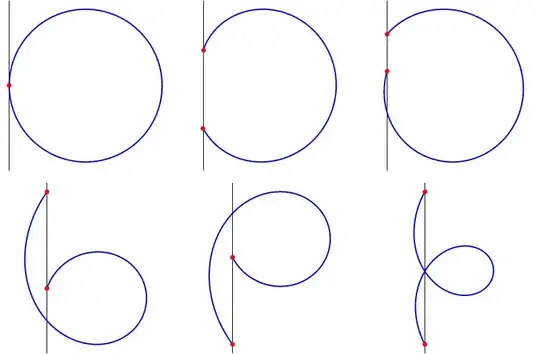
enter image description here

How would one describe the resultant curves mathematically?

martin
  • 155
  • 1
    From a mathematical point of view this problem is not constrained enough. You cannot say what the shape is of the circle based on only two points. See, for example, the third shape it can be many different shapes and depends on how the metal would deform. So some information should be provided on the properties of the metal. – Jasper Oct 01 '14 at 09:29
  • 2
    Interesting question. I don't know the answer, but your question is very similar to this one. The accepted answer assumes only small deformation, which may not be applicable to your question. However it does provide a link to this PDF that describes how to calculate the shape. – John Rennie Oct 01 '14 at 10:36
  • So what would be the difference between the second shape, but with the endpoints at the same distance as they are in the third shape, and the actual shape in your third case? I figure you would need at least two more known factors here, which should most likely be the angle formed by the axis and the tangents to the curve in each of the endpoints. Maybe it's possible to do this with only one known angle, but I don't know right now.... – Thyamarkos Oct 01 '14 at 10:50
  • 2
    Whatever the equations, one thing is for sure. If you cut the (thin) metallic ring and place its ends at different distances apart from each other, the wire will settle in the shape; which if it conforms to, has the least elastic potential energy. The equations for the shapes can be derived by using this as one of the conditions. (except for the other complicated shapes given). Any other factors that may contribute ? – Gaurav Oct 01 '14 at 12:30
  • @John Rennie Thank you for the links - the PDF especially is helpful :) – martin Oct 01 '14 at 13:25
  • 3
    @PhysicistByLogic Actually it might not be the least elastic PE: just a local minimum. Looking at the bottom curve on the right, the wire would settle into two stable equilibriums with the same projection as shown: you can grasp the central loop and twist it a full turn about an axis horizontal on the page and through the intersection point: you'll get two different equilibrium states, with different torsion in the wire. – Selene Routley Oct 03 '14 at 15:08
  • 1
    The end conditions should be that the force components on the top point should be equal and opposite of the force components on the bottom point. Otherwise the wire would move. – John Alexiou Oct 03 '14 at 15:28
  • 1
    These curves are briefly mentioned in The Feynman Lectures vol 2, 38-12. They are related to Jacobian elliptic functions. If I understood more I would write a full answer instead of a comment. – Noah Oct 06 '14 at 23:54
  • @Noah, great resource :) – martin Oct 07 '14 at 00:45

1 Answers1

5

This problem was first formulated by Leonhard Euler in 1744 WPlink: "That among all curves of the same length which not only pass through the points A and B, but are also tangent to given straight lines at these points, that curve be determined in which minimizes the value of \begin{equation} \int_A^B \frac{ds}{R^2} \end{equation}

It is a problem of calculus of variations and the Euler-Lagrange equations WPlink allows to solve it as an ODE of the type:

\begin{equation} \frac{dy}{dx} = \frac{a^2 - c^2 + x^2}{\sqrt{(c^2 - x^2)(2a^2 - c^2 + x^2)}} \end{equation}

The physical meaning is this: the wire will take the shape that minimizes the total energy related to bending further in each point. This energy is similar to the the spring potential energy for deformations, but in this case the measure of the deformation is the curvature $k = \frac{1}{R}$. Since in your proposal, the elastic line was initially a circle, I would propose the integral to be: \begin{equation} \int_A^B (\frac{1}{R} - k_0)^2ds \end{equation} where $k_0$ would be the initial curvature which should be the rest one. I would set it constant here since for the circle it is the same in any point, but in general if you start with a different rest position, the rest curvature in each point will differ from point to point.

Now let's analyze the curves, and group them. If we number them from left to right and from top to bottom we can make the 2 following groups:

  • Fixed ends condition: The curves 1,2 and 6. This curves are only determined by fixating the extremes of the curve, or frontier conditions. This means that they are shapes that the curves will take naturally under no external forces on any point of it.

  • Fixed ends + one fixed end angle conditions: The curves 3,4 and 5. It can be seen that 4 and 5 are the same. This curves need, apart from the fixed extremes condition, the fixing of one or two of the extremes' angle. A bending force there or some general external force acting on one r more points of it would cause them as well. If they did not have this extra condition, nothing would prevent them from falling back to form 2 or 6.

Finally, here is a review of the solutions, with a great historical presentation of the problem: ElasticaHistory. But if you really want to get serious I recommend A Treatise on the Mathematical Theory of Elasticity.

rmhleo
  • 3,775
  • Thank you for your great answer! It is group 2 that I am particularly interested in. Would it be fairly straightforward to incorporate fixed angle constraints into the calculations? – martin Oct 08 '14 at 14:09
  • Yes, the "fixed angle" conditions would simply be set by the frontier conditions for the tangent of the curve, i.e. the $dy/dx$ values in A and B (I meant the fixed points). – rmhleo Oct 08 '14 at 14:12
  • You're very welcome! – rmhleo Oct 08 '14 at 14:23
  • question now moved here – martin Oct 09 '14 at 10:58
  • Would the integral $\int_A^B (\frac{1}{R} - k_0)^2ds$ still apply for the fixed-angle conditions? I have tried to solve numerically for the question linked above, and am out by approx. $0.2$. Would this imply that the curve I am dealing with is not of the elastica type, or am I missing something? – martin Oct 09 '14 at 12:46
  • I don't see why not, is just setting a different minimal configuration for the curve. But bare in mind that differential equation above comes from minimizing the first integral, not the one I proposed. I have not done it for the one I proposed but it should be easy to obtain since the integrand must follow the Euler-Lagrange relation. – rmhleo Oct 09 '14 at 14:33
  • I think we have conversations going on in two places! Thank you for your patience in this, and thanks for responding BTW :) – martin Oct 09 '14 at 14:36
  • Sure! Is an interesting question also for me :) – rmhleo Oct 09 '14 at 14:55