7

Consider a hydraulic jack with massless pistons as follows.
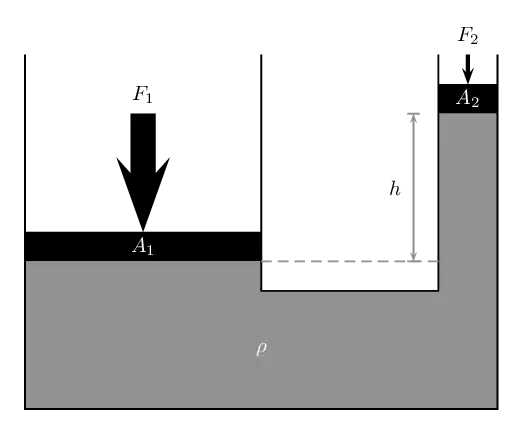
enter image description here

The famous equation for this system is

$$ \frac{F_1}{A_1}=\frac{F_2}{A_2} $$

My question is why isn't the equation as follows?

$$ \frac{F_1}{A_1}=\frac{F_2}{A_2} + \rho g h $$

It is based on my understanding that any points in the same horizontal line have the same pressure.

Could you spot my misconception?

  • 2
    This is a good exercise to learn a bit of thinking like a physicist. You've done the "be careful and pedantic in deciding what the physics is" part. Now do the "figure out what contributions we can safely ignore" part... – dmckee --- ex-moderator kitten Mar 11 '14 at 16:04

2 Answers2

4

Your second equation is correct. The $\rho gh$ term is small compare to the force needed to lift a car for example in a real jacking situation, however.

DavePhD
  • 16,164
0

Your second equation is correct when there is a piston height difference.this equation is derived from pascal law.law states the initial difference remains same.it only talks what happens when you apply a force on one end and how the pressure of incompressible liquid transmit that force to the other end.

Vaishakh Rajan K
  • 967
  • 4
  • 16
  • 35