7

I know that the aperture size has a direct effect on the depth of field.

However, what about distance to the subject? Let's say I took two pictures, one at 24mm and one at 70mm, using the same lens and camera settings. In post-processing, I crop the 24mm picture so that it has the same field of view as the 70mm picture. Will both of them have the same depth of field and bokeh?

Daniel T.
  • 1,827
  • 4
  • 20
  • 27

4 Answers4

11

In your example, assuming you kept the same distance to the subject, the 24mm picture would have more depth of field than the 70mm picture. To keep the same depth of field, you'd need to stop the 70mm lens down until it has the same absolute aperture diameter (so that 24/f-number = 70/other f-number).

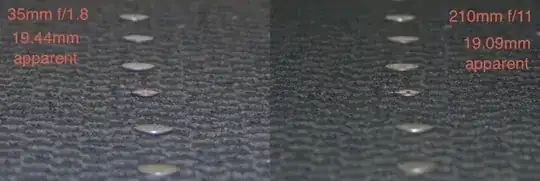
In this picture, you can see that a 210mm f/11 lens has roughly the same depth of field as a 35mm f/1.8, when cropped to the same field of view and subject distance is kept constant.

Evan Krall
  • 12,397
  • 10
  • 60
  • 93
  • Believe it or not (as you wish), what you are seeing here is an artifact of digital photography. If your recording medium had enough resolution, you'd come to the opposite conclusion (as I did with Kodak Technical Pan, which, at some 200 line pairs per millimeter when developed for continuous tones handily outresolved all of my lenses -- equivalent to about 140 megapixels). Once the circle of confusion gets smaller than about 120% of a pixel, it doesn't have a lot of influence on any pixel but the one it hits hardest. –  Feb 09 '11 at 22:52
  • 1
    @Stan I'd be willing to bet if you tried the experiment again, but with film, you'd get the same results. – Evan Krall Feb 12 '11 at 01:59
8

Absolutely it does. Just to give you an idea, here's a few recent pictures of mine. The first was shot at f/14 with my new 100mm lens at a very close distance, the second was shot with the same lens at f/13, at a more typical distance. Note the huge difference in the DOF.

F/14 at 100mm

Police cutbacks

PearsonArtPhoto
  • 10,941
  • 10
  • 60
  • 93
6

Even if you don't have your camera with you, you can experiment with a depth-of-field calculator (like this on-line one) to play with focal lengths, f-stops, and focus distances to see exactly how depth-of-field changes as those variables change.

5

The depth of field is more like a ratio. so the further the focal plane is away from you the more area will be in focus. A rough way to visualise this would be to imagine a bell curve with one of the lower points being attached to the camera and the top of the curve being attached to the focal point. A near object would have a steep curve, a far object would have a longer gentler curve.

Designer023
  • 1,237
  • 2
  • 12
  • 22