28

Let's suppose I'm on a tripod, photographing a perfectly still scene (also dark) and I take these photos:

  • 5 photos at ISO 3200 and 1s exposure
  • 1 photo at ISO 100 and 5s exposure

There is a common thing between the items, and it's the total time used.

The EV of the first item is much higher, right? Now suppose I average the 5 photos at ISO 3200 to reduce noise, producing a single image.

After that, I take the ISO 100 photo and I adjust levels (which would increase noise) to reach the same EV of the blended photo, in a way if I look these 2 photos from far away they'd look the same.

Would the noise level be equal, comparing the blended photo and the levels adjusted photo?

I hope you understand my point.

EDIT

In response to drewbenn's commentary

Also, I don't think that blending the 5 photos will reduce noise the way you think it will

Blending photos reduce noise a lot, in fact here is an example:

I took 20 photos of a tree with: ISO 1600, F4.1 and 2s exp. The upper image is showing how much noise any of those images have. The lower is showing the result of averaging the 20 photos in one.

Sory for the bad focus.
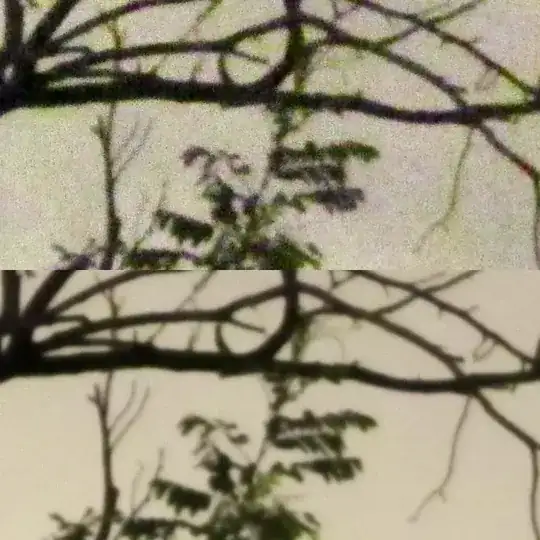
100% view of the original image and blended one

As you can see, the noise gets almost completely deleted

EDIT2

For the ones who are asking, I used a very simply command of imagemagick to average the images:

convert [input1.JPG input2.JPG ...] -average output.JPG

If I have some time later, I'll try to conduct one of those experiments you're talking about. I guess there is no a static pattern and it'll vary on each camera.

EDIT3

I've also done a experiment a little more different:

This is the Scene:

Scene

And I've taken these set of photos (the aperture is always the same), I used manual mode.

  • 01 @ ISO 100, 0.6s
  • 02 @ ISO 200, 0.3s (averaged later)
  • 04 @ ISO 400, 1/6s (averaged later)
  • 08 @ ISO 800, 1/13s (averaged later)
  • 16 @ ISO 1600, 1/25s (averaged later)

Each set has the exactly same EV, these are the results, in the same order:
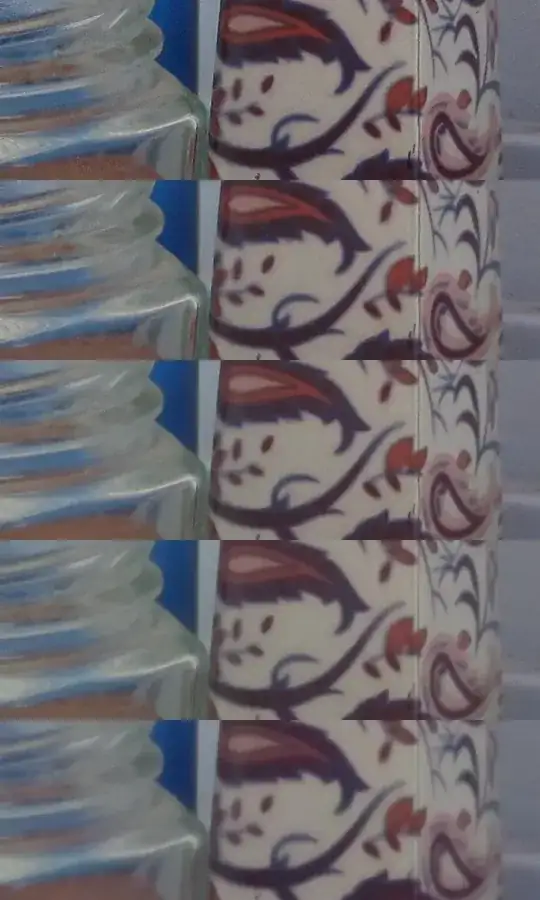
Experiment

It seems that a higher ISO, there is less noise but less details as well.

mattdm
  • 143,140
  • 52
  • 417
  • 741
tomm89
  • 3,231
  • 3
  • 29
  • 35
  • 1
    I think it'll reduce the noise a little, and that noise could be the same amount as in the photo with adjusted levels. – tomm89 Feb 02 '11 at 07:19
  • 4
    You have provided a sample of averaging ISO 1600 images. I would also like to see a single properly exposed ISO 100 image. I still believe that the ISO 100 image is going to exhibit low noise, and probably better detail. Not to mention the fact that it is FAR simpler than taking 20 ISO 1600 images and averaging them together. – jrista Feb 02 '11 at 09:20
  • 2
    What software are you using to blend and what method of blending is used? – ilija veselica Feb 02 '11 at 09:28
  • 2
    Why don't you just try it out and let us know the result? – Chris Feb 02 '11 at 12:23
  • @ile Check EDIT – tomm89 Feb 02 '11 at 19:11
  • With your latest example, there is a marked reduction in detail in the averaged ISO 1600 images. There is noticeable reduction in detail for all the averaged images, particularly in the the specular highlights of the glass bottle. – jrista Feb 02 '11 at 21:31
  • The second series is fascinating. Unless the tripod is absolutely rock solid--and maybe even then--we could expect the different images in a series to be slightly misregistered. This requires resampling in order to overlay them. The effect is going to be a like a Gaussian blur whose radius is proportional to the square root of the number of images. The largest misregistration should be about 1/2 pixel (variance = 1/12 pixel^2), so overlaying 16 images ought to create a "registration variance" around 16/12 pixel^2, corresponding to a Gaussian blur of about 1.2 pixel radius. – whuber Feb 02 '11 at 21:36
  • (Continuation) Consequently, following up the image overlays with an appropriate sharpening--one designed specifically to deconvolve Gaussian blurring--might do a remarkably good job at recovering details. – whuber Feb 02 '11 at 21:38
  • Pentax's cameras have a multi-exposure shooting mode setting to do something similar in-camera, FWIW. – mattdm Feb 02 '11 at 22:48
  • 1
    Mu guess is "average" is a mean. The problem with mean is your are just smoothing the noise into the image, which will ultimately reduce sharpness. Median, on the other hand, will mostly eliminate noise below a certain threshold. Can you try a median? – rm999 Feb 02 '11 at 23:09
  • @rm999 Assuming the noise is zero mean gaussian, using the mean is correct thing to do and will not reduce sharpness in any way. – Matt Grum Feb 03 '11 at 10:23
  • @tomm89 Did you use a tripod and cable release (to avoid moving the camera in any way)? Also did you make sure high ISO noise reduction was turned off? Only the experiment I did revealed no loss of sharpness by blending 16 ISO1600 shots together. – Matt Grum Feb 03 '11 at 10:24
  • Well, I used I tripod although it's a Chinese brand (and also very thin) so the quality is questionable. To shoot the photos, I used a script so the movement is between each set (when I press the shutter) but there should be no movement between the photos inside each set. And last, remember my camera is a Point and Shoot so the overall quality will not be the same compared to a DSLR. – tomm89 Feb 03 '11 at 16:43
  • @Matt Grum With a small number of photos the chances of the noise contributions to a single pixel summing to ~0 are very low. This is easy to show mathematically: the distribution of the sum of gaussians will have a higher variance than the individual gaussians. In an averaged (mean) photo, each pixel is more likely to be affected by noise than in the individual photos, but the noise will be of lower magnitude. If you have a large enough number of photos the magnitude will be low enough that you are correct. – rm999 Feb 03 '11 at 21:45

5 Answers5

9

Provided your ISO100 image was not underexposed I wouldn't expect a noticeable reduction in noise (except maybe in the deep shadows) with the 5 1 second ISO1600 images blended together.

In the infamous other thread I demonstrated that a 1/30s ISO100 will contain more noise (lower signal to noise ratio) than a 1/30s ISO1600 image. Same amount if light but the higher ISO had less noise.

The reason for this was that the read noise is proportionally greater in the ISO100 image (as readout happens after amplification). In a "correctly" exposed ISO100 the read noise is so small compared to the signal that any reduction in read noise is probably not noticeable.

edit: just did the experiment

I shot one photo at ISO100 16 seconds, and 16 shots at ISO1600 but only 1 second. All images were well exposed. What follows are two crops, the top row is a single ISO1600 image, and the bottom two are the 16 ISO1600 images averaged in Photoshop, and the ISO100 image. I won't tell you which way round the bottom two are, to see if anyone can actually tell the difference - I certainly can't!

Glorfindel
  • 1,128
  • 1
  • 11
  • 21
Matt Grum
  • 118,892
  • 5
  • 274
  • 436
  • If the ISO 100 image was correctly exposed, then each of the ISO 3200 images must have been grossly overexposed (by 2.7 stops). I think it more likely the ISO 3200 images were reasonably exposed. Thus, we should be contemplating comparing 5 ISO 3200 images to one ISO 640 image. (I see in the Edit that the OP has changed to 20 ISO 1600 images. Their blend should be compared to a single ISO 80 image.) – whuber Feb 02 '11 at 17:10
  • When I tried to write the question, my point was: 1 image with low ISO and longer exposure and a series of images (averaged later) with higher ISO and a exposure that equals a/n, being a the exposure time of the low ISO image and n the quantity of high ISO images. But all of this speaking in terms of not blowing nor underexposing any of the images. Can I explain myself? – tomm89 Feb 02 '11 at 19:18
  • +1 Your answer has me wondering if you really need to blend all 16 images together, and if not how many you need before the differences are not noticeable. Did you try blending half of the high ISO images together? – Benjamin Cutler Feb 02 '11 at 20:53
  • How exactly did you average the images together? – jrista Feb 02 '11 at 21:28
  • I think I've done the same experiment. Check my EDIT – tomm89 Feb 02 '11 at 21:29
  • @Matt The middle images seem slightly sharper to me. – whuber Feb 02 '11 at 21:39
  • By the way, it's perfectly reasonable that less images (or a single image) yield to a sharper result, because even if the pictures are taken with a tripod and a remote control, it's very difficult that they are perfectly aligned (and also the light source might have changed because the temperature of the bulb raising over a longer period of time [including the lapse between shots], for example). – fortran Feb 03 '11 at 16:39
  • @fortran Looking again at the 16 image sequence the first and last images are out by about 1.4 pixels, or 0.02% of the image width. After auto align in Photoshop the images were almost perfectly aligned (to within my ability to detect any misalignment). The total time to shoot the sequence was not much longer than the other 16 second exposure. – Matt Grum Feb 03 '11 at 18:59
  • @jrista I loaded the images into a stack at 16bpp and merged 8 pairs of layers, then I merged the resultant 4 pairs, then 2 pairs and then the final pair, which is close enough to the mean values for 8 bit output. – Matt Grum Feb 03 '11 at 19:06
  • 1
    @whuber The middle image of the first crop is the averaged one, the middle image of the last crop is the single ISO100 one! – Matt Grum Feb 03 '11 at 19:06
  • @Matt That shows you how undiscerning some people's eyes can be :-). – whuber Feb 03 '11 at 19:35
6

This is a very nice question, but I fear that the answer is totally dependent on the performance of the sensor and its stimulus response curves.

If we think of the noise as the the error between the real colour and the measured colour, we can use an statistical model to find out how many samples with greater error we must take in order to have the same error as a single more accurate sample. But in order to do that, first we need:

  • The distribution function of the noise (it may be a normal distribution, but I don't know for sure, an electrical engineer that knows better how sensors work could throw some light into this matter). But recalling my statistic lessons, I think this doesn't matter at all in this case.
  • The function that relates the sensitivity to the noise (in a perfect sensor I think it should be linear, but I guess that in real world hardware, boosting the sensitivity yields much greater noise levels).

Having that, it's easy to apply some formulae to deduce how many pictures of a higher ISO you need to compensate the higher noise compared with a single lower ISO picture.

In the linear sensitivity-to-noise scenario, with the same total exposure time the error should be the same... And seeing @Matt Grum's excellent answer, it seems that it is quite close to the real thing.

fortran
  • 1,735
  • 1
  • 11
  • 18
  • 1
    This is the right idea. However, we need to recognize that not all noise is random or independent. The SD formulae you refer to will be too optimistic. BTW, "sensibilité" (French) = "sensitivity" (English). "Sensibility" does not mean what you think it does... – whuber Feb 02 '11 at 17:06
1

Technically speaking, the EV of the two images is identical. You are maintaining the same exposure with both settings, the only thing that really changes is the level of noise. The amount of noise you will encounter with ISO 3200 is going to be fairly significant, and even blending all 5 images together is probably not going to produce an image with as low noise and fine of detail as a single 5 second exposure at ISO 100.

You quoted one of Matt Grum's answers in your own answer, however that quoted statement explicitly states with the same amount of light coming into your camera. If you change from a 1s exposure at ISO 3200, to a 5s exposure at ISO 100, you are increasing the amount of light reaching your sensor. With a still scene, ISO 100 is still most likely going to be the best option. You may be able to mitigate a certain amount of noise by blending 5 ISO 3200 exposures...but you are also compounding the amount of noise by five times as well! Not only that, but you are likely to encounter both luminance noise as well as color noise at such a high ISO, and color noise is more difficult to identify and remove without damaging color accuracy and detail.

The only time when using a higher ISO would be better is when you physically do not have the option of doing so. If you were unable to take a 5s exposure, and were limited to 1s as your maximum, then using ISO 3200 is going to be the best option because it lets to expose correctly. Using ISO 100 and increasing EV with post processing at that point would digitally amplify the noise that does exist in the image...which while mostly invisible in an unmodified image, will be more intrusive than the ISO 3200 noise when you digitally increase exposure.

jrista
  • 70,728
  • 15
  • 163
  • 313
  • I wrote the above assuming that a shot at 1s/ISO 3200 or 5s/ISO 100 produced a "correct" exposure. After re-reading your question, I can't tell if that is correct or not. If you are stating that blending 5 1s/ISO 3200 shots is REQUIRED to produce a correct exposure, then you may actually want to look into buying a...MUCH...faster lens, as you seem to be photographing in near-pure blackness... – jrista Feb 02 '11 at 08:01
  • The exposure wouldn't change averaging equal condition photos. Another thing, you are talking about the amount of light reaching the sensor of just one of the ISO 3200 photos, not the 5 averaged (which toghether make 5 seconds) that's why I made that relation, the total time of the 5 photos (as a group) and the ISO 80 photo is the same. – tomm89 Feb 02 '11 at 08:17
  • 1
    @jrista Digital sensors heat up over time, and this can dramatically increase noise, so a 30s ISO100 image might have more noise than a series of 2s ISO1600 taken over a couple of minutes with short gaps between each one to let the sensor cool down. – Matt Grum Feb 02 '11 at 10:17
  • @jrista There is an interesting and possibly important subtlety here. The "compounding" of the noise splits it into two parts: a systematic part, which is common to all images, and another part, which varies (fairly randomly) from one image to another. The systematic part stays. The varying part follows a square root law: that is, the typical amplitude of the noise in combining n images is about 1/Sqrt(n) as great as the amplitude in a single image. To settle this question, what we really need is a more detailed, quantitative understanding of how noise varies by ISO. – whuber Feb 02 '11 at 17:03
  • @Matt: Sure, noise can increase as the sensor heats up, however 30s is not really that long of an exposure in the grand scheme of things, and noise caused by increase heat should be minimal for a 30s exposure at ISO 100. Additionally, the noise most prominently caused by sensor heat is "fixed pattern" noise, which is very easy to correct. Either way, I figure we would need some empirical evidence to support either case. – jrista Feb 02 '11 at 17:10
  • @whuber: I would agree, we need a more quantitative understanding of how noise varies by ISO. I think some sample images and the basic scientific method of test and observe can provide some answers though. @Tomm has already provided a sample of merging ISO 1600 images...some samples taken at ISO 100 would provide an ideal baseline comparison. – jrista Feb 02 '11 at 17:13
  • @jrista Yes, I would love to see that comparison. Some care is needed. For instance, I wouldn't use a tree, because small motions in its leaves and branches could confound the results. Also, the result could (and I think likely will) vary with how high the ISO goes, too, so it would be useful to conduct more than a single experiment. (Because I don't have software to combine images, all I can do is write about this, rather than just carrying it out, for which I apologize.) – whuber Feb 02 '11 at 17:19
  • @whuber: I agree about the scene...something that exhibits the differences in noise better would be ideal. As for merging the results, I was thinking of using Enfuse. Its adaptive algorithm should be able to handle multiple exposures at the same EV, although I will admit I've never tried that before. Enfuse may not be the best tool, either, because it is also explicitly designed to eliminate both random and fixed pattern (what I think you referred to as systemic) noise. I guess we could ask the OP what his merging approach is. – jrista Feb 02 '11 at 17:43
  • My merging approach is just deleting noise. If I'd want a higher dynamic range in my image, I would have taken different exposure photos and then yes throw them to the fantastic enfuse! In this case, I don't think enfuse could do something better than plane averaging. – tomm89 Feb 02 '11 at 23:20
  • @jrista: The fixed pattern noise you're talking about, is the one corrected with dark frames, right? – tomm89 Feb 03 '11 at 16:46
  • @Tomm: Correct, it can be corrected with just one dark frame, since it is fixed pattern. You need a very long exposure to produce fixed pattern noise, however. A 30s exposure is on the lower bound of the length of time necessary to heat a sensor up enough at ISO 100 to produce a strong enough fixed pattern signal that it intrudes into higher key image signal. (A low-key image will have a lower SNR, so fixed-pattern noise is more visible...however a long enough exposure to actually heat up the sensor is still required.) – jrista Feb 03 '11 at 17:59
1

The only real drawback to the multiple exposure tactic is a probable loss of sharpness, at least with a focal-plane shutter SLR and an ordinary tripod. Sensels are really tiny, and making sure they are at exactly the same location for every exposure is tough. Multishot backs (for medium and large format cameras) tend to rely on leaf shutters, mirror lockup that extends across multiple exposures and a camera stand (like one of the monster Foba units) rather than a tripod.

The kind of sharpness loss I'm talking about would be at the level of putting a much stronger low-pass (antialiasing) filter in front of the sensor. Call it a half-pixel blur (anything more than a half pixel can be minimized by shifting the images before averaging). You can regain some apparent sharpness by binning pixels (a down-scaling technique that treats pixel quads as a single pixel; a sort of special case of next-neighbor).

Long exposures for a single shot have their own noise problems, particularly at high temperatures. Shooting at ISO 100 sounds like a good idea, but if the exposure gets to be really long, there's still going to be thermal noise -- and with only one copy of the image, you're stuck with whatever you get. An actively cooled sensor (like on an astronomical back) will largely eliminate the problem, but that means specialized kit. However, you can be pretty sure that the sensor will stay more or less in one place while the image is being recorded, so you'll get better sharpness.

Multishot techniques can result in less noise than single shot, especially with a good combining algorithm. If you have enough images, you can throw away the statistical anomalies before averaging at any given pixel. That's pretty much how high-res low magnitude astronomical pictures are done -- a star isn't a star unless it appears in a clear majority of captures, and its brightness is reckoned by averaging.

  • You can shift images by less than 1 pixel by resampling, you can also do something called super-resolution if you have many misaligned images which treats the non-overlapping sensel locations as extra samples and can increase resolution. see http://en.wikipedia.org/wiki/Super-resolution – Matt Grum Feb 03 '11 at 19:03
  • Super-rez is a good IR strategy (it's great for turning surveillance images into evidence and so forth), but it can introduce artifacts (just an awareness statement; not pooh-poohing the idea). My preference is for best-match pixels with a consensus rule, but it is exactly that: my preference (I hate interpolated edges -- they always look like overdone unsharp masking to my eyes). –  Feb 03 '11 at 20:06
0

A part of the Matt-Grum's answer here would resolve my doubt.

If you use a lower ISO (with the same amount of light coming into your camera) you will get an underexposed image and when you brighten it in post you will amplify both the photon noise and the read noise. Your total noise will then be higher.

tomm89
  • 3,231
  • 3
  • 29
  • 35
  • 1
    Matt's answer does not really apply here, since you are compensating for the lower ISO with a longer exposure. By increasing your shutter speed to 5s, you increase the amount of light reaching the sensor, so the lower ISO will produce lower noise. Please see my counter to Matt's answer in that same thread. – jrista Feb 02 '11 at 07:47
  • Again, the exposure is the same in terms of just one averaged image. – tomm89 Feb 02 '11 at 09:15
  • You are averaging images to the same EV for the purpose of reducing noise, not increasing exposure, so comparing one ISO 100 image is the same a comparing to 1 or 20 ISO averaged ISO 3200 images. – jrista Feb 02 '11 at 09:22