25

I've tinkered with a bit of high speed photography (catching a water drop with low power flash in a dark room) and had success, but mostly through the volume of trials. I've got a shot in mind (I'd like to drop an Oreo into a glass of milk), and I'd like to minimize the number of tries it takes to work.

What techniques are there to help capture such shots?

UPDATE: Regarding the answers below, they touch on how to do high speed photography, but I was really hoping for a detailed technique for triggering the flash that was more than luck and at least more detailed than a link elsewhere. I may be hoping for too much, time will tell.

mattdm
  • 143,140
  • 52
  • 417
  • 741
rfusca
  • 26,496
  • 12
  • 95
  • 142
  • I've used my water drop technique for this as well, it just takes a lot more luck to get a good shot and it takes some good hand-eye coordination to drop and trigger. I suspect, however, that there are easier ways to do it without resorting to laser triggers, etc. – Joanne C Jan 27 '11 at 20:52
  • JoanneC - Ya, I'm hoping for a technique somewhere between "trial and error" and laser trigger. – rfusca Jan 27 '11 at 21:01
  • as I mentioned in my answer, timing is less of a problem with your cookie than what seems in the first place. – ysap Jan 27 '11 at 21:25

3 Answers3

10

Because I am sometimes asked to do these sorts of shots as part of my business, where 'trial and error' is often incompatible with 'client budget,' I use a programmable intervalometer with a variety of sensors which give me that ability to capture the sorts of pictures where 'timing is everything.' Among other things over the years I've used such devices to capture images of bullets being fired, arrows flying, explosions, water drops, things being dropped into various types of liquid, 'shy' animals, and to 'slow down' industrial machines.

Although I've used many different systems, currently I use the Mumford Time Machine, and I've been very pleased with it.

While I realize that my answer may not appeal to everyone (DIYers, hobbyists, etc.), for someone with more money than time, or who is capturing these sorts of images professionally and doesn't have time to do it '600 times and pray one of them is usable,' there are definitely pro-level options that don't involve 'picking up a soldering iron.'

Jay Lance Photography
  • 26,740
  • 16
  • 99
  • 135
9

The most common setup is the following:

  • Very dark room
  • Long exposure ( seconds )
  • Trigger the flash (low power flash for a very fast burst) at the correct time.

Flash can be triggered by sound ( useful if you want to take a broken glass picture) or laser sensor ( useful for moving objects ). Sometimes a small delay should be added. Often an Arduino board is used to control the electronics as described here or here for instance.

asalamon74
  • 4,573
  • 4
  • 33
  • 44
  • 2
    That "Trigger the flash at the correct time." is the kicker. – rfusca Jan 27 '11 at 19:29
  • Noob question probably but why do you need a flash, rather than a constant light source such as a spotlight? – Winston Smith Jan 27 '11 at 19:50
  • 5
    @Winston Smith - A low power flash burst is so fast, that the picture is only really exposed for an incredibly brief period of time (often much shorter than any shutter speed, like 1/30000th of a second) that the light "freezes" the action. – rfusca Jan 27 '11 at 19:57
  • 1
    @Winston: because a speedlight-style flash, especially at low power, emits a very brief pulse of light which can freeze motion much more effectively than the shutter. – mattdm Jan 27 '11 at 19:57
  • 3
    @rfusca -- Jinx! – mattdm Jan 27 '11 at 19:58
  • Right, makes sense. So is an external flash required or will the built in one do? I was planning on trying some water drops tonight actually. – Winston Smith Jan 27 '11 at 20:02
  • @Winston Smith - CHeck out one of our user's tutorials on it, I found it very helpful for water drops - http://www.grumpyjohns.com/?p=147. I'm pretty sure you'll need an external, even if you could freeze (which I'm not sure you could), the on axis flash isn't likely to produce good results. – rfusca Jan 27 '11 at 20:06
  • +1 for the Arduino. If you've got a bit of electronics skill, a bit of programming skill and a Mac, it's almost trivially easy to set up an Arduino-controlled/laser-triggered flash. – kubi Jan 28 '11 at 01:44
  • I've updated the answer the emphasize the low power flash. Thanks for rfusca for pointing out. – asalamon74 Jan 28 '11 at 07:23
8

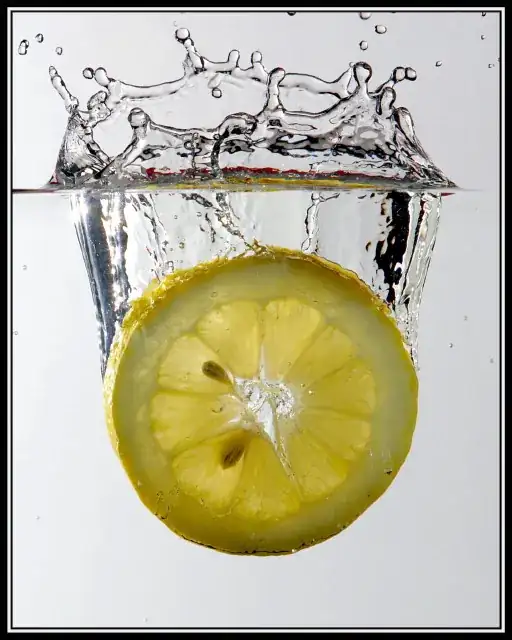
For shooting an Oreo in milk you don't necessarily need a very high speed. In the image below you can see similar idea where the speed was 1/250sec (flash sync speed):

enter image description here

In the past I tried capturing waterdrops. The problem was that with my older 380ex flash, when it was set off-camera it fired in full power, so the exposure was too long to get a real sharp, frozen drop. So my advice is to use a flash in manual mode, set to a low power so the exposure is as short as possible. Alternatively, you can use high-speed sync mode, if you can control your off-camera flash in this manner (unfortunately, the flash master in the EOS 7D does not allow for HSS when controlling the 580EXII using the built-in flash).

Still for the Oreo shot, use a wireless trigger to trigger the camera while releasing the cookie into the milk. It took me a surprisingly small amount of trials to get to a good timing with the lemon splash.

If you feel inspired, you can build yourself a IR beam detector trigger that will trigger the camera once the cookie crosses the beam. UPDATE: HiViz is a good resource for HS photograhy.

ysap
  • 11,208
  • 3
  • 37
  • 56
  • 3
    The camera shutter speed is probably irrelevant. And, generally, HSS will do the opposite of what's wanted, won't it? – mattdm Jan 27 '11 at 19:56
  • @mattdm - The shutter speed is irrelevant if you are shooting in a dark room and long exposure. It was very relevant for that image. For waterdrops, I wanted faster speed but could not get one. – ysap Jan 27 '11 at 21:22
  • Why "the opposite" anyway? You want to freeze motion, don't you? – ysap Jan 27 '11 at 21:27
  • 3
    Keep in mind if you're using a flash and you keep the ambient light low (relative to your exposure), the flash strobe speed is what is freezing your subject, not your shutter. The shutter could be 1/15s but your flash is somewhere around 1/20,000s and thats what matters. – Shizam Jan 27 '11 at 22:58
  • @Shizam - When the flash fires in full strength, the length of exposure is far longer than 1/20Ks. So, I thought if I can get the camera to shoot at 1/8000 (yes, I know it is much faster than what's required for a drop), then the flash exposure is longer and the speed is set by the shutter. Anyway, the fact is that the 1/250s max sync speed + full power of the 380EX was too long for a good freeze of the water drop. – ysap Jan 27 '11 at 23:32
  • @ysap - so why not just not use full power? Lower powers of flash are almost always faster... – rfusca Jan 27 '11 at 23:37
  • @rfusca - I could not do that with the 380EX b/c it has no manual mode. However, coming to think about it, in order to activate the HSS mode, it need to be connected to the hotshoe (supposedly with a long enough TTL cable) so FEC can be used to manually reduce the amount of light. – ysap Jan 27 '11 at 23:59
  • @ysap ah, that does make that more difficult. – rfusca Jan 28 '11 at 00:03
  • @ysap thats true, at full power flash speed is way way slower. – Shizam Jan 28 '11 at 00:06
  • 1
    HSS is the opposite because it strops the flash multiple very, very rapidly times in order to simulate a longer-duration (effectively continuous) light source. That's what I mean by "the opposite" of freezing motion. – mattdm Jan 28 '11 at 00:24
  • 1
    @mattdm - I see what you mean, but on the other hand, it is what let you use shutter speeds faster than 1/250. See the couple of comments above. – ysap Jan 28 '11 at 00:27
  • So, I'm looking at the manual for the Metz 58 AF-2. (To my knowledge, Canon doesn't publish these numbers, which is why I'm looking at Metz.) At a normal-lens field of view using HSS, the maximum guide number is 19. This corresponds to somewhere between 1/4 and 1/8th power. If you'd just put the flash at that level, you'd get a T.1 flash duration of around 1/2000th of a second. – mattdm Jan 28 '11 at 03:38
  • And, crucially, HSS power decreases even more as you shorten the shutter speed — every 4× increase in shutter speed halves the GN. So, by the time you're at a 1/2000th shutter speed, you're getting an effective GN of around 7 from HSS. But a reduced-power non-HSS flash of that level has a duration of around 1/10,000th of a second. And, if you could get your shutter speed that high, HSS would be reduced to a GN of about 3 — and at that point you might as well just go for 1/256th flash power and a T.1 duration of 1/33,000 (i.e. 30 microseconds). So I'm just not seeing HSS as a winning approach. – mattdm Jan 28 '11 at 03:51
  • @mattdm - it may not be a winning approach if you can manually set your flash power. If you're stuck at full power, then it may. Anyway, as I mentioned, working in HSS anyway requires a ETTL connection which means the power can be controlled manually - regardless of the inherent reduction of the HSS mode. I guess the point is that with HSS, I am controlling exactly the duration of the exposure, while otherwise I am limited to whatever the flash is capable to deliver. – ysap Jan 28 '11 at 05:06
  • We probably can conclude that it is a case were the same outcome can be pretty much achieved in several ways. Considering all the factors that come into the play, HSS might give a slightly more control over the process, but for any reasonable setup, a reduced power manual flash with longer shutter speed can give an equivalent result. – ysap Jan 28 '11 at 05:11
  • Yeah, like you say, I'm having a hard time envisioning a situation where you have HSS but no control over output level. With manual flash levels, you're controlling exactly the duration of the exposure too. It'd just be helpful if Canon (or Pentax!) would bother to tell us what that duration is! Nikon and Metz are awesome here. – mattdm Jan 28 '11 at 05:21
  • 2
    And, I still don't think it's an equivalent result — manual power gives you more light and the possibility of much shorter durations. That gives you more flexibility — more control over the process. Plus, since the cutoff is electronic rather than actual physical motion, I suspect that the variation shot-to-shot is much smaller, allowing more consistently-repeatable results (but I have no reference to back this up). – mattdm Jan 28 '11 at 05:27
  • @mattdm - If you have manual mode! The 380EX doesn't. As for your last point, one can argue that although the cutoff is electronic vs mechanical motion of the shutter blades, the assumption is that the variance in exposure times for a 1/8000s Tv should be fairly smaller than 1/8000s, otherwise it makes this settings somewhat meaningless. Additionally, I think the actual light emission duration from the flash is also varying depending on ambient temperature, etc. – ysap Jan 28 '11 at 05:41
  • 1
    @ysap, okay, I can see that in that case — and in fairness you did say a couple of comments up that this flash has no manual mode. :) But I think that's a really special case. Hmmm, but apparently the Canon 270EX is in the same boat. (The 430EX is okay, though.) – mattdm Jan 28 '11 at 06:00
  • @mattdm - thankfully, since playing with waterdrops I have upgraded about all of my equipment and now I have a 580EXII. I just did not have enough mental powers to setup everything once again and try it out. That said, the lemon shot was actually taken with my new equipment, but in a very lit environment (my kitchen in the summer afternoon), so in this case, the flash was not the only light source contributing to the exposure, but luckily, 1/250s was short enough for freezing that lemon piece (after the deceleration from the impact). – ysap Jan 28 '11 at 06:06
  • @ysap — I'm curious; does the EXIF data for the picture show what power the flash was fired at? – mattdm Jan 28 '11 at 14:22
  • @mattdm - I just checked and not only it doesn't show its power, it rather shows the Flash Type as the Built-In Flash... which I actually used as the master for wirelessly controlling the 580EXII. – ysap Jan 30 '11 at 00:53