0

I bought a Vario ND 2-400 filter today and tested it out. I think it goes up to +8 stops, and I was using it darkest to let less light in.

I used high f-stop, ISO 200, and up to 10 seconds. However, anything longer than ~5 seconds became mostly white, and I couldn't see anything.

Question: how do people do exposure times of something like 1 minute without everything become overexposed?

scottbb
  • 32,685
  • 12
  • 104
  • 188
plyck
  • 107
  • 2
  • 7
  • Are you shooting into the sun? Can also try highest f-stop possible like f/22, and use iso 100 as well. – rcs Jun 02 '15 at 23:55
  • ah thanks, reading through that. also x100s only goes down to 200 – plyck Jun 03 '15 at 11:01
  • more info on the scene situation would give us better idea to assist you. Try to test it near sunset where light is usually dim in the foreground and see what you'll get. 8 stops is enough density as you're cutting the current light by 256 times of the original scene – K'' Jun 03 '15 at 15:08

1 Answers1

1
  1. Use a lower ISO; your picture will also benefit from reduced noise.

  2. Use smallest aperture possible, up to the point where diffraction effects blur the image.

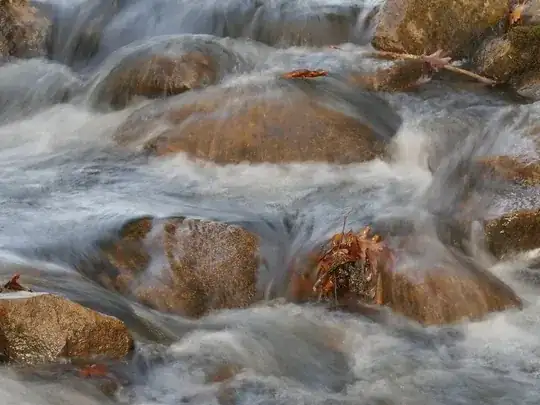
  3. An 8 f-stop ND filter may not be enough; add another filter such as a circular polarizer (CPL) or fixed ND filter. This has enabled me to make silky, diaphanous images of flowing water. The downside of that is there will be more internal reflection from the additional glass-air interfaces, and at short focal-length, there is some vignetting. My feeling is that reflection is not an issue with multicoated filters (and the subject is intentionally blurred, anyway). Vignetting is minimized by using longer lenses (or settings), and the image can be cropped later.

Here's a not very good example, made using all three adjustment above: enter image description here

DrMoishe Pippik
  • 2,636
  • 9
  • 14