15

I have old photos of a town and landscape around it. I'd like to take these photos again, from the same locations. In some cases I am struggling with finding the original location of the camera.

I can identify objects on the photo, I know their position on the map in some cases even their dimensions, but I don't know anything about camera or lens. Are there any techniques (or even better any ready-made software) to calculate position of the camera from the photo?

mattdm
  • 143,140
  • 52
  • 417
  • 741
Lukas Kabrt
  • 253
  • 2
  • 6

3 Answers3

15

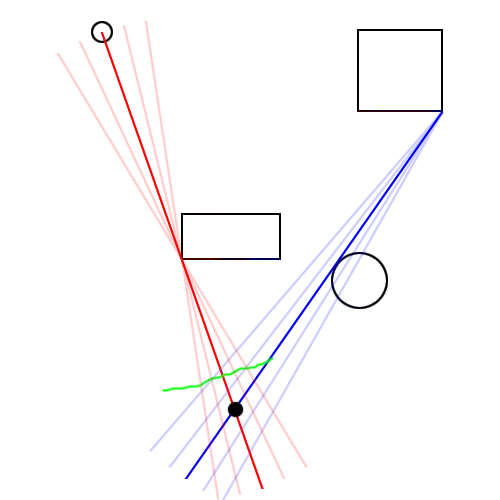
The key is to find areas of the image with a lot of parallax, such as a foreground building and a background tree. Try to pick a point as close to one edge of frame as possible. Now walk left/right (green) to find the correct point of intersection from the old photograph.

enter image description here

Now that you've done that, you've established a straight line to move along (red).

Pick a different parallax intersection on the other edge of frame. Instead of walking left/right, walk along the red axis you established earlier. Once you've matched that parallax, without spoiling the first match, you've found the position of the camera.

Once you're in the same position, matching the lens is easy. You can just look through the camera and adjust until the framing matches, or measure the angle of view.


There is software that can calculate the position of the camera, but generally you need a 3D model of the scene as a basis.

mhlester
  • 460
  • 4
  • 14
  • 1
    Thank you for your answer. I suppose it's great for photos with close objects, but for the landscape photography it might get little impractical. Out of curiosity, can you recommend any software that is capable of calculating position of the camera from a 3D model? – Lukas Kabrt Jun 05 '14 at 20:44
  • My experience with that software is for moving footage (for visual effects). These may be overkill for still work: Syntheyes, Boujou, PF Track. As for landscape photographs, I wouldn't discount this solution too quickly. Nearby trees and the distant horizon should give you plenty of data. – mhlester Jun 05 '14 at 20:57
  • 2
    On the first Iron Man movie, I used this technique (virtually) to find where they filmed this so we could blow up the mountains. Worked great even at that distance – mhlester Jun 05 '14 at 21:30
  • You didn't mention field of view - how does that play into it? –  Jun 06 '14 at 06:28
  • @Clara, what I like about this approach is that you don't need to deal with too many factors at once. Establishing the camera'a position is entirely independent of field of view, and field of view is entirely independent of position. Field of view is a function of focal length, so either zoom your lens until you get the edges framed correctly, or get a big protractor to calculate the same thing – mhlester Jun 06 '14 at 06:59
  • 1
    If you have multiple photos from different angles, the necessary point cloud can be calculated by software. The last time I tried ot ms photosynth it was able to show position of the photographer for each photo in its model, but that was many years ago and rather imprecise but could be a starting point. – PlasmaHH Jun 06 '14 at 15:11
  • I like to do then & now historical photos of my town, many buildings will have changed/disappeared but usually enough landmarks remain. All the same I'm usually disappointed that that it's much more difficult to get an exact perspective than I expect . I will use the above method and see if I can get better results. – zzapper May 05 '21 at 07:35
1

You don't require multiple photos. if you can see the angle between known landmarks you can use Resection, a triangulation technique used for surveying. As long as you can see 3 items whose location you know and you can measure the angle between them then you can calculate the exact location of the photo.

There is a nice paper I saw from the University of Liege. you can find it and some other algorithms for resection at http://www.telecom.ulg.ac.be/triangulation/

-1

With this tool...

http://www.jungledragon.com/daylight

...you can input any location and time (also in the past) and see the exact height and angle of the sun. As you do not know the exact location in this case, you could hopefully get an idea of the sun's height and angle from the actual photo. It's not perfect science, but hopefully it helps.

Disclaimer: I'm the creator of that tool. It's non-commercial and ad-free.

Fer
  • 756
  • 1
  • 8
  • 16