I think the better question is why image sensors aren't (close to) ciruclar, rather than wider.
The image circle focussed onto the sensor is, well, a circle. In some sense, in the ideal case, you would capture the entire circle, and then choose what portion of that circle to use as your image. I say 'ideal' from the point of view of maximising framing capabilities, not making it easy to use.
The popularity of rectangular photos (and videos) has meant selecting a 3:4 or 2:3 section of that circle, to avoid having to crop every single photo—instead we frame it in the camera, and most of the time it's much simpler. But if you want anything other than the native aspect ratio, you're going to be cropping.
The only real advantage of 16:9 would be if you always use 16:9, then you're getting a slightly cheaper sensor (because you could shave a little off the top and bottom) and about 8% more area than the 16:9 crop from a 3:2 frame. On the other hand, any 'squarer' crops from that 16:9 frame will be 28% less area than they'd have otherwise been from a 3:2 sensor (to fit the same image circle).
A square sensor, on the other hand, gives you 63% more area for a square image, compared to a square crop from a 3:2 sensor, while 4:3, 3:2 and 16:9 are 10 to 39% smaller compared to the same aspect-ratio crops from a 3:2 sensor.
Cost aside, I think the ideal camera would have a (roughly) circular sensor, with similarly circular RAW files, but cropped JPEGs. You'd set your desired aspect ratio, and the camera would apply the appropriate crop. Shooting RAW, you could quickly switch between portrait and landscape without even rotating the camera. And you'd always get the maximum resolution possible for any aspect ratio (1:1 through 16:9), for the given sensor pixel pitch.
Here's a table with some comparisons of crops from different sensor sizes. The columns specify how the native sensor is limited (i.e. by image circle, or a specific sensor aspect ratio at its maximum size in the image circle), the rows specify the shape of the final (cropped) image, and each cell shows the percentage of the image circle covered by said crop from said sensor.
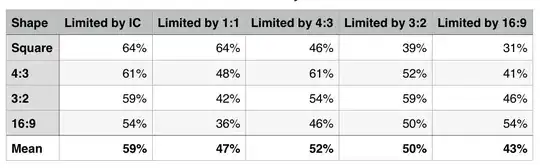
Naturally the best result comes from using the sensor at its native aspect ratio (and the square maximises the rectangular coverage of a circle).
A 16:9 image from the 16:9 vs 3:2 sensors won't be vastly different (about 50–54% of the image circle), but the differences in the other crops between these sensors are quite significant. The best 'all round' sensor seems to be 4:3 or 3:2 (though really depends mostly on whether you're more likely to go squarer or wider than the native).
The first column shows the ideal for any crop aspect ratio, which would only be achievable with a circular sensor (or a larger sensor that covers the full image circle).


