Any time you re-size or print at a lower resolution than the original image file you lose data that can't be recovered. What exactly you lose is determined by how the information from adjacent pixels is combined. The method employed in your drawing at imgur.com/WrLWMpe assumes only one of several ways used to combine more lines of resolution into fewer lines before combining two images. Another method might average the contrasting lines in each of the two contributing images so that your wind up with alternating stripes of medium grey (from the white+black stripes averaged to grey) and dark turquoise (from the black+light turquoise stripes averaged to a darker hue). Yet another method might average the even lines from each to produce the even lines in the combined image and average the odd lines from each to produce the odd lines in the combined image.
All of that only applies to how the resolution of each image is reduced before combining them into a single image. With a lenticular image you don't combine both images into a single new image - you print each row of both the downsized contributing images by alternating them at half height (or each column at half width if the lenses run vertically instead of horizontally) and then place a lens over each set of two rows so that only all of the rows from image #1 or all of the rows from image #2 are visible when viewed from a particular angle.
With a lenticular print your resolution is somewhat limited by how narrow the rows of lenses can be made as well as how precisely they are uniformly made. Each lens has two rows underneath it - one from each image. Assuming the lenses run across the image horizontally, each lens has underneath it the same horizontal line from both contributing images. The first lens has the first row from image #1 printed at half height above the first row from image #2. The second lens has the second row from image #1 printed at half height above the second row from image #2, and so on. When viewed through the lenses only one of the two rows under each lens is visible and appears to occupy the entire space between the two adjacent rows displayed by the adjacent lens. Please note, that each half height line will usually be several pixels in width.
A lenticular print combining the first two drawings would not look like the third square in your example drawing.
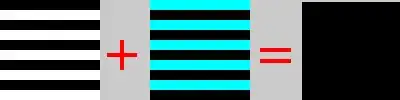
Rather, it would have twice the number of rows with each at half the height of the rows in each of the original images. If we call the first two rows 1a and 1b their combined height would be the same as each of the rows in the first two drawings. Row 1a would be black, 1b would be turquoise. Row 2a would be white, 2b would be black. Since your original images repeat the same color for odd and even-numbered rows, the space underneath each odd-numbered lens would repeat 1a and 1b, underneath each even-numbered lens would repeat 2a and 2b. Once the lenses that are the same height as each row in the original squares are placed over the print, then only all of the a lines or all of the b lines would be visible from a particular viewing angle.


