My setup is:
1, Bounce umbrella 2, Shoot Thru Umbrella 3, camera :)
Lighting:

The result:
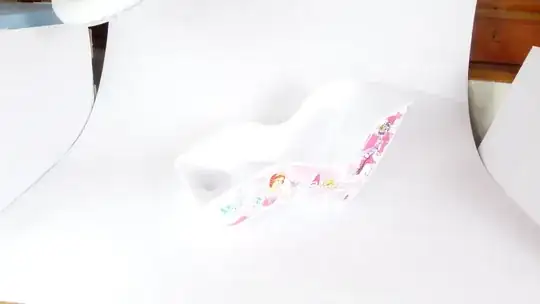
I think there are too many shadows. Is there any way to avoid shadows with this setup?
My setup is:
1, Bounce umbrella 2, Shoot Thru Umbrella 3, camera :)
Lighting:
The result:
I think there are too many shadows. Is there any way to avoid shadows with this setup?

If you can increase the separation between the product and the backdrop, you need a light on the backdrop that isn't increasing the exposure of the product. Increase the power for the back light until the background is right at maximum saturation (in other words, on the verge of clipping). Ideally you want a white backdrop to be exposed higher than the product, not lower.
With products that have spaces not reached by the front lights, you also need an overhead light to eliminate the shadows inside the bowl.

If you can raise your object being photographed, and pull it farther away from the vertical background, you can place the shadows behind the object so they won't be visible. This is much easier to do than adding additional lights, which will cause still more shadows to cover.
You can also use a couple of white sheets to further diffuse your umbrellas as light sources, which will soften the shadows, perhaps to the point they will not be visible.

You need a top light (neither of the front lights can get down in to the product). Ideal placement would be above and slightly in front of the product. You also need to turn down your key light (or turn up your fill).

Some great answers already. Here is what I would do: Soft box with light on a boom directly over head, two additional lights with Softbox at a 45 degree direction opposite of each other. Slightly elevate the back of the product so there is a slight tilt forward. Shoot slightly above the product with a downward turned angle.
Now two very important points; 1) Your front lights should be close to level with the product, 2) Your EV needs to be identical at every visible angle. Even a half a stop out and you could start to see some shadowing.
Also, I really wouldn't shoot products with umbrellas. They tend to throw light everywhere and you lose a lot of control, which is the absolute worst thing when shooting products. You will really be doing yourself a favour by using soft boxes or light diffusing panels. Hope that helps.

Coaxial light is shadowless. You can create it by using a large onesided mirror, where your camera will be hind it, shooting through it. it will be at a 45 degree angle and the light should fire from the side and will be reflected off the mirror onto your subject. As the light rays from the light and the rays going to the camera will have the same angles, there will be no shadows seen by the camera. There will be a shadow, but it will be exactly behind the subject, occluded by it.
Whether the subject will look interesting is another matter.
