12

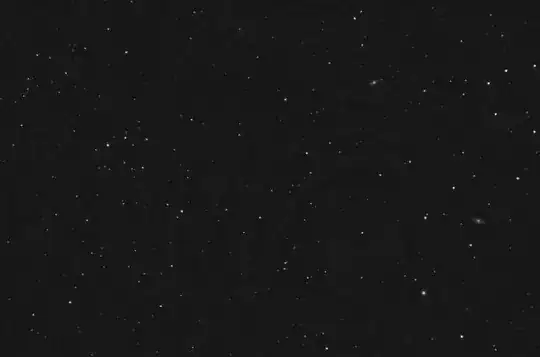
When processing an astro-images taken with a Canon 450D and prime focus, I often end up with a series of faint circles radiating outwards from an off centre point. What are they and how do I get rid of them. I can hide them by darkening the background, but by doing that I then lose some of the detail in the distant galaxies.

Here is a link to my local astro-society. And here is the image: enter image description here
mattdm
  • 143,140
  • 52
  • 417
  • 741
Ron Larter
  • 121
  • 1
  • 4
  • What is prime focus? Do you mean a prime lens? – Unapiedra Aug 01 '13 at 11:25
  • 3
    Prime focus is when the camera is attached to the telescope in place of the eyepiece. – Ron Larter Aug 01 '13 at 11:27
  • prime focus is an astrophotography technique which places the camera pointing into the telescope eyepiece. – Paul Cezanne Aug 01 '13 at 11:28
  • For prime focus you need to use a T-ring and camera-telescope adapter. – Ron Larter Aug 01 '13 at 11:38
  • Are you using a narrow-band filter? – coneslayer Aug 01 '13 at 13:32
  • No filters were used. After stacking a number of short exposure images and then processed to remove unwanted light pollution and uneven illumination using the method of making a duplicate, blurring the duplicate and merging by using 'apply image'; the image then acquires the faint circles when trying to tease out details using levels and curves. – Ron Larter Aug 01 '13 at 16:17
  • Even without a filter it could be Newton's rings if your sky background comes mainly from line emission (e.g. sodium light pollution). – coneslayer Aug 01 '13 at 16:30
  • If it is sodium light pollution, how would one get over the problem; other than moving out into the dark regions of the country. – Ron Larter Aug 01 '13 at 17:07
  • If that is the cause, a light-pollution filter should help by blocking sodium and other common emission lines. – coneslayer Aug 01 '13 at 18:11

2 Answers2

11

This looks to me like Newton's rings, an interference pattern that occurs from closely-placed surfaces. They are usually only visible when narrow-band filters are used, or when the light is inherently narrow-band. With wide-band illumination, the rings fall in different places for the different wavelengths of light, so the effect is largely canceled out.

My best guess would be that, in your case, the rings are coming from the various parts of the sensor assembly. I'm not sure how the 450D is arranged, but there's likely an anti-aliasing (AA) filter, IR-blocking filter, and the sensor itself—all flat surfaces in close proximity that could give rise to Newton's rings.

coneslayer
  • 7,406
  • 3
  • 37
  • 55
  • These do look like an artifact that is introduced at the filter level. You can test the source by:
    1. Rotating the camera position
    2. Rotating the filter if it's an external one

    You can eliminate most of these artifacts by taking flats and using them in your processing. A flat field will show the profile of light fall off and will provide a reverse curve for calibration.

    – smigol Aug 02 '13 at 17:26
0

These circles could be glare. This often happens if you have a light source hitting the front element of the lens from outside the image circle.

To prevent it use a lens hood.

It could also be light leakage in the telescope + camera assembly.

Unapiedra
  • 4,013
  • 22
  • 31
  • 1
    It's not glare. Besides, my telescope, a 5" refractor is fitted with an objective lens hood as part of its accessory. – Ron Larter Aug 01 '13 at 11:36
  • Okay, definitely not glare. It looks a bit like JPEG colour compression artefacts like you often see in a sky. However, I have no idea whether this could happen here. – Unapiedra Aug 01 '13 at 13:41
  • Thank you for having a look and for your comments. Much appreciated. – Ron Larter Aug 01 '13 at 13:46