10

I am a bit of a noob when it comes to photography. But I recently got the opportunity to shoot John Mayer this past weekend in Wisconsin. Upon getting home, I noticed the pictures weren't as sharp as they could have been, and saw that almost all of them had a slight blur to them.

Me being new to the photography world, it is quite overwhelming jumping into such a huge act like John Mayer. I took some advice from a Nat Cam employee on how to shoot.

He told me to shoot in Aperture Priority mode. Keep my lens wide open at 2.8, (lens I'm using is a Tamron 17-50mm (no stabilizing feature) on my Nikon D5100). I stuck to shooting from an ISO of 800-1600 most of the show. Exposure meter was at 0.0 the whole time.

I'll attach some pictures.

But I do need some help badly, as I am shooting John Mayer again next week, and I really dont want to mess thing up this time. Because all of my pics so far aren't really useable.

I stopped back into Nat Cam yesterday to see if they could explain the problem. The guy there thought it was the "focusing points" that were focusing on random things in the background, speakers, mic stand, etc and that I should change it from auto area AF to Dynamic area so that I can put one focus point on his face so the focus point doesn't get distracted with anything else. He also told me to bump up my ISO to 3200 because the "D5100 can handle it". Lastly he said I should keep it on center weighted metering as I have it.

Do you all think that could be the problem? Or is it something else?

I can use all the help I can get, I just don't want to blow my shots again next week.

Thank you all who respond!

http://s806.photobucket.com/user/AKOG/media/DSC_0135_zpsd975cd62.jpg.html

http://s806.photobucket.com/user/AKOG/media/FinalJM2_zpscbf304db.jpg.html

Justin F.
  • 101
  • 1
  • 4
  • Looking at some of the other photos in your photobucket album demonstrates that a lot of the issue seems to be related to the sharpening settings used. You have several shots there with two very different versions displayed: one very soft and another with sharpening applied and a little less saturation/exposure as well. – Michael C Jul 10 '13 at 09:02
  • The other "sharpened" duplicate photos was my attempting to use photoshop for the first time. Failed pretty bad. – Justin F. Jul 10 '13 at 21:56
  • How were the others processed? – Michael C Jul 10 '13 at 21:59
  • @MichaelClark Can I chat with you and ask some questions if you are available? They weren't processed at all, as I have no clue how to use photo shop – Justin F. Jul 10 '13 at 22:21

3 Answers3

14

When shooting a concert or other event under theatrical type lighting, I use a single focus point only (usually the center) and use either Evaluative or Center Weighted metering in Aperture mode when shooting wide/normal angle (less than 80mm on a FF body) in landscape orientation.¹ If the background is dark, as is usually the case, I use about -1 to -2 stops exposure compensation (EC). I tend to shoot in manual mode with the telephoto lens using an AF point centered about two-thirds up the middle of the vertical frame. The key is that regardless of which shooting mode you select, you must keep an eye on the shutter speed (Tv) and Aperture (Av) displayed in the viewfinder for every shot and adjust if necessary.

My general setup is a 24-105mm IS lens on FF body, ISO at around 3200, Av around f/4, Evaluative metering with -2 EC and the single center focus point. (Nikon's "Matrix metering" is a little less consistent than Canon's "evaluative", so if shooting Nikon I would probably go with center-weighted and about -1 EC.) My second body is a Canon 7D (APS-C sized sensor, like your D5100) with a 70-200mm IS lens, ISO at 1600-3200, Av at f/2.8, center weighted metering with -2 EC and the single focus point. My 7D allows me to use the center point for horizontal shots and automatically senses when I go vertical and switches to one of the points near the top of the frame I have selected for portrait orientation. With both bodies I will mix it up some and go from Aperture to Manual exposure as well as from Evaluative to Center weighted metering. Learning your camera's controls well enough to do this on the fly without even pulling your eye off of the viewfinder is paramount!

The IS/VR doesn't help with subject motion, but it does help with the stability of the surface upon which you are standing. Temporary outdoor stages move around a lot, and even on the ground in the media pit, the ground shakes from the energy pumping out of the speakers (don't forget your ear plugs if you want to still have good hearing in a few years). I own the Canon version of the Tamron 17-50mm f/2.8 Di II and used it on my APS-C bodies as my primary normal zoom lens for several years, but with the narrower Av allowed by the higher usable ISO on my FF body I find using IS at f/4 works better for me.

As far as subject motion goes, be very selective about when you open the shutter. A guitarist's hands slow down at the top and bottom of the strumming motion. That split second between moving up and then down is when you can get a clean shot even at moderately slower shutter speed (Tv). The same holds true for a jumping performer: catch them in mid-air just as they stop going up and start coming back down. If the lights are blinking on/off rapidly, time your release when the lights are up - just be sure your metering was also done when the lights were up. Learn to use the back buttons on your camera body to lock in focus and/or exposure, then wait for the next cycle to trip the shutter.

Don't be afraid to take plenty of extra shots! You are stretching your gear's limits to the edge of their capabilities. Just like when shooting sports, there are going to be some shots where focus or exposure is missed. Your client (or fans) don't care if you took 20 or 200 or 2000 shots, as long as the 20 you deliver meet their expectations. That doesn't mean you just "pray and spray", but it does mean you acknowledge that there will be plenty of times when you anticipated the artist zigging left and he zagged right!

And since you have expressed how new you are to photography, I'll remind you to save your files in RAW format so that you have MUCH more latitude to adjust exposure and color temperature variations in post production. And don't expect too much from your gear. While it is true that better gear won't take a better shot for you, it is also true that lesser gear can limit what you can do in challenging light. You are going to need to shoot RAW at higher ISO and deal with the noise in post. And regardless of your gear, you're not going to get results at a live concert that are as good from a technical standpoint as you would be able to produce in a controlled studio setting.
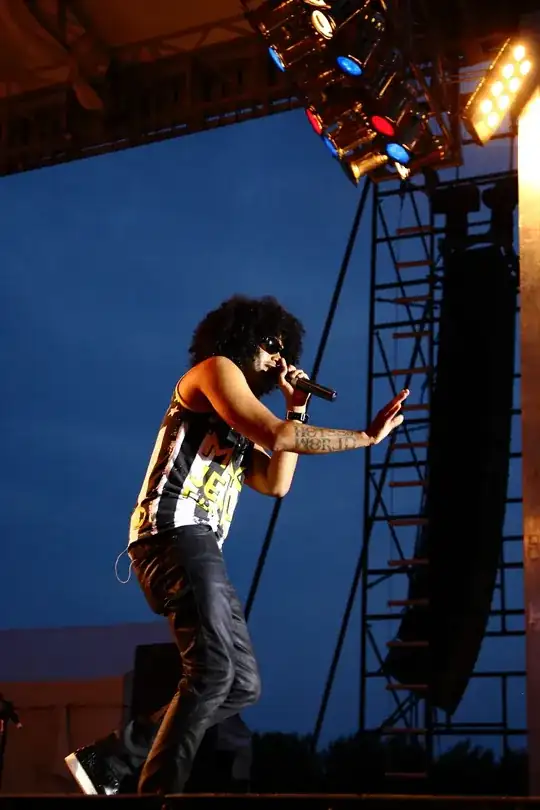
Manwell
Canon 5DII, EF 24-105mm f/4 L IS @ 55mm, Aperture Priority, 1/160 sec, f/4, Evaluative metering, -1 1/3 EC, ISO 2000. Exposure increased 0.5 stops in post. At this slower Tv, timing his arm at the top of its motion was the only way to freeze it.
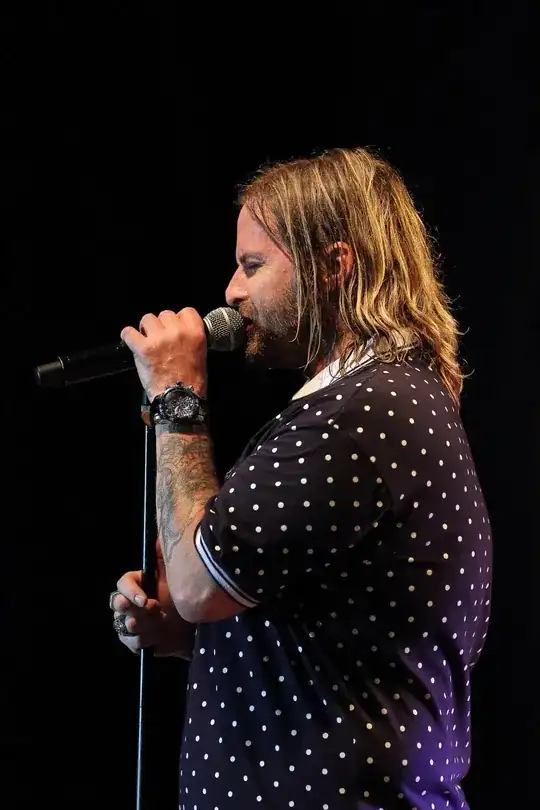
Kevin
Canon 7D, EF 70-200mm f/2.8 L IS II @ 200mm, Aperture Priority, 1/1600 sec, f/2.8, Center-Weighted Avg., -2 EC, ISO 3200, Exposure increased 0.3 stops in post. I could have gotten away with a stop less ISO and Tv in this one, but even with the noise reduction (NR) needed for ISO 3200 on the 7D, you can still read the numbers and see the index marks on his watch before downsizing! Yes, it is a $2,300 lens.


From comments by the OP:

Wow, thanks for all the info. I will admit, it is a bit overwhelming, and I don't understand all of you lingo... like "tv" and a few others. Is there a way you can dumb it down for me a bit. Because I'm only work with a d5100. $500 camera and $500 lens. So can you suggest some settings to use, as I'm shooting John Mayer again next week. I have a D5100 with a Tamron 17-50mm (no stabilizing feature) lens. So I'm not dealing with $5,000 worth of camera equipment. When I say I'm new to photography, I mean new, new.

I just really badly NEED to take some good photos this next week, as I have quite a few people counting on me to come out with some GREAT photos, (lots of pressure). It will be in the same setting as before, just at a new venue (RED ROCKS) and John Mayer again. So please experts, dumb it down for me a bit, as a few things mentioned above were a bit confusing.

Tv (Time value) is shorthand for shutter speed. The main things you can do with your current gear is shoot RAW, use a high enough ISO to keep your Tv up and time your shots with the performers movements and when the lights are at their peak intensity. Then deal with the noise from high ISO in post. Based on the photos in your photobucket gallery I don't think your problem is focus. The ones you sharpened in PS show that. You need to learn how to use post processing to bring out the best on the photos you take.

There are a lot of things in the answer you should be able to apply with a D5100 and Tamron 17-50. I got a lot of great shots back a few years ago with a Rebel XTi (which I limited to about ISO 800!) and that lens, and even better shots with a 50D and that lens. The main thing is that there is no substitute for experience. The more you shoot in those situations, the better you'll get at recognizing what will and what will not work in a given situation with a given set of gear.

What setting would you recommend me to start out at???

Start in Aperture priority mode, ISO 3200, f/2.8, center weighted averaging, -1 1/3 exposure compensation and see what the shutter speeds look like. Unless you really know how to time the subject's movement you need to be at 1/250 sec. or faster if possible. If you can stop down to f/3.5 or f/4 without going under 1/250 sec., then try some shots there. If you're getting Tvs better than 1/640 sec., drop your ISO 1/3 or 2/3 stop if you can wind up with your Tv still around 1/500 sec.

Save your files as .NEFs because you're probably going to need to increase exposure a little when you convert the RAW files to jpeg. And take a crash course in Adobe Lightroom or the Adobe Camera RAW plugin for Photoshop.

I want to get quality pictures, but will not have the time to learn photoshop or lightroom.

Then hire an experienced pro that has already learned and knows how to do this.

What if I just left exposure at 0.0 and changed the f/ & iso accordingly? Is exposure really that big of deal to get quality pictures? I also thought that being under exposed was a bad thing.

You are not going to get the results you want without learning how to manage light curves in post processing. Your camera's meter expects everything to be 18% grey. If the background and most of the scene is dark and you leave EC at 0 then what is black in the scene will be gray in your photos and the photo will be overexposed. Underexposed and slightly noisy is easier to correct than blurry because of a slow shutter speed.

What im asking, is there an "easiest way to do this" without messing with a bunch of setting on my D5100? Or is there a "standard setting" that will be good, considering you saw my pictures from the last concert, and the next concert will be almost identical, except for a different venue, same lights, same graphics, etc.

NO. There is no easy way to do what you want to do. The answer above tells you what you should do, both in terms of shooting the concert and in terms of post processing. If you refuse to accept that, do it your way and live with the results.

The reason your photos are blurry is because they are slightly overexposed and unsharpened, not because the focus is bad. When you desaturated and sharpened, the focus problem went away. The reason your camera has exposure compensation is because your eye should be capable of seeing how what is in front of you is different from an average scene that your camera is designed to meter properly.

I understand. But I really think if I use Dynamic focus, I should get better focus in general if I shoot the focus point at his face, correct? As you can see, I did a terrible job sharpening my photos, because I really had no clue what I was doing, and in doing so it looks crappy and lost a lot of color.

As to Dynamic Focus, I've already stated several times that in this situation you are probably better off using a single focus point and focusing on the eyes, then recomposing the shot if needed while holding the focus lock using the buttons on the back of your body. Your camera's user manual tells you how to do this.

I'm not looking for out of this world photos, I'm looking for sharp photos that I don't have to touch up in post processing, and can quickly share with John Mayer's fan base within an hour or two after the show with a few Jpegs.

What you are expecting your camera to do for you is one of the hardest scenarios there is in photography: Shooting subjects in motion under much less than optimal lighting in terms of color spectrum that is also very dim. Even experienced pros with top grade equipment are challenged to get such images out in only a couple of hours under such scenarios. That doesn't mean you can't get some good pictures with your D5100 and Tamron SP 17-50mm f/2.8 Di II lens. But you can't expect the camera to do it all for you. Even the best camera on the market is just a tool. Tools require knowledge, skill, and experience to be used to their potential.

¹ Evaluative metering works for me mostly because that is what I am used to and know how much exposure compensation to dial in for what I am seeing in the viewfinder. Others prefer to use spot metering. Either approach is perfectly legitimate. The key is to do things consistently so that you understand what to do with the info your meter is telling you in whichever metering mode you use.

Michael C
  • 175,039
  • 10
  • 209
  • 561
  • Wow, thanks for all the info. I will admit, it is a bit overwhelming, and I don't understand all of you lingo... like "tv" and a few others. Is there a way you can dumb it down for me a bit. Because I'm only work with a d5100. $500 camera and $500 lens. So can you suggest some settings to use, as I'm shooting John Mayer again next week. I have a D5100 with a Tamron 17-50mm (no stabilizing feature) lens. So I'm not dealing with $5,000 worth of camera equipment. When I say I'm new to photography, I mean new, new. – Justin F. Jul 10 '13 at 22:14
  • I just really badly NEED to take some good photos this next week, as I have quite a few people counting on me to come out with some GREAT photos, (lots of pressure). It will be in the same setting as before, just at a new venue (RED ROCKS) and John Mayer again. So please experts, dumb it down for me a bit, as a few things mentioned above were a bit confusing. – Justin F. Jul 10 '13 at 22:17
  • Tv (Time value) is shorthand for shutter speed. The main things you can do with your current gear is shoot RAW, use a high enough ISO to keep your Tv up and time your shots with the performers movements and when the lights are at their peak intensity. Then deal with the noise from high ISO in post. Based on the photos in your photobucket gallery I don't think your problem is focus. The ones you sharpened in PS show that. You need to learn how to use post processing to bring out the best on the photos you take. – Michael C Jul 11 '13 at 12:00
  • Due to the nature of this community, the answer is written a little more broadly than for just your specific situation. But there are a lot of things in the answer you should be able to apply with a D5100 and Tamron 17-50. I got a lot of great shots back a few years ago with a Rebel XTi (limited to about ISO 800!) and that lens, and even better shots with a 50D and that lens. The main thing is that there is no substitute for experience. The more you shoot in those situations, the better you'll get at recognizing what will and what will not work in a given situation with a given set of gear. – Michael C Jul 11 '13 at 12:05
  • What setting would you recommend me to start out at??? – Justin F. Jul 12 '13 at 00:27
  • Start in Aperture priority mode, ISO 3200, f/2.8, center weighted averaging, -1 1/3 exposure compensation and see what the shutter speeds look like. Unless you really know how to time the subject's movement you need to be at 1/250 sec. or faster if possible. If you can stop down to f/3.5 or f/4 without going under 1/250 sec., then try some shots there. If you're getting Tvs better than 1/640 sec., drop your ISO 1/3 or 2/3 stop if you can wind up with your Tv still around 1/500 sec. – Michael C Jul 12 '13 at 01:24
  • Save your files as .NEFs because you're probably going to need to increase exposure a little when you convert the RAW files to jpeg. And take a crash course in Adobe Lightroom or the Adobe Camera RAW plugin for Photoshop. – Michael C Jul 12 '13 at 01:27
  • I want to get quality pictures, but will not have the time to learn photoshop or lightroom. What if I just left exposure at 0.0 and changed the f/ & iso accordingly? Is exposure really that big of deal to get quality pictures? I also thought that being under exposed was a bad thing. – Justin F. Jul 12 '13 at 18:13
  • What im asking, is there an "easiest way to do this" without messing with a bunch of setting on my D5100? Or is there a "standard setting" that will be good, considering you saw my pictures from the last concert, and the next concert will be almost identical, except for a different venue, same lights, same graphics, etc. – Justin F. Jul 12 '13 at 18:18
  • Also, do you recommend Dynamic focus? And just aim the focus point at his face the whole concert? Because it doesn't seem like the auto focus did me any good last concert because of the large amount of blur in all of them. So they are basically un-usable. – Justin F. Jul 12 '13 at 18:20
  • You are not going to get the results you want without learning how to manage light curves in post processing. Your camera's meter expects everything to be 18% grey. If the background and most of the scene is dark and you leave EC at 0 then what is black in the scene will be gray in your photos and the photo will be overexposed. Underexposed and slightly noisy is easier to correct than blurry because of a slow shutter speed. – Michael C Jul 12 '13 at 18:20
  • NO. There is no easy way to do what you want to do. I've already told you what I recommend you do, both in terms of shooting the concert and in terms of post processing. You refuse to accept that, so do it your way and live with the results. – Michael C Jul 12 '13 at 18:22
  • The reason your photos are blurry is because they are slightly overexposed and unsharpened, not because the focus is bad. When you desaturated and sharpened, the focus problem went away. The reason your camera has exposure compensation is because your eye should be capable of seeing how what is in front of you is different from an average scene that your camera is designed to meter properly. – Michael C Jul 12 '13 at 18:28
  • I understand. But I really think if I use Dynamic focus, I should get better focus in general if I shoot the focus point at his face, correct? As you can see, I did a terrible job sharpening my photos, because I really had no clue what I was doing, and in doing so it looks crappy and lost a lot of color. I'm not looking for out of this world photos, I'm looking for sharp photos that I don't have to touch up in post processing, and can quickly share with John Mayer's fan base within an hour or two after the show with a few Jpegs. – Justin F. Jul 13 '13 at 00:08
  • I'm hoping with the setting you suggested, I can come out with much better pictures this next week? Who knows? I'm assuming they will be sharper right? – Justin F. Jul 13 '13 at 00:09
  • Have you bothered reading the D5100 user manual to see how to set the in-camera sharpening settings? But you are not going to be able to capture the full dynamic range of the scene using in-camera jpeg processing as well as you will customizing the light curves for each shot in post. As to Dynamic Focus, I've already stated several times that in this situation you are probably better off using a single focus point and focusing on the eyes, then recomposing the shot if needed while holding the focus lock using the buttons on the back of your body. Again, read the manual as to how to do this. – Michael C Jul 13 '13 at 10:39
  • 1
    Great answer. One point not mentioned is white balance, which should generally be set to tungsten for stage lights. – Caleb Dec 24 '14 at 15:29
  • Thanks. The question specifically addresses sharpness/focus which is directly related to exposure and AF and only peripherally related to WB. WB when shooting/editing concert photos is probably worthy of a question all to itself. I've found that it is greatly a matter of personal preference. Sometimes you want white objects to look white. Sometimes you want to see the influence of specific color lights. Sometimes you are stuck with different sources, including crappy limited spectrum LED lights, and take whatever you can get. – Michael C Dec 25 '14 at 02:02
1

I would concur with their advice. The first photo, the guitar body itself is clearly in focus. The second one is a little ambiguous at the resolution you have posted, but it may either be a stray focus point or a shutter being too slow.

The advice to use a specific focus point will allow you to shoot for the eyes and the extra ISO should give you a faster shutter to reduce motion blur without having to worry too much about noise yet.

Be aware that at f/2.8, you aren't going to have all that wide of a depth of field to work with, so things are going to go out of focus pretty quickly on either side of the focal point. If you want more in focus, you are going to have to close down the aperture some, but that will also reduce the light reaching the center and slowing the shutter speed, which of course starts making camera shake a problem again.

Trying using the 1/focal length rule for shutter speed and adjust the ISO and aperture as necessary to balance depth of field and noise levels. Adjust the rule as necessary based on your ability to hold the camera steady. Also, since you are in the press area, if they allow it, bring a monopod to help with holding the weight of the camera and it should buy you some additional breathing room (though you still have the motion of your subjects to worry about.)

AJ Henderson
  • 34,864
  • 5
  • 54
  • 91
  • Sorry, I'm not completely understanding. Doesn't the camera control the shutter speed in "A" mode? I'm a bit confused by the 1/focal length rule. – Justin F. Jul 09 '13 at 20:54
  • Also, as you can see in the pics, I am zoomed in completely in every photo. I almost felt like I need a little more zoom to get a few close ups of his face/guitar, (that way I dont have to crop a bunch of the photo). Do you recommend me getting the next step up zoom lens? Or do the photos look fine? – Justin F. Jul 09 '13 at 20:57
  • Also, the opening band pics came out great. I just don't understand why John Mayer's came out so bad. Seen here: http://s806.photobucket.com/user/AKOG/media/DSC_0026_zps044888c8.jpg.html – Justin F. Jul 09 '13 at 21:02
  • Then again, since I was shooting in an amphitheater, it was much lighter out before the sun went down... so maybe bumping up the iso will really help the John Mayer shots? – Justin F. Jul 09 '13 at 21:06
  • Shutter speed is controlled automatically and that may be problem. It may be too slow and you probably even didn't notice. You can try to find Shutter speed in EXIF data and write it for us. – zacharmarz Jul 09 '13 at 21:17
  • As being a rookie at the who photography thing, you would have to tell me how to do this, as I have no clue how to find EXIF data or how to write it... Sorry :( – Justin F. Jul 09 '13 at 21:24
  • You have to use some special software, which will show you this information. Or for example flickr will do it (if you click for example on this link: http://www.flickr.com/photos/82505773@N04/9073999658/ and find Additional info, you will see Settings: 1/160,... - it means 1/160 s. – zacharmarz Jul 09 '13 at 21:47
  • Also the guy at Nat Cam said keep it wide open at 2.8, Should I do that? Or close it up a bit? – Justin F. Jul 09 '13 at 21:50
  • http://www.flickr.com/photos/98661362@N02/9249171289/meta/ – Justin F. Jul 09 '13 at 21:58
  • Another http://www.flickr.com/photos/98661362@N02/9249190513/meta/ – Justin F. Jul 09 '13 at 22:02
  • Part of my wants to shoot in AUTO mode, but I know that kind of a cheating way to do it and I heard they could turn out bad... So I would hate to resort to that. – Justin F. Jul 09 '13 at 22:12
  • @JustinF. - yes, in A mode, the camera will adjust shutter speed as necessary, but you should keep an eye on it to make sure it doesn't get too slow. If it does, then you need to adjust another parameter manually to bring it back in to an allowable range. Semi-manual modes are great for allowing greater creative control without having to go full manual, but you still have to monitor the situation and make sure that the parameters being used make sense for the content you are shooting and occasionally make manual adjustments. – AJ Henderson Jul 09 '13 at 22:31
  • @JustinF. you seem to have a lot of questions that aren't directly related to the initial question. If you want to jump in chat I'd be more than happy to have a more in depth discussion with you. – AJ Henderson Jul 09 '13 at 22:32
  • It's really up to you if you wanted to upgrade to a lens with more reach. The 50 seems fine as long as you want to get full body shots, but obviously something going more into the 70-200 range would be (or 50-150 range for APS-C sensors) would give you a good zoom range for shooting from front of stage and getting closer shots. The other thing to keep in mind is that when shooting at f/2.8, your DoF is so shallow that making sure that you what you want in focus is equidistant becomes key. – AJ Henderson Jul 09 '13 at 22:40
  • I noticed you were at more of an angle then so their feet and instrument were significantly closer than their face and even their face was spread out over a good 6 to 8 inches of difference in distance. That makes it so an f/2.8 shot is going to have parts that are soft. – AJ Henderson Jul 09 '13 at 22:41
  • @zacharmarz - photobucket has the same ability if you go to more info in the lower right corner, though I missed it at first too. – AJ Henderson Jul 09 '13 at 22:44
  • 1
    @JustinF. They were recommending f/2.8 mostly to capture as much light as possible, but if you are shooting at an angle where it makes the DoF too small, it'll force the image out of focus anyway. In those cases, you need to adjust the aperture down to allow for more of the shot to be in focus even though it'll cost you in terms of needing to increase ISO unless you have shutter speed to spare. As for AUTO, in general, you are going to end up with the same shots. At low light, AUTO is going to throw the aperture wide open, just like you have it manually set now. – AJ Henderson Jul 09 '13 at 22:47
  • AJ, if you are on a bit later. I would love to chat with you. You have a lot of great insight into my problems. I'm about to head out the door for a few hours... but if you are on later, I would love to chat. Thanks – Justin F. Jul 09 '13 at 22:58
  • @AJHenderson Are you around to chat? – Justin F. Jul 10 '13 at 02:36
  • I also asked another Nat Cam employee today for advice, but he seemed pretty annoyed by me for asking him questions... But he recommended that I change the aperture to 4,5, or 6 to get a sharper photo. But he did agree on using dynamic focus... compared to AF. – Justin F. Jul 10 '13 at 02:42
0

F/2.8 is pretty low and whole John Mayer may be out of focused area if you focus wrongly. So if he is moving, you should definitely use dynamic focusing. And you should also check, if your focusing is working properly. I had for example issue with tamron 28-75 - it was focusing before focused item. So try to shoot something with similar setting and then check, if it's focused properly.

But you should definitely check shutter speed. If it's too low, blur may be consequence of hand shake (you have no stabilization) or singer's movement.

zacharmarz
  • 680
  • 1
  • 5
  • 16
  • I'm pretty sure the lens is focusing fine, due to the sharp pictures I got from the opening act. Could it have been because of the daylight the opener had? And when John Mayer started I had bumped it down to 800-900. – Justin F. Jul 09 '13 at 21:28
  • Do you think I should jump to a lens that zooms a little more, due to shooting at the top of my current lens zoom capability? Or does quality go down from jumping up to the next step up? – Justin F. Jul 09 '13 at 21:30
  • I don't think that upgrading your zoom will help. Good zoom lens is not cheap and cheaper one may be slower. ISO is good think, because you can increase it and therefore lower shutter speed, but you will add noise. – zacharmarz Jul 09 '13 at 21:45
  • I thought higher the ISO, the higher the shutter speed? Ooops must have had it wrong. Also do you recommend a good ISO # to shoot at with John Mayer? – Justin F. Jul 09 '13 at 21:48
  • You are right, I'm wrong. I was thinking about two things in that moment ;) Sorry. – zacharmarz Jul 09 '13 at 22:13
  • 1
    Blur also comes in ground shake, when talking about concert photography. The ground can literally shake a lot especially at outdoor concerts when 10.000+ people dance and jump together. – Esa Paulasto Jul 10 '13 at 02:00
  • @EsaPaulasto It's more like 20-40 thousand. Haha. – Justin F. Jul 10 '13 at 02:38