22

I found an image of the night sky taken by James Sainty at http://500px.com/photo/11615131.

It has the following EXIF metadata:

Camera Canon 5D Mk II
Lens Canon 16-35mm L
Focal Length 16mm
Shutter Speed 140 sec
Aperture f/4
ISO/Film 1600

As I know there is a rule of "600" and night sky photographing, which says that if I don't want to shoot star trails, the max shutter speed should be 600/Focal Length. In this case, based on this rule, shutter speed should be 37s. But it is 140s, and there are not any star trails.

How could it be? Is this rule incorrect or are there some other aspects to it?
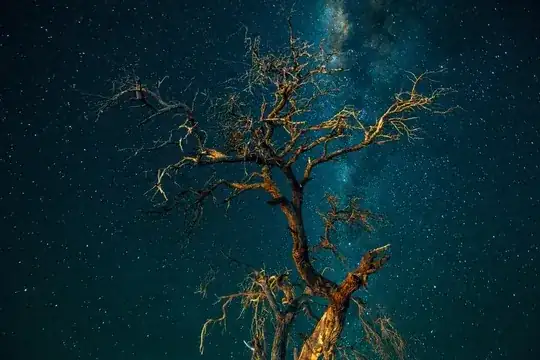
Image taken by James Sainty

Chait
  • 645
  • 10
  • 24
Sergey Litvinov
  • 363
  • 7
  • 14

3 Answers3

16

I initially marked this as a duplicate of How can I avoid star trails without an expensive tracking mount?, but on reflection, I think the answer here is simply the assumption in that one: to get a night-sky exposure longer than 30 seconds or so, you have to track the motion of the sky, and a fancy tracking mount is the way to do that.

It looks (from the shadows) that the tree is lit by a burst from a flash; it's effectively a double-exposure (the tree frozen by the quick flash burst, the sky with the natural light at long exposure). The photographer confirms that he uses this technique in comments on another similar photograph.

mattdm
  • 143,140
  • 52
  • 417
  • 741
8

1) He used a rig to track the motion of the stars.

2) A flash for the trees.

3) some PP to make local adjustment to the color temperature of the trees.

My guess.

7

A little late to the party here, but as the photographer in question I thought I'd weigh in. It's a single exposure. I used an external speedlite flash to "paint" the tree - with several bursts from different angles. Then used PP to adjust the colour temp. The confusion is quite rightly from the shutter speed - that EXIF input data was a manual input and should've said 40 seconds (so sorry!) It is a little longer than had I wanted, but I needed the extra seconds to get sufficient exposure - if you look closely you'll see trails beginning towards the edges. Hope that helps... many many years on!

James Sainty
  • 86
  • 1
  • 1