In the past, I've asked about taking photos of luciferase. Now I'm curious how weak of a light source I can detect. From How many photons per second is one Lumen? on Physics Stack Exchange, I can determine how many photons/sec makes one lumen. What then is the minimum amount of lumens needed for a camera to detect?
Asked
Active
Viewed 2,112 times
7


-
1I think this is already answered at http://photo.stackexchange.com/questions/16427/assuming-a-perfect-sensor-what-is-the-physical-limit-of-iso-pixel-area – James Youngman Mar 27 '12 at 21:00
-
@JamesYoungman. Good point. Although I'm now curious about an imperfect sensor. – bobthejoe Mar 27 '12 at 23:03
2 Answers
12
Note: The dark adjusted human eye can detect a single photon!
Short: About 5 picolumen per pixel with the best commercial DSLRs such as a Nikon D3s.
Long :-) :
Minimum detectable light source will depend on camera and how much of the image area the source occupies. For best detectability, a source will be "brightest" if all it's energy arrives in a one pixel area. The image will not be very interesting in most cases :-).
But, to attempt to put a very approximate empirical answer to the question:
I'll make various assumptions along the way and summarize them at the end so they can be adjusted as desired.
1 EV is a bit above bright Moonlight and is correctly exposed at ISO 100 at f1 for 1 second.
1 EV = 1 lux = 1 lumen per square meter.
I'll avoid the temptation here to leap into steradians and candela and stick with more intuitive empirical terms :-).
Let's assume you are using a Nikon D3s which has a 12 megapixel sensor that can just about see in the dark with no photons at all.
At about 100,000 ISO and an exposure of one second at f1 at 1 EV and dark field subtraction you may perhaps have difficulty detecting whether a given pixel was illuminated or not as even a D3s is getting somewhat noisy. At around 12800 ISO there would be little doubt.
If you set your camera to image 1 square meter then then the 1 EV lighting will be providing 1 lumen total so the 12 million pixel sensor will be accepting ~1/12,000,000 th of a lumen per pixel.
That's at f1 and ISO 100 and 1 second exposure.
Increase ISO to 12800 as above and you can detect 1/12800th less light again.
1/12 million x 1/12800 ~= 6.5 x 10^-12 lumen = 6.5 picolumen.
I don't think I've seen picolumen used before :-)
So, if, all of:
You use an f1 lens
Your camera can image at ISO 12800 for one second at 1 lux or 1 EV and produce a discernible change in a given pixel
You have a 12 megapixel sensor
Then you can DETECT about 5 picolumen **in a single pixel area.
A Nikon D3S should do thus with relative ease.
Longer exposure times will produce increased sensitivities but in time noise will catch up with even a D3s.
Over the whole 12 megapixel sensor his corresponds to 78 microlumen which is 1/12800 th of a lumen total which is no surprise as it is just the inverse of the ISO setting when imaging a square meter at 1 lumen per square meter.
If you vary imaged area, aperture, ISO, sensor pixels, exposure time or camera capability then the answer will vary accordingly.
The biggest gain you can make with a given sensor is to cryo cool it.
And then there are advanced photo multiplying sensors that take the question away from the realm of "normal photography". eg Electron Multiplying CCD, Frame Transfer CCD, Intensified CCD, ...
See also:
Added: Sensor dynamic range -
It's been suggested that some cameras are superior to the D3s in light detection ability per pixel. For cameras which are actually available to take real photos wih, The D3s is still the king of low ISO. See DxOMark's evaluations here.
They explain their reasoning and method on the above site.
In per pixel terms raher than whole image the closest contenders are actually worse than shown by a factor of square_root(Mp/12) where Mp is the megapixel rating of the comparative camera and 12 = D3s 12 Mp. eg 36 Mp D800 is worse than shown by a facor of sqrt(36/12) = 1.7 on a per pixel basis.
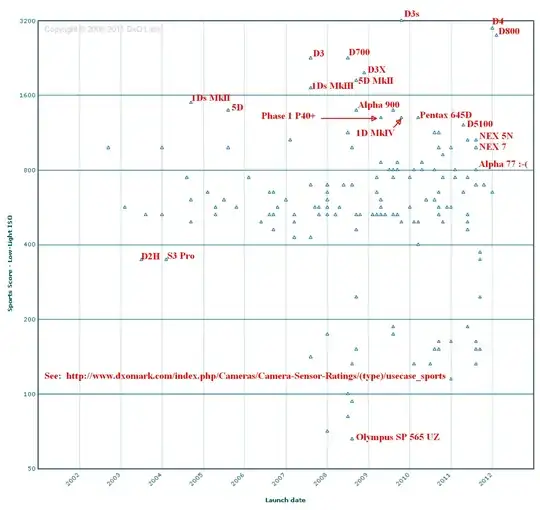
Added:
For those who have the time and patience to wade through a long thread, this DPReview user discussion discusses sensor dynamic range and MUCH more related material. There are several quite capable and high powered people there banging heads together rather solidly but they largely seem to come to a good degree of agreement overall.
Max dynamic range of a sensor is one of their easy topics. It is generally agreed that gains due partially due to dithering allow up to +1.8dB more dynamic range than ADC bits.
Note that you can get more again IF the sensor is better than the resolution of the ADC used BUT if the ADC is either more precise than its number of bits ie LSb = 1.0 or 1.00 and not just 1. in actual accuracy OR if the ADC is stable in its results, regardless of actual accuracy. In such cases the addition of controlled noise of designed characteristics can allow more bits to be extracted from the ADC than it notionally possesses.
Here is a NatSemi (now TI) application note which covers the subject well.
TI literature Number: SNOA232. Here -> Improving A/D converter performance using dither
National Semiconductor Application Note 804, Leon Melkonian, February 1992
See figure 12, page 5, where the addition of optimum dither noise allows recovery of a 1/4 LSB amplitude signal - effectively adding 2 bits to the ADC!!!.

Russell McMahon
- 19,630
- 1
- 44
- 79
-
We have some details on how steradians bring geometry into the equation here: http://photo.stackexchange.com/a/14721/124. – jrista Mar 28 '12 at 14:59
-
We have much more in-depth information about steradians and luminance here: http://photo.stackexchange.com/a/10183/124 – jrista Mar 28 '12 at 15:00
-
+1 Excellent answer. :) Might want to add a couple notes about sensor INefficiencies. Technically speaking, you would only be able to gather 1/12800th of a lumen assuming perfect behavior, perfect, even distribution of light, etc. There are quantum efficiencies to consider, the random nature of photon shot noise, etc. that would eat into sensitivity well before electronic noise affected things, and there is still electronic noise to consider. – jrista Mar 28 '12 at 15:30
-
This is pedantic, but both common usage (including Wikipedia and commercial dictionaries) and the NIST standard on SI disagree with you over the notion that 'lumen' is plural. – mattdm Mar 28 '12 at 17:44
-
@mattdm - Thanks. Your pedantry does appear to be correct :-). Brain and text adjusted. – Russell McMahon Mar 28 '12 at 23:03
-
1@jrista - Thanks - extra material useful. I tried to keep the answer in the empirical and experience based area rather than very much of the underlying physics. The D3s seemed like a good reference as it has the best low noise sensor at the pixel level so far available for DSLRs and I (even though I've never even hel one :-) ) can make some reasonable assessments of how it would perform in the current context. – Russell McMahon Mar 28 '12 at 23:07
-
@RussellMcMahon: The 1D X and 5D III actually seem like they are better low-light cameras than the D3s. The 1D X in particular supports sensitivities up to 51,200. Using your formula (1/pixelCount) * (1/iso) = minLumens, the 1D X would be capable of 1.08 X 10^-12 lumen, or ~1.1 picolumens [(1/18,100,000) * (1/51200) = 5.525 x 10^-8 * 0.00002 = 1.105 x 10^-12]. That really begs the question...how many photons are there in a picolumen? At what sensitivity do you reach 1 photon/
lumen? – jrista Mar 29 '12 at 00:24 -
@jrista - For cameras which are actually available to take real photos wih, The D3s is still the king of low ISO. See DxOMark's evaluations here . They explain their reasoning. In per pixel terms the closest contenders are actually worse than shown by a factor of square_root(Mp/12) where Mp is the megapixel rating of the comparative camera and 12 = D3s 12 Mp. eg 36 Mp D800 is worse than shown by a facor of sqrt(36/12) = 1.7 on a per pixel basis. – Russell McMahon Mar 29 '12 at 12:08
-
The 5D III IS actually available to take real photos with, and has been for about a week. I've been following people on CanonRumors forums who have been posting photos taken with their just-arrived pre-order 5D III's and they are pretty stellar right up to ISO 25,600. Noise characteristics are awesome (noise looks like film grain, its great), and SNR is extremely high at higher ISO's. So while DXO may not have reviewed the 5D III yet, it is technically the most sensitive camera money can actually buy today. – jrista Mar 30 '12 at 05:48
-
As for DXOMark, they are a useful statistical resoource, but you have to take their data with a grain of salt (if for no other reason than that Nikon is a big-bucks paying supporter, where as Canon is not, and DXO tests frequently demonstrate weighting in favor of Nikon.) DXO has also not yet evaluated the 1D X and 5D III, even though the latter is on store shelves now. Using a simple square root of higher over lower MP is too simplistic, as it does not take into account hardware-level improvements to sensor technology, of which many have made their way into Canon's latest sensors. – jrista Mar 30 '12 at 05:51
-
When it domes to sensitivity, Canon improved SNR by a couple orders of magnitude to achieve ISO 51200 (1D X) and ISO 25600 (5D III). With a high SNR, their sensors should be very sensitive to miniscule quantities of light. When it comes to DR, DXO mark does not take into account how each manufacturer weights sensor output for various tonal ranges. Canon favors highlights (and rightly so, given that they have a tremendous amount of wedding photographers and the like as customers), where as Nikon favors shadows at the cost of a small amount of highlight range. – jrista Mar 30 '12 at 05:54
-
@jrista - DxO depend on producing demonstrably measurement-based results in order to maintain commercial credibility. You are calling them liars and cheats. Fact based figures would be of interest - to me and others here if not to DxO's lawyers. DxO's results usually lag market release by some weeks - I'm as keen as any to see results for all systems. There is no doubt that the 5D Mk III is a superb camera and that 1D X also will be - but claims re measureable performance need to be fact based. If any of the new Canon's outperforms the d3s I'll be delighted - and also extremely surprised. – Russell McMahon Apr 01 '12 at 08:08
-
@jrista - Re "Using a simple square root of higher over lower MP is too simplistic ..." -> Did you read their explanation. Factors such as improvements to hardware are irrelevant to what is being measured. They may well affect the result. But the effect is what is being determined. Their "simple square root" makes sense in the context they use it, as one would expect. – Russell McMahon Apr 01 '12 at 08:40
-
@Russell: In all honesty, I do believe DXO are liars and cheats. Riddle me this: The D800, according to DXO's "Screen DR" tests (raw data strait out of the camera) is capable of 13.23 stops of DR. Their "Print DR" tests indicate it is capable of 14.4. The physical sensor is a 14-bit sensor, which dictates it is capable of a MAXIMUM of 14 stops of DR. If you need to photograph a scene with exactly 14.4 stops, are you going to blow highlights, because the sensor is only capable of 13.23 stops, or are you magically going to get 1.17 stops more DR (and 0.4 stops more than 14 bits allow for?) – jrista Apr 01 '12 at 19:33
-
There is something WRONG with DXO claiming the D800 is capable of achieving 14.4 stops of DR. Physically, the sensor would have to produce 15 bits (2^15 levels) to actually support fully photographing a scene with 14.4 stops of DR in a single exposure. I'm sorry, but yes...I do believe DXO's "Print DR" results are bogus, regardles of how mathematically accurate they may be relative to each other. Your going to blow highlights or block shadows even with the D800 when you try to photograph a scene with 14.4 stops of dynamic range, since its beyond the 13.23 stops the sensor is capable of. – jrista Apr 01 '12 at 19:35
-
@jrista - if you have the time and patience to wade through this DPReview user discussion you'll have that question answered and learn quite a lot that is related besides. There are several quite capable and high powered people there banging heads together rather solidly but they largely seem to come to a good degree of agreement overall. Max DR of a sensor is one of their easy topics. It is generally agreed that gains due partially due to dithering allow up to +1.8dB more dynamic range than ADC bits. – Russell McMahon Apr 10 '12 at 08:03
-
@jrista - see addition to my answer with more detail and a dithering reference. – Russell McMahon Apr 10 '12 at 08:19
1
It all depends on your exposure length! I've successfully photographed nebula with a telescope attached to my camera. Using imaging sensors I've measure the black of an LCD display. (Not with any huge accuracy but hey, the sensor was picking up photons...) Exposures were on the order of minutes to 30 seconds.
I read your earlier question on luciferase. I take it you've not been able to shoot it yet? Can you ask those who did and see what they did or is this question just for general knowledge?

Paul Cezanne
- 6,468
- 4
- 34
- 67
-
Thanks for asking. I have been able to shoot it. Now I just want to be able to shoot less of it. – bobthejoe Mar 27 '12 at 22:53
-
Longer exposures. Modern sensors. My GF's Canon 7D can easily do ISO 2000 without too much noise, my older, Canon 40D balks around 400-800. And the new cameras are even better. Do you have any sample shots, I think I'm not alone in wanting to see some! – Paul Cezanne Mar 27 '12 at 23:37