3

The longest lens I normally shoot with is a 70mm prime — a 35mm-e of 105mm on my APS-C DSLR. I'm trying out the DA★ 200mm f/2.8, though, and the thing people always say about a stabilized viewfinder image with in-lens stablization is hitting home. With my typical lenses, it's a non-issue, but at 200mm, I'm finding it really hard to hold the lens steady enough to get the precise framing I intend!

Is this something I can get better at, by improving my camera-holding technique? I'm shooting at pretty fast shutter speed and/or using in-body shake-reduction, so the results are sharp — just not always lined-up as I meant. Should I practice holding still, or should I instead plan to frame loosely and crop later when a tripod isn't an option?

mattdm
  • 143,140
  • 52
  • 417
  • 741
  • 1
    go to high speed mode and shoot bursts. One of them will be good. I'm halfway serious. – Paul Cezanne Mar 23 '12 at 21:53
  • 1
    Read up on sniper techniques for making steady shots. I recommend skipping past the ghillie suit parts though =) – Patrick Hughes Mar 23 '12 at 22:16
  • I mention some of the techniques I use for this at http://photo.stackexchange.com/a/18813/7603. There is probably a lot written about this for nature photography because you often want to use a long lens and don't have a tripod handy. – Olin Lathrop Mar 23 '12 at 22:43
  • @drewbenn: so.... the last sentence of my question? :) – mattdm Mar 24 '12 at 01:05
  • @drewbenn: heh; no problem. :) – mattdm Mar 24 '12 at 02:34
  • Have you thought of using a monopod or even a tripod with a gymbal type head? Hand-held long and telephoto photography without IS is very difficult, however MUCH of that viewfinder instability can be remedied by simply using the right mount. A monopod is great when you need to be on the move a fair bit, but have the time to stop, drop the pod to the ground, pan and take a shot. – jrista Mar 24 '12 at 02:45
  • @jrista: hadn't really considered it, but that might be part of the solution at least in some cases. – mattdm Mar 24 '12 at 02:57

1 Answers1

4

I can't remember which Pentax you have, but since I've have 120-400mm for my K-5, I can give you some of what I do...

  1. Shoot in bursts, especially for moving targets, but even if it is stationary burst shooting will help.

  2. Use a tripod and get a head designed for long lens shooting. Wimberly makes some good ones, so does Arca Swiss.

  3. Practice, practice, practice.

Now, rifle shooting techniques do actually help. When I was in my military days, I had a really good lesson on technique from a guy that taught shooting for the Ontario Provincial Police and these can work for photography:

  1. Bring your elbows closer in to your body, letting your body help support. If you can, down on one knee resting the elbow of the arm holding the lens can help a lot. The strap can also add tension to steady your hands.

  2. When you're about to shoot, take a deep stomach breath and take up the slack on the shutter. Let the breath out half way, hold and shoot. Don't hold your breath too long, you'll get hand shake.

  3. When you shoot, squeeze the shutter, don't stab it. If you stab it, you'll move the lens.

  4. Practice the technique on a subject that you don't care if you miss... It takes getting used to, but if you do it, it works.

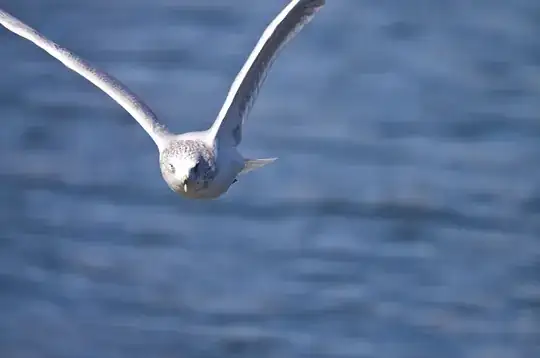
Finally, don't just discard the mis-framed shots, sometimes they can be interesting:

enter image description here

Joanne C
  • 33,138
  • 4
  • 72
  • 132
  • 2
    I do like your mis-framed shot. – mattdm Mar 24 '12 at 02:35
  • 1
    Don't forget the Custom Brackets gymbal head. Its newer, but its received nothing but good to raving reviews from long-time bird photographers. Its nice and modular as well, breaks down neatly and nearly entirely flat, and is lighter than the Wimberly. – jrista Mar 24 '12 at 02:46
  • 1
    @jrista - New one on me, I'll have to check it out. – Joanne C Mar 24 '12 at 03:38
  • @mattdm - Me too, normally I just use seagulls for practice, but I liked this one. – Joanne C Mar 24 '12 at 03:38