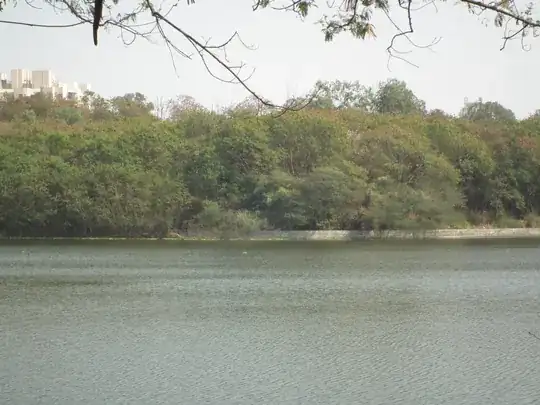
It is correct that a smaller aperture (higher f number) results in greater front-to-back focus, whilst larger apertures (smaller f numbers) result in more selective focus.
There is, however, a tradeoff. With the smaller apertures, less light is let into the camera body and in order to compensate for this, the camera must do one of two things. a) slow the shutter speed, in order to collect more light, or b) increase the ISO to make the sensor more sensitive to the light it does receive. Possibly, your camera will do both.
You do not say whether your sample images above were taken on a tripod, though since they are framed ever so slightly differently, I'm guessing not. The lack of sharpness in the second photograph may be caused by camera shake, where the shutter was open longer than for the photo with the larger aperture. The longer shutter time would also accentuate and capture movement in the water, as opposed to the first shot which, with a faster shutter speed, 'froze' the water.
With all things being equal however, the photos should result with the same 'brightness'. Your second photo is clearly slightly overexposed, compared to the first. So I am wondering if in the first photo, your camera metered off the water, and the second metered off the trees.
Unfortunately it's difficult to identify the exact issues based on the two photos provided. Can you perhaps supply not only the f stop used, but also the shutter speed and ISO values? (This will be stored as metadata (called EXIF) in the photo file. Windows or Mac should display this when the file is selected in Explorer/Finder).