6

Example:
The prime lens Nikon 1.4F G is said to be very sharp at F3.5.
So, if I compare that with the normal or telephoto zoom lens's F3.5, will the level of sharpness be same?

If no, then will the sharpness of the prime lens be better as compared to its counterpart at the max aperture (without diffraction)?

Assumptions:
- The sensor size, and brand for both lenses are same.
- The normal/telephoto len's aperture starts from F3.5 to F16.
- The prime len's aperture starts from F1.4 to F16.
- The focal length used for shooting is 50 mm for both.

Aquarius_Girl
  • 5,602
  • 16
  • 59
  • 115
  • 3
    This seems like it's going to be somewhat specific to the two lenses involved. People generally seem to suggest overall better optical performance for prime lenses, however I wouldn't expect that this would mean for ANY TWO zoom/prime comparison the prime would always come out sharpest... – forsvarir Jan 18 '12 at 12:05
  • @forsvarir What is "optical performance"? – Aquarius_Girl Jan 18 '12 at 12:09
  • you can't really compare sharpness at different focal lengths, Nikon don't make any f/1.4 telephotos! – Matt Grum Jan 18 '12 at 12:11
  • Y'all, I think this can be answered in general, even if the answer is "not necessarily". – mattdm Jan 18 '12 at 12:17
  • @mattdm When you say not necessarily I request you to tell the reasons. – Aquarius_Girl Jan 18 '12 at 12:19
  • 1
    @MattGrum Sorry, assuming that the focal length for both is 50 mm. :doh: – Aquarius_Girl Jan 18 '12 at 12:20
  • @Matt Grum — one can't or one shouldn't compare sharpness at different focal lengths? Why not? (Can't I say "my 40mm lens is sharper than my 15mm?") – mattdm Jan 18 '12 at 12:34
  • 1
    I think there's a basic, simple fact of optimization at work here: if, for a given budget, one could design a zoom that was "optically better" (in some well-defined sense) at a focal length equal to that of a competing prime, then the best solution for the prime would be to manufacture the zoom and freeze it at that focal length! This demonstrates that when you hold all relevant factors the same and you keep your design objectives fixed, the prime cannot be any worse than the zoom. – whuber Jan 19 '12 at 22:55

3 Answers3

15

There is no answer to your general question.

Prime lenses are usually sharper than zooms at the same focal-length and aperture, mostly at wider apertures when the sensor out-resolves the lens. At one point lenses can out-resolve the sensor and then you will see equal sharpness in your images despite a potential difference in lens sharpness.

If someone were to built a prime and a zoom today with the best technologies, then the prime will be sharper since there are less variables in its design. However, once you compare lenses introduced at different time and even different quality levels, you will have to compare case-by-case.

Now, manufacturers choose to use different qualities of materials, different designs and tolerances today which sets the price-point of lenses. That is why you see standard zoom lenses which are very soft at their widest apertures. Other premium zooms can be extremely sharp from wide-open.

Itai
  • 102,570
  • 12
  • 191
  • 423
  • At one point lenses can out-resolve the sensor What does that mean? – Aquarius_Girl Jan 18 '12 at 14:46
  • 1
    It means the lens can let in more details than the sensor can capture. This is usually the case with quality lenses which is why you do not throw them away when you upgrade your camera. Although as cameras resolutions go higher, more and more lenses get out-resolved by the sensor. – Itai Jan 18 '12 at 14:49
  • @AnishaKaul: You should join the PhotoSE chat room sometime SOON. You have LOTS of questions here, and I think we could help you much better with a real-time chat than here on the forum. I'm in the chat room most of the time, although not always watching. If you join and stick around, I'll keep an eye on chat and hopefully we could have a real-time conversation and clear up a lot of the questions you have here. – jrista Jan 19 '12 at 20:48
  • @AnishaKaul: Go here for chat. – jrista Jan 19 '12 at 21:25
  • I second visiting chat, but questions are good too. Lots of views per day on these, too. – mattdm Jan 19 '12 at 21:52
  • @jrista Is it bad to ask too many questions on the main forum? Actually, I don't prefer chat for technical discussions. Reason is that chat results don't get shown up in Google results, and if someone else needs the answer he won't be able to get it. Also, chat doesn't involve "many" people. – Aquarius_Girl Jan 20 '12 at 01:12
  • 1
    @AnishaKaul: You can certainly ask individual questions here, and I would recommend you do. It just seemed like the answers on this particular question were just creating a deluge of new questions for you, and I thought I could clear some of them up, so you could better understand the answers here. Chat may not be visible on google, however it is fully archived, and all content there is available for perusing. – jrista Jan 20 '12 at 01:22
  • @jrista Thanks for your concern. I'll think about it. :) – Aquarius_Girl Jan 20 '12 at 01:27
9

If we were to graph out the "sharpness" or various lenses, my guess is that we'd come up with something like this:
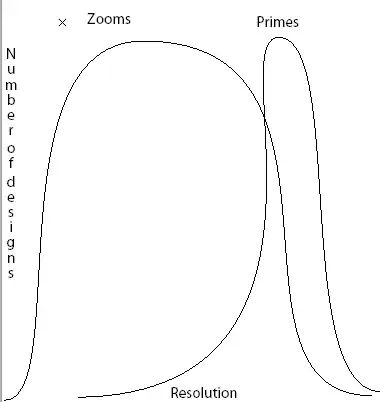
enter image description here

Keep in mind that this is hand-drawn based on my beliefs, not an actual graph of results from tests, or anything like that. Since it is hand-drawn, don't try to read too much into things like whether it might not be more accurate to show more overlap between the two, the spot with a negative slope on the left-hand part of the "Primes" curve, etc.

In any case, let me point to a couple of points this is intended to show.

  1. On average primes have higher resolution than zooms, but
  2. There's a lot of overlap between the two
  3. Resolution of zooms tends to vary a lot more widely
  4. Conversely, primes tend to be much more consistent
  5. A lot of zooms have much lower resolution than almost any prime, but...
  6. the best zooms are better than all but a few of the very best primes

As you reduce the aperture (smaller opening/bigger number), differences between lenses tend to get smaller. By f/8, even poor lenses usually produce decent results. By f/11 they're all starting to get worse, and by f/22 they're virtually all getting pretty poor.

Jerry Coffin
  • 19,310
  • 1
  • 55
  • 87
  • 3
    @drewbenn: The more you stop down the aperture, the less maximum resolution a lens can achieve. Its a simple matter of physics. A "perfect" lens, one which has no optical aberrations, would always produce the highest resolution wide open, and resolution would always decrease the more you stop down. The only reason we sometimes see BETTER resolution when stopping down a lens a little bit is because there are often optical aberrations wide open that impact IQ MORE than diffraction. When optical aberrations are not an issue, diffraction is the only quality detractor. – jrista Jan 19 '12 at 20:55
4

In general a prime lens is easier to build and need less glass due to the single fixed focal length.

Add to that the fact that most prime lenses have a wider aperture than their zoom equivalents, which requires a better lens design and better glass (including coatings) to allow full use of the benefit of a wider aperture without horrible distortion or colour fringing, stopping a prime lens down can only make the result better as pretty much any lens gets sharper when you reduce the aperture (up to a point, depending on the lens).

As a result, a prime lens will, provided the lenses are from roughly the same area, always give a higher quality image.

(A significantly older prime lens can be worse because of the advances in optics since. A zoom lens also needs to compromise on distortion, especially when it covers for example 24-70mm, wide angle to the beginning of telephoto.)

DetlevCM
  • 3,068
  • 14
  • 19
  • This means that at F11, prime len's sharpness will be "better" than a normal/telephoto zoom lens? Is the difference noticeably? – Aquarius_Girl Jan 18 '12 at 12:14
  • Perhaps you should touch on the relationship between prime and normal lenses, looks like there's some confusion on that front. – Imre Jan 18 '12 at 12:17
  • @Anisha At f11 you might find some lenses not to be at their sharpest. For many lenses it tends to be around f8.

    But overall yes: In general a prime lens at say f8 should be sharper than a zoom lens at f8. (If you can see the different is another matter) Go to say f4 between a prime lens and a zoom lens and the difference should be more visible.

    – DetlevCM Jan 18 '12 at 12:27
  • @Imre What is a "normal lens" to you? :) There are two large groups of lenses, prime lenses with a fixed focal length and zoom lenses which cover a range of focal length.

    Next you have the types of lenses: Wide angle Standard Telephoto Super-Telephoto (though they are technically just telephoto lenses)

    Then specialist lenses, such as fisheye and Tilt-Shift.

    And lastly, there is a variation of telephoto lenses which a very small minimum focusing distance known as macro lenses.

    – DetlevCM Jan 18 '12 at 12:29
  • @Anisha Kaul at f/11 diffraction will be limiting sharpness more than the lens design so I wouldn't expect any appreciable difference! – Matt Grum Jan 18 '12 at 12:38
  • 1
    @DetlevCM It's not necessarily true that the wider the max aperture the sharper the lens will be stopped down, in fact the wider the aperture the more corrective lens elements are required which are at best dead weight when stopped down and at worst extra sources of dispersion. I'd bet the Canon 50 f/1.8 is sharper at f/4.0 than the Canon 50 f/1.0! – Matt Grum Jan 18 '12 at 12:44
  • Just a nice comparison - though on Canon: 200mm f2 vs. 70-200mm f2.8 II at f4 http://www.the-digital-picture.com/Reviews/ISO-12233-Sample-Crops.aspx?Lens=458&Camera=453&Sample=0&FLI=0&API=3&LensComp=687&CameraComp=453&SampleComp=0&FLIComp=0&APIComp=2

    The prime lens is just a tad sharper.

    @Matt It is not quite that easy. Yes, you need more correction in a wide aperture lens - but the positive effects of that carry through to the smaller apertures. You don't magically loose all the optical enhancements implemented in a wide aperture design by stopping down.

    – DetlevCM Jan 18 '12 at 12:48
  • @Matt Canon 50mm f1.2 and f1.8 at f1.8 http://www.the-digital-picture.com/Reviews/ISO-12233-Sample-Crops.aspx?Lens=403&Camera=453&Sample=0&FLI=0&API=3&LensComp=105&CameraComp=453&SampleComp=0&FLIComp=0&APIComp=0 - the f1.2 lens is noticeably sharper. Though in my experience the 50mm f1.8 II lens is a lot sharper when actually using it (on a 5D MK II). – DetlevCM Jan 18 '12 at 12:50
  • @MattGrum f11 was just an example of the least minimum aperture. Have edited the question. – Aquarius_Girl Jan 18 '12 at 13:42
  • 1
    @DetlevCM ahh but if you look at the dpreview test the 50 f/1.8 is sharper than the f/1.4 from . You could spend all day finding examples and counterexamples on various review sites, my point was that the issue is not clear cut, you can't just say x is sharper due to the wider aperture. And if you are correcting for things like spherical aberration then blocking the light causing the aberration with the aperture stop will cause you to lose the benefit. – Matt Grum Jan 18 '12 at 13:55
  • @DetlevCM I'd say normal lens is a prime lens with focal length approximately same as length of imaging area diagonal. So, comparing prime lenses to normal lenses would be like comparing apples to medium-sized apples. – Imre Jan 18 '12 at 14:11
  • @Matt To my eyes the 50mm f1.4 is sharper at 1.8 than the 50mm f1.8 II. And at f2.8 the difference becomes even more pronounced. http://www.the-digital-picture.com/Reviews/ISO-12233-Sample-Crops.aspx?Lens=115&Camera=453&Sample=0&FLI=0&API=4&LensComp=105&CameraComp=453&SampleComp=0&FLIComp=0&APIComp=2 – DetlevCM Jan 18 '12 at 14:17
  • @Imre You still haven't said what a "normal lens" is. You have linked to a question about a "standard" lens. Standard != Normal.

    By the way, nobody uses the terminology "normal" - everybody refers to 50mm as "standard".

    – DetlevCM Jan 18 '12 at 14:19
  • @DetlevCM — you're quite mistaken on that. For example, http://theonlinephotographer.typepad.com/the_online_photographer/2007/07/normal-lens-uni.html and http://theonlinephotographer.blogspot.com/2007/02/elusive-normal-and-myth-of-fifty_18.html – mattdm Jan 18 '12 at 14:24
  • @Matt Interestingly the first time I have heard of it. Everywhere I look a 50mm lens is refereed to as "standard". Besides, those two pages are run by the same person ;) - else the same subdomain wouldn't make any sense. – DetlevCM Jan 18 '12 at 14:29
  • Sorry, I meant to link to ltn100's answer earlier, which seemed the most relevant piece here. On any other day, you could also look up "normal lens" on Wikipedia. I posted a new question to resolve the issue and have a better resource for linking in future :) – Imre Jan 18 '12 at 14:33
  • @DetlevCM — yes, but I link those pages because it's a guy who knows what he's talking about, with a long history as an editor for photography magazines. Other references can be found, for sure. – mattdm Jan 18 '12 at 14:38
  • Wikipedia isn't considered a valid resource :) (Amongst academics anyway - A link to the Britannica would be more valuable - or Brockhaus.)

    What I do wonder though - is the term "normal" used in the US by any chance? Because I'm looking at it from a European point of view.

    – DetlevCM Jan 18 '12 at 14:44
  • 3
    @DetlevCM Here you go, although AFAIK no Encyclopaedias are acceptable as references among academics. Here's a UK photog explaining normal lens, never mentioning standard. I'm in Europe, but "standard" would have more likely made me think of a kit lens rather than a medium prime. Now I know better, thanks ;) So perhaps it's a community thing (i.e. who you've been talking to), not a continental difference. – Imre Jan 19 '12 at 07:49
  • @Imre - Thanks for researching. Interesting indeed. I shall stick with "standard lens", but try to remember that some people call them "normal".

    I wonder how it happens that two terms are used... And it is less the kit lens that the term refers to, as the focal length. A lens that covers the 50mm equivalent on a camera is a standard lens on that camera - at least in my books.

    A complicated world...

    – DetlevCM Jan 19 '12 at 11:03
  • And just to follow up: Established Encyclopaedias are accepted as references, especially for a general background. But established means Britannica for the UK and Brockhaus for Germany. Of course details require appropriate literature, but for just breaking into a topic, nobody would fault you for citing one of the established ones. – DetlevCM Jan 19 '12 at 11:08
  • @DetlevCM: For several decades it was usual for most interchangeable-optics 135-format cameras to come bundled with a 50mm lens. In other words, the standard lens was a normal lens, if you catch my drift. Which would have made it quite natural to assume that "standard lens" == "normal lens", leading to a confusion of terms later on when the bundled ("standard") lens was usually a mid-range zoom instead. – Staale S Jan 20 '12 at 13:41