How can I determine the minimum shutter speed at which I can effectively avoid camera shake while hand-holding the camera?
Asked
Active
Viewed 4.2k times
30

5 Answers
35
General Rule
The general rule of thumb for 35mm (full frame) has been the reciprocal of the focal length.
This means that for a 50mm lens, the minimum shutter speed when hand-holding is 1/50 sec.
1/(focal length) = 1/50
Since this is usually not an option, 1/60 sec is the next option.
Since the move to digital and multiple sensor sizes, the generally agreed upon rule is that the effective focal length is the number to keep in mind.
So, on a APS-C cropped sensor, a 50mm lens would need a 1/(50 * 1.6) = 1/80 sec.
On a longer telephoto, say a 300mm on a full-frame (35mm) you would need 1/300 sec.
Image stabilization
Camera (and lens) makers are now adding image-stabilization to their lenses, which lowers the shutter speed needed. Generally the makers will rate the level of stabilization in stops. Keep in mind these ratings are used for marketing and may be a bit inflated, but I am going to do my calculations based on the numbers being correct to keep it simple.
If you are using a 100mm lens with a 2 stop image stabilization system on a APS-C cropped sensor then:
 (1/(effective focal length)) * (2 ^ image-stabilization-stops)

 (1/(100*1.6)) * (2^2)

 (1/160)*4 = 1/40 sec

chills42
- 23,657
- 7
- 85
- 136
-
A tool inspired by this post: http://www.aneejian.com/2017/03/handheld-shutter-speed-calculator.html – Ian Mar 25 '17 at 01:49
20
You can determine the minimum shutter speed to avoid camera shake by
1) applying the following approximate rules of thumb. (See Wikipedia article - rule of thumb)
2) or carrying out careful measurements, as I did.
1) The rules of thumb
a) With NO image stabilisation
The approximate rules of thumb are:
Full frame cameras : min shutter speed = 1/focal_length
APS-C cameras : min shutter speed = 1/(focal_length*1.6)
Note that these are approximate rules and are heavily dependent on photographer technique, which is why they are called rules of thumb (my thumb and your thumb are not the same).
b) With image stabilisation.
Here the rule of thumb is to take the above calculation and increase the above shutter speeds by either two or three stops, depending on your confidence in the manufacturer.
2) Measured results
By conducting more than 1000 measurements under carefully controlled conditions I arrived at the following results. The fully documented study can be found on scribd.com:
A Study of the Effectiveness of Shake Reduction in the Pentax K7
The graph below shows the main result of this study. With a 50mm lens motion blur was kept below one pixel down to a shutter speed of 1/8 sec, which is more than acceptable.
This is effectively equivalent to the following rule (for the Pentax K7):
min shutter speed = 1/(focal_length*1.6) - 3 stops.
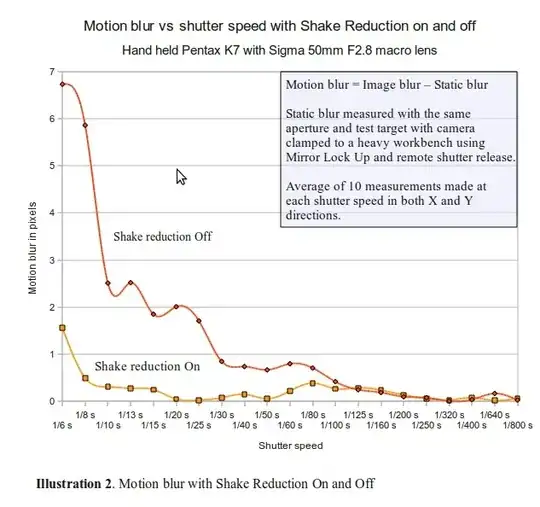
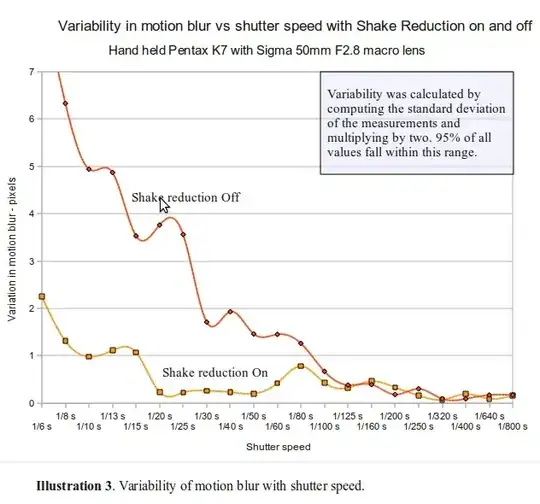
However at shutter speed below about 1/30 sec the result are critically dependent on photographer technique. The graph below shows how variability of the results increases rapidly at lower shutter speeds, which illustrates the importance of photographer technique.

labnut
- 8,297
- 3
- 34
- 55
-
4+1 for contributing to the campaign to add more good answers to old questions. :) – mattdm Apr 01 '11 at 17:13
15
Okay, mine is not a technical answer, but I think it has some merit that the technical answers lack: empiricism. Try using different speeds and see what you can hand-hold.
For each lens (and zoom setting, if applicable), handhold the camera while on shutter priority,and see what the slowest shutter speed YOU can use is without shaking the camera. Different people have hands that shake to different degrees.
By the way, I would check out whether or not it is blurry on a monitor, not on the camera LCD. You just can't see clearly enough to be sure whether there is blur on the LCD (unless you have a much better quality LCD screen than I've seen.

Rabbi David
- 1,752
- 1
- 12
- 17
-
1Most cameras allow you to magnify the image you're viewing, so it's usually possible to check for pixel-level blur even without a computer. – che Jul 31 '10 at 06:06
-
1well said, Rabbi. And it doesn't just depend on the person, but the photographer's health, state of mind, physical comfort, environmental conditions, etc. I've shot in a force 10 winter gale at times, being battered by 120kmh winds is a good way to be unstable (with or without tripod) even if you're shielded from the worst of the winds by things like buildings. – jwenting Dec 14 '11 at 07:16
10
A couple of answers have already mentioned the 1/FL rule of thumb. Keep in mind, however, that this is only a rule of thumb, not an iron-clad law. Depending on how steady you are, you may find that you can (or must) adjust it.
Good technique is critical here. The same techniques used by target rifle shooters work nicely. First, get the steadiest stance you can: prone is best, kneeling second best, standing up your last choice. If you have to shoot standing, put your left hand directly under the lens and brace your elbow against your chest if possible (especially important with longer/heavier lenses). Take a fairly deep breath, then let it about halfway out before you squeeze the shutter release.

Jerry Coffin
- 19,310
- 1
- 55
- 87
5
The general rule is 1/EFL (equivalent 35mm focal length) without IS.
That means if you're on an APS-C, 1/(FL * 1.5~1.6).
The improvement IS gives is given in stops. One stop is applying a power of two, so, the final calculation is:
(1/EFL)*(2^IS)
Everyone shakes different amounts, and even interacts differently with each IS systems.


-
I don't think you need to apply the crop factor here. The size of the sensor effects field of view, it doesn't necessarily magnify the image. – Joanne C Jul 30 '10 at 19:28
-
9Narrowing the field of view is magnifying the final image. It doesn't matter where the step occurs.
Think about a P&S with 6mm lens.
– eruditass Jul 30 '10 at 19:30 -
How do you figure? If a full frame sensor has the same pixel density and size of photosite as the APS-C, then a 1.5 crop of it will have exactly the same image as the APS-C shot, ergo no magnification. – Joanne C Jul 30 '10 at 19:34
-
3The object on the APS-C shot will be larger relative to the overal frame due to the sensor-cropping, regardless of pixel densities and photosite size. If you print them both to a 8x12, an object will be larger on the APS-C shot. – eruditass Jul 30 '10 at 19:38
-
But that's just, potentially, upsizing the image. If I printed that full frame crop at the same size it would still look the same. And yet, I only need 1/FL for the full frame and more for the APS-C to get steady, sharp, shot? – Joanne C Jul 30 '10 at 19:46
-
3If you crop an image, you are increasing the magnification as you are zooming in on the image. The shake-induced blur will be magnified as well and the guideline, which is based on not cropping, applies less. The APS-C and cropped FF will look the same. Of course, as you crop, it will typically be obscured by pixel size, as larger format cameras tend to have lower pixel densities. – eruditass Jul 30 '10 at 19:59
-
-
I let it drop, but there are some strange assumptions that don't bear out such cropping equals magnification... I'm not zooming by cropping, I'm cropping. I'm zooming if I resize an image, but then you'll introduce blur from the algorithm and how would you distinguish that from shake blur? – Joanne C Jul 30 '10 at 22:09
-
1@John: I believe you are thinking in terms of raw pixels and numbers, but we are projecting all of the pixels onto a common image physical image size in inches. – eruditass Jul 30 '10 at 22:36
-
Exactly! But this is not a result of magnification on the sensor, this is a result of software. In one you may have to scale it up, which introduces blur, and in other you may have to scale it down, which will sharpen. However, neither is related to the fact that a 100mm lens is still a 100mm lens, this is now in the realm of software and the degree of blur or sharpening is algorithmic. Your APS-C may magnify, but it's comparison based only. You may magnify against a Nikon D700, but you may not against a Canon 5D mk II. – Joanne C Jul 30 '10 at 23:35
-
@John: It doesn't matter where the step occurs, it's still magnification (see my first comment). Software or hardware, doesn't matter. 100mm lens is a 100mm lens. The increasing focal length is the same thing as cropping which is the same thing as a teleconverter. The guidelines are based on the magnification, but it is convenient to use FL, which is the same as cropping and adding a teleconverter. They are just happing in different domains. See my explanation here: http://photo.stackexchange.com/questions/139/what-is-the-difference-between-focal-length-and-crop-factor/1244#1244 – eruditass Jul 31 '10 at 00:31
-
You are looking at per-pixel sharpness (heavily dependent on photosite size and gives an unfair advantage to low density sensors), but we are looking at the final product in a normalized way, which is a more suitable point of comparison. – eruditass Jul 31 '10 at 01:17
-
I think my point is being missed... You're treating the scaling of the software as a reason to change your behaviour around shutter speed and lens length. This isn't about per pixel sharpness, it's about whether or not the sensor in question is more or less sensitive to the movement of the lens than another and, well, the crop factor of the sensor doesn't determine that. It's not possible that this is the case, the math and physics simply don't agree with it. – Joanne C Jul 31 '10 at 01:29
-
Just to continue from above... The only way for that to be the case is to measure the ratio to some standard. If the standard for film, for example, is 4000 dpi and your sensor is 6000 dpi, then you have a 1.5 multiplier on your situation, presuming the lens can even resolve to that. Otherwise, for the same functional area, you have the same amount of capture or less, and thus the same amount of blur or less. That's physics, a light receptor of the same size can't be more sensitive to motion because of the dimensions of the plate that holds it. – Joanne C Jul 31 '10 at 01:34
-
@John, I am having some trouble deciphering some of your sentences. I think the key to your understanding is extrapolation of the situation. DPI is irrelevant: if you have a FF sensor, one with 1000 MP pixels, one with 10 MP, and a 10mm lens, the guideline will be the same for each one because the object will occupy the same relative space in the frame for each. When printed or with the whole image on the screen, each object will occupy the same physical space. On one, the object will have 100 times as many pixels in each dimension, but it doesn't matter. – eruditass Jul 31 '10 at 03:15
-
Now, for a 10 MP FF sensor and a 10 MP 1/8" sensor (crop factor of 21.65) with 10mm lenses, the guideline will be 1/10s and 1/216.5s. Why? If they both point at a man 5 ft away, one will the whole body and perhaps the photographer's own feet (a fisheye), while the other will be filled with a fraction of the man's face (with the field of view of a decent telephoto). On the Fuji S100FS, at 100mm, you can't hand hold it at 1/100, because it acts like a 400mm lens in magnification. The focal length is a measure of magnification, and the crop factor is a measure of relative image magnification. – eruditass Jul 31 '10 at 03:27
-
I am not saying light receptors of the same size are different in sensitivity to motion (this is per-pixel blur by the way). I said for the same photosite size, a FF cropped to a APS-C will infact display the same amount of blur, both when viewing the whole image and in per-pixel. You are down at the pixel level (a light receptor) when you need to think about how the light receptors work together to produce the image. – eruditass Jul 31 '10 at 03:30
-
1The 1/focal length guide is an ESTIMATE! I can hand hold a little below the 1/FL rule on my crop sensor camera. So, for anyone who's confused by the crop sensor part, I'd say just ignore it. If you have a 200mm lens, start with the assumption that 1/200 is as slow as you should go. 100mm lens = 1/100. And anything less than 1/60 is usually not handholdable. Then experiment on your own and find out what works (reliably) for YOU; some people are more steady than others and as you learn better holding techniques you'll find you handhold at lower speeds than even the 1/FL rule on a crop camera. – Erica Marshall Jul 31 '10 at 05:07
-
@Eruditass All I'm trying to say is that a sensor can only magnify if it is capable of resolving more detail in the same physical space. At which point it may effect the 1/FL rule of thumb, but it is not specifically related to the physical size of the sensor. Basically, I agree with Erica, because of variations of sensors at each size, 1/FL is a starting point and then you must learn what your own skills and camera capability mix together to do. – Joanne C Jul 31 '10 at 13:33
-
Here's a site: http://enginova.com/Minimum%20Shutter%20Speed.htm that explains much, much, better than I have. – Joanne C Jul 31 '10 at 13:51
-
@John: You are 100% correct in what you are saying. I don't disagree with that. With digital, many guidelines need to be changed, such as depth of field markings. However, there is one point you are still missing. We are mapping two different sizes (sensors) with identical resolving powers to the same size (a print). The result is the on the print, the pixel spacing will no longer be equal. The blur and resolution of the capture was the same, just one was blown up more to reach the print size, and thus the perceived magnification is different. – eruditass Jul 31 '10 at 15:50
-
This remains true for all sensors and enargments that do not exceed a certain size. John, your link is a DIFFERENT guideline for achieving MAXIMUM sharpness (not acceptable perceived sharpness). This comes into play only when doing enlargements that are large enough that you are reaching the limits of captured resolution. The APS-C and FF scenario do exactly as you state at a large enough print because your eyes are fully resolving the resolution. As you shrink it beyond this point, APS-C's captured pixels will always be larger in physical space than FF's and you eyes are limited by that. – eruditass Jul 31 '10 at 15:51
-
About your link, for such a technical analysis of the rule, I have to say I was dissapointed in his "new" rule of using 2 to 10 times the old rule! Actually, he goes on to use megapixels as I expected. For maximum sharpness, you can never depend on one variable for limiting the resolution. He is depending on pixel spacing. That is one hard limit, but often lens quality and diffraction step on that, especially with current P&S models. – eruditass Jul 31 '10 at 15:51
-
@Erica, exactly. As I mentioned, everyone shakes different, and everyone even interacts with IS systems differently. Best to go out and see what you're capable of. – eruditass Jul 31 '10 at 15:53